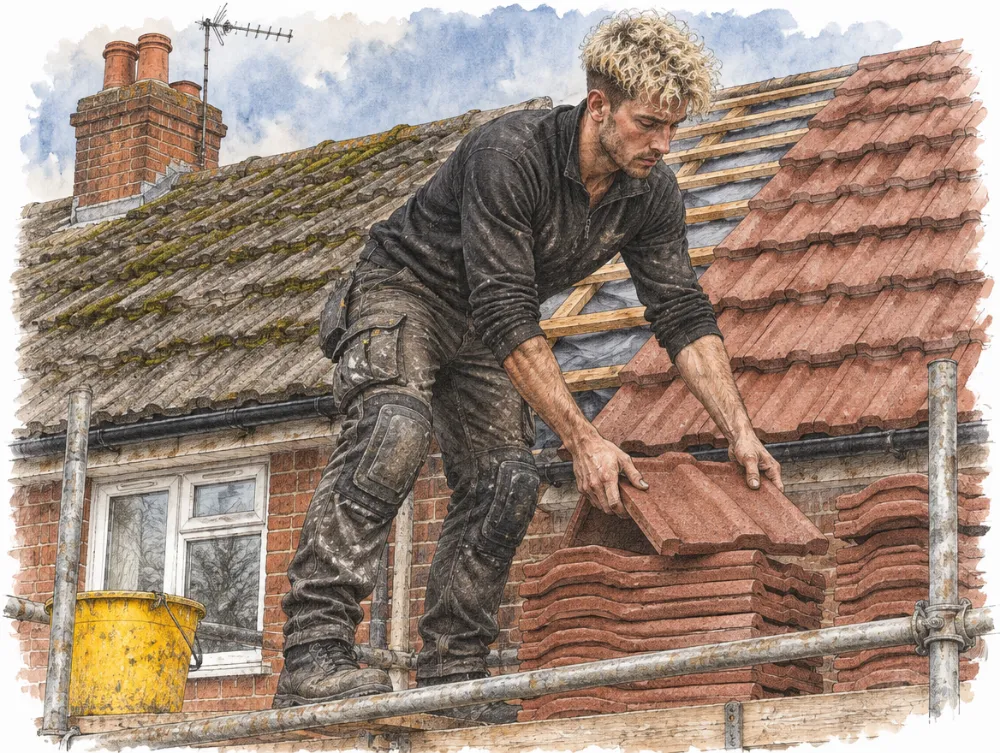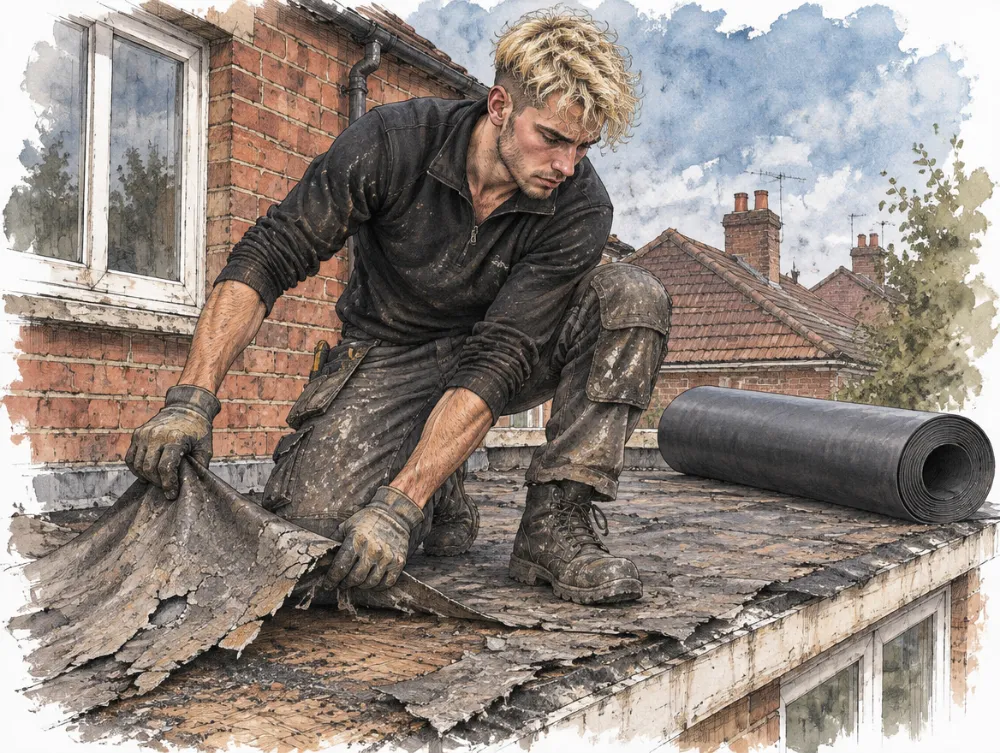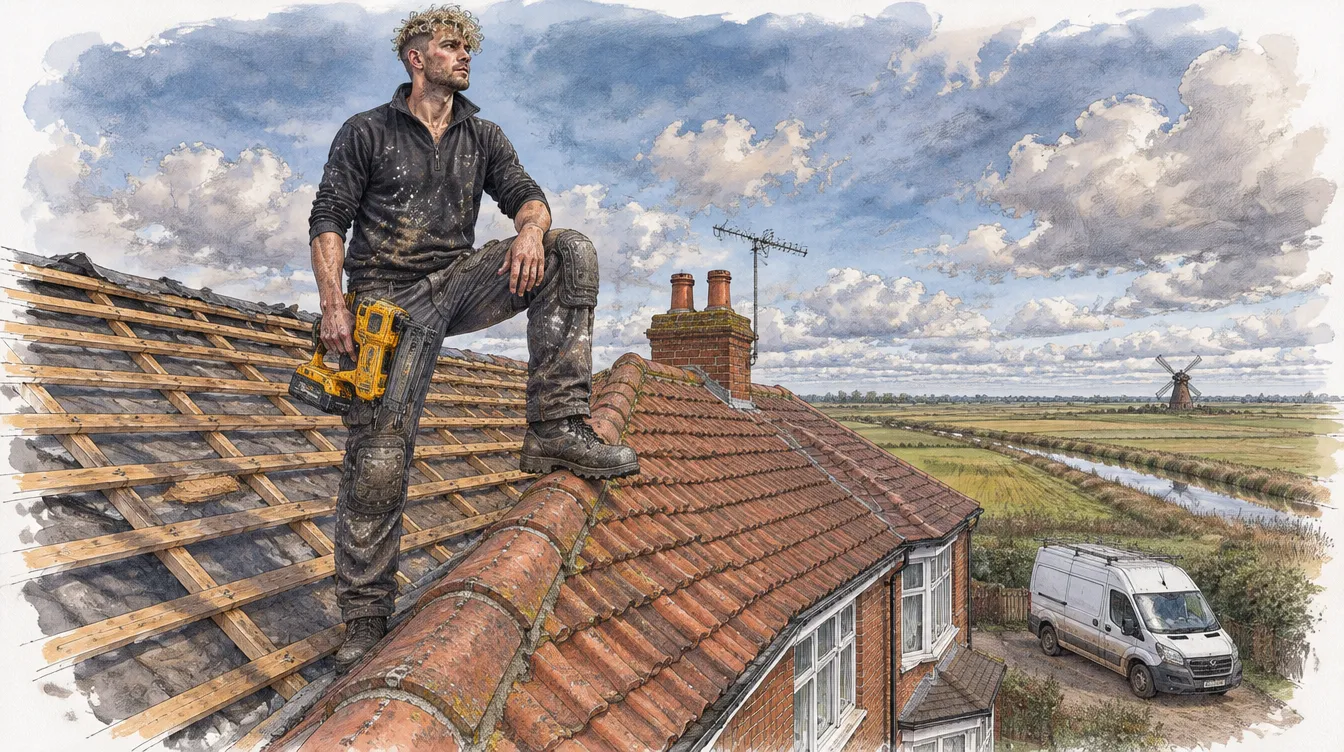
Roofz are roofers in March, Whittlesey and Chatteris, the three Fenland towns on our doorstep.
We're based in Wisbech, run by Leo, and we do roof repairs, re-roofs, EPDM flat roofs, chimneys, leadwork, gutters and fascias, plus brickwork, walls and repairs.
Every job starts with a free survey and a fixed price in writing.
If you want a roofer who'll tell you straight whether it's a repair or a new roof, book a free survey.
What we do in March, Whittlesey and Chatteris
- Roof repairs: slipped tiles, cracked ridges, leaks and storm damage. See our roof repair cost guide.
- Re-roofs: stripped, new membrane and battens, re-covered. See our new roof cost guide.
- Flat roofs: EPDM rubber is our speciality, see our rubber roofing guide and our garage roof guide.
- Chimneys and lead: repointing, flaunching and lead flashings.
- Gutters and roofline: cleaning, repairs and uPVC fascias and soffits.
- Building and odd jobs: brickwork, garden walls, fencing and repairs.
Full list on our services section.
Roofs we see in March, Whittlesey and Chatteris
All three were islands in the fen once, and all three still sit up out of flat, open land.
Same wind, very different buildings.
March: a railway town on the Nene
March grew up at a ford on the old course of the River Nene.
The railway made it, with lines to Peterborough in 1846, Wisbech and St Ives in 1847 to 1848, and Spalding in 1867.
The Whitemoor sidings, built in the 1930s, were among the biggest in Europe, and in 1931 nearly a quarter of the town's workers were on the railway.
The station at the north end pulled the town's growth that way, along the High Street to the bridge and out between the Wisbech roads.
Down on Nene Parade the riverside is like a small version of the Wisbech Brinks, and the Ship Inn there is timber-framed under thatch.
St Wendreda's Church is famous for its double hammer-beam roof with 120 carved angels, with lead over the nave and aisles.
We won't be quoting for that one, but it shows how long a roof lasts when it's looked after.
Whittlesey: brick, clay and mud walls
Whittlesey's island is a thin gravel cap over Oxford Clay, and that clay made it a brick town.
At one time forty brickworks chimneys could be seen from miles off, and one brickworks is still going today.
Plenty of the older houses in the centre are stone, with stone slate roofs, and the Buttercross in the Market Place dates from 1680.
Whittlesey also has something you won't find many other places: mud walls, built from local clay mixed with straw.
There are over 25 sections, seven of them Grade II listed, and Fenland District Council brought in an Article 4 Direction in early 2026.
That means you now need planning permission to demolish or alter a traditional mud wall in Whittlesey.
If you've got one on your boundary, don't let anyone near it with a cement mixer without checking first.
Chatteris: rebuilt after the fires
Chatteris was a raised island in the fen, and fires in 1706 and 1864 took out most of its medieval and Georgian buildings.
The 1864 fire alone destroyed more than 100 houses.
So most of the listed buildings left are Victorian or later.
The conservation area covers about 38.5 hectares and holds 99 listed buildings, most of them along the High Street.
Historic England has it on the Heritage at Risk register as "very bad", though improving.
One of the oldest survivors, No. 8 St Martin's Road, has Dutch gables and a partly stone-slated roof, with a chimney brick dated 1605.
Low roofs, long history
Single-storey cottages used to be common across the Fens.
Chatteris had rows of one-storey labourers' cottages in its yards, and Whittlesey had one-storey cottages under thatch.
Most of those have gone, but the Fens still love a low roof, and these days that mostly means bungalows.
A bungalow has a lot of roof for the size of house, with long verges and ridges all exposed to the wind.
Good news is it's easy to get at, so repairs are usually quicker and cheaper than on a two-storey house.
The wind and the ground
Fen blows happen when strong winds, with nothing on the flat land to stop them, strip dry topsoil off the fields.
One near Chatteris lifted soil hundreds of feet high across the A142.
If it can shift a field, it can shift a ridge tile that's only held on by tired mortar.
The ground moves too.
Peat soils cover 18% of the Fens, and at Holme Fen, south of Peterborough, the land has dropped about 4 metres since 1851 as the peat dried out and shrank.
Clay shrinks and swells as well, and on a roof that shows up as cracked mortar and flashings pulling away from walls.
Get Leo round for a look
Free survey. One fixed price in writing. No hard sell.
Areas we cover
- March: the town centre, Nene Parade, West End, Town End, Knight's End, plus Wimblington, Doddington, Benwick and Christchurch.
- Whittlesey: the town, Coates, Eastrea, Turves, Pondersbridge and Kings Delph.
- Chatteris: the town, Slade End and Horseway, plus Manea and Somersham.
- Postcodes: PE15 for March, PE7 for Whittlesey and PE16 for Chatteris.
We also cover Wisbech, Peterborough and Ely.
How it works
- Free survey. We get up there, take photos and show you what's what.
- Fixed price in writing. One figure, with what's in and what's out.
- The job. Done properly, tidy site, waste removed. If something hidden turns up, you see it before anything changes.
- Written guarantee. On paper at the end.
Not sure what you need? Our signs you need a new roof checklist will help.
Why use a local roofer
Because these towns are on our patch, not a long drive from it.
We know the Fens wind, the moving ground and the mix of old brick, stone and newer estates.
We'll tell you when a roof's got years left in it.
And we're close enough to come back if anything's not right.
If someone knocks with a cash price and a start date of "now", read our cowboy builders guide first.
It won't work for cowboys.
Areas we cover
- March town centre
- Nene Parade
- West End
- Town End
- Knight's End
- Wimblington
- Doddington
- Benwick
- Christchurch
- Whittlesey
- Coates
- Eastrea
- Turves
- Pondersbridge
- Kings Delph
- Chatteris
- Slade End
- Horseway
- Manea
- Somersham
- PE15
- PE7
- PE16
Questions people ask
Do you cover March, Whittlesey and Chatteris?
Yes. Roofz is based in Wisbech and covers all three towns and the villages round them, plus Peterborough and the rest of the Fens.
I've got an old mud wall in my garden in Whittlesey. Can you repair it?
Since early 2026 an Article 4 Direction means you need planning permission to demolish or alter a traditional mud wall in Whittlesey, and seven sections are Grade II listed. Check with Fenland District Council first, and the Whittlesey Mud Walls Group advises owners on repairs.
Why do so many Fenland roofs lose ridge tiles?
The land is flat and open, so wind hits roofs with nothing to slow it, and old mortar-bedded ridges crack and let go. A dry ridge system with mechanical fixings is the usual cure.
Can ground movement in the Fens damage my roof?
It can show up on the roof as cracked mortar and flashings pulling away, because peat shrinks and clay shrinks and swells. Serious movement is a job for a structural engineer, and we'll tell you if we think that's what you've got.
Is the Chatteris conservation area a problem for roof repairs?
Not for normal like-for-like repairs on unlisted houses. Listed buildings, and changes to how a roof looks, are worth checking with the council first.