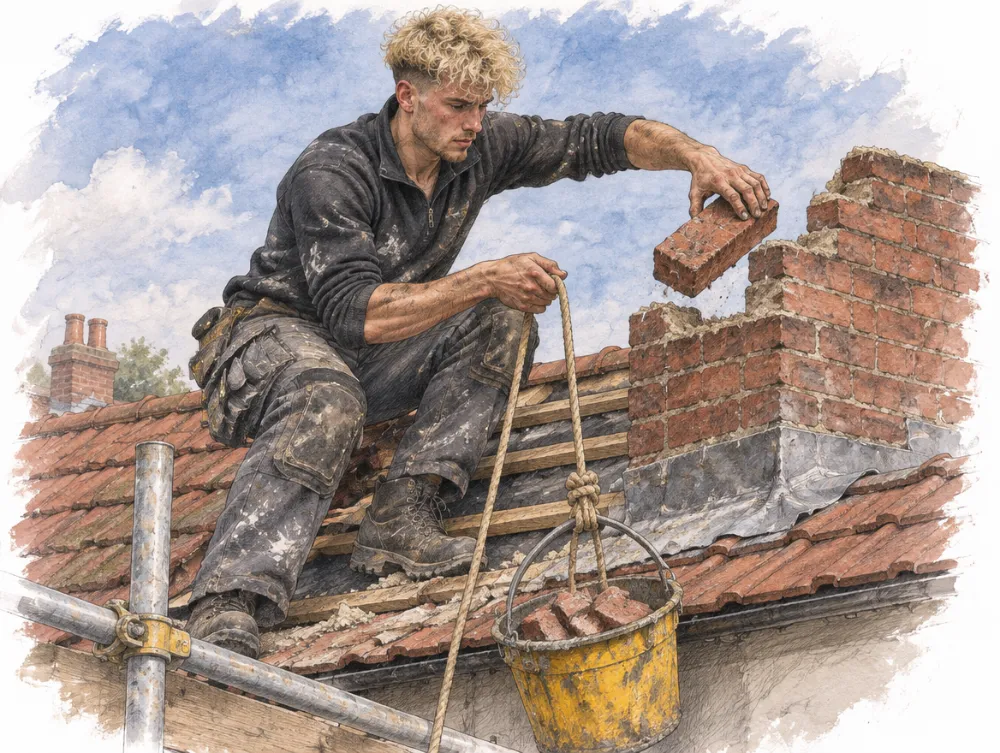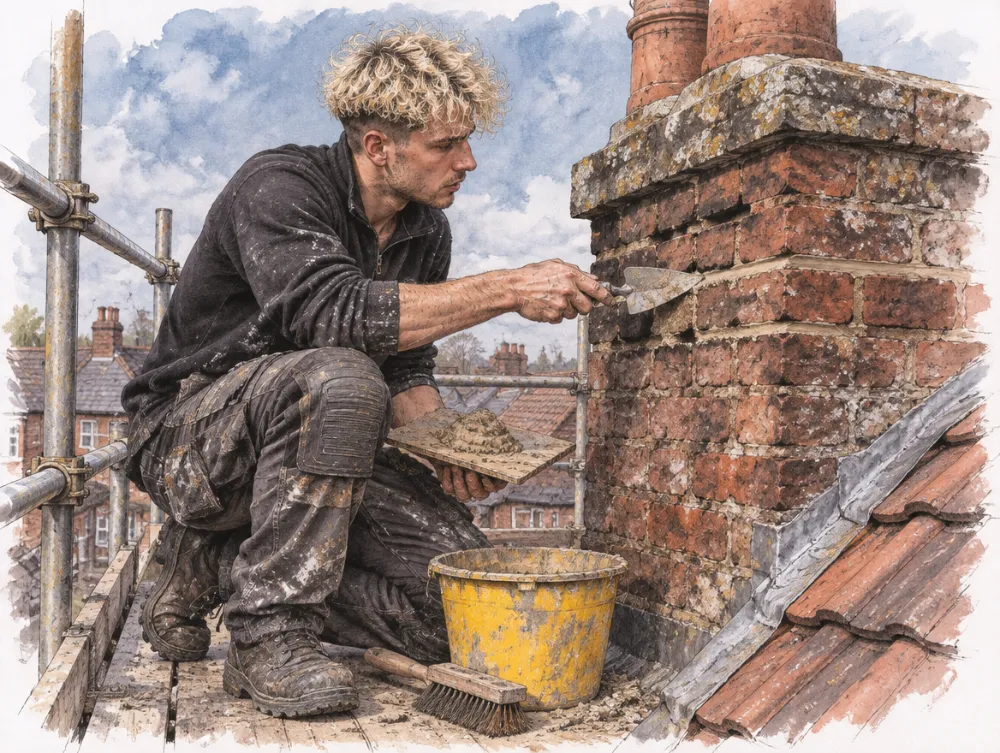
Lead flashing repair usually costs £150 to £400 for a small patch or re-dressing job in 2026, and £350 to £1,200 to replace the flashing round a typical chimney.
If scaffolding is needed, add roughly £300 to £500, which is why a patch on a high chimney can cost more than a full replacement on a bungalow.
Flashing is the strip of lead (or a lead alternative) that seals the joint where a roof meets a wall or chimney.
When it fails, water gets in fast.
Most leaks round chimneys, dormers and lean-to roofs come down to flashing that has split, lifted or lost its mortar.
Catch it early and most flashing is a few hours' work.
Leave it, and you're paying for rotten timbers as well.
How much does lead flashing repair cost?
These are typical 2026 prices from the main UK cost guides, rounded and grouped by job.
| Job | Typical cost | Typical time |
|---|---|---|
| Repointing loose flashing back into the wall | £150 - £350 | 2 - 4 hours |
| Patch repair, no scaffold | £150 - £250 | 1 - 3 hours |
| Minor patch repair, harder access | £200 - £400 | Half a day |
| Patch repair with scaffold | £450 - £650 | Half a day to a day |
| Replace chimney flashing, no scaffold | £350 - £600 | Half a day to a day |
| Replace chimney flashing with scaffold | £700 - £1,200 | 1 - 2 days |
| Full flashing replacement, large or complex job | £1,200 - £2,500 | 2 - 4 days |
MyJobQuote's September 2026 guide puts an average patch repair at about £200 and an average full chimney replacement at about £570.
Checkatrade's figures, which include VAT, put replacement on all four sides of a chimney at £450 to £600 without scaffolding and £800 to £1,200 with it.
Book a Builder's 2026 guide gives the higher end, £1,200 to £2,500, for full replacements that need scaffolding on bigger or more awkward chimneys.
Not every guide is clear on VAT, so always ask for a written price that states it.
What makes up the price?
Labour is the bulk of it, with Book a Builder estimating that it makes up 60 to 70% of the total.
MyJobQuote gives a roofer's day rate of £200 to £300.
The lead itself isn't the expensive bit, at roughly £2 to £4 per kg according to Book a Builder's 2026 figures.
Scaffolding is the wild card, with MyJobQuote putting erection and dismantling at £300 to £500 and Checkatrade saying it adds roughly £300 to £400 to a flashing job.
Roofz guide
Lead flashing repair: costs and fixes
What it costs to fix or replace the lead round chimneys and walls in 2026, and which fix lasts longest.
The headline numbers
£150-£400
Patch or repoint
£350-£1,200
New chimney flashing
£300-£500
Scaffold on top
40-80+ yrs
Well-fitted lead
Typical cost by job (top of range)
How long each fix lasts (top of range)
Signs your flashing is failing
- Lead lifting away from the wall
- Mortar missing along the top edge
- Splits or holes in the lead
- Flashing missing - possibly stolen
- Thick lines of old silicone
- Damp beside the chimney breast
- Leaks only in wind-driven rain
Lead or lead alternative?
Lead
- Lasts decades
- Higher cost
- Theft target
- Heavy, needs a skilled leadworker
- Best for chimneys
Lead alternative
- Up to about 30 years
- Around 50% cheaper
- No scrap value
- Light and easy to shape
- Good for porches and extensions
How a chimney flashing goes on
- Apron Fitted first, across the front.
- Soakers One under each tile course up the sides.
- Step flashing Tucked 25mm into the joints and wedged.
- Back gutter Formed behind the stack, under the tiles above.
- Finish Pointed, clipped and patination oiled.
What are the different types of lead flashing?
"Flashing" covers several different pieces of lead, and if you know the names, a quote makes a lot more sense.
- Apron flashing - the front piece across the bottom of a chimney or along the top of a lean-to roof, dressed down over the tiles.
- Soakers - small L-shaped pieces slipped under each tile course up the side of a chimney or wall.
- Step flashing - the stepped strip that tucks into the brick joints and covers the soakers on a sloping abutment.
- Back gutter - the piece behind the chimney on the uphill side, which carries rainwater round the stack.
- Cover flashing - a general term for any lead that sits over another piece to shed water.
The back gutter catches all the water running down the roof above the chimney, so it is a common trouble spot.
What code of lead should be used?
Lead sheet is graded by "code", which is a measure of thickness under the British Standard BS EN 12588.
NHBC Standards say apron and cover flashings and saddles should be at least Code 4, with soakers allowed to be Code 3.
Lead supplier guidance suggests Code 4 to 5 for chimney aprons, Code 4 for soakers and Code 5 to 6 for back gutters, stepping up on exposed sites.
Code 4 lead is 1.80mm thick, according to Roofing Superstore.
Thin lead is a classic corner cut.
A MyBuilder answer from an experienced roofer notes that Code 3 splits more easily and is harder to weld.
Why does lead flashing fail?
Lead can last for generations, so when it fails early, someone usually got something wrong.
- Thermal movement - lead expands in heat and shrinks in cold, and if it's fixed too tightly or fitted in long lengths, it eventually splits.
- Lengths too long - NHBC says flashing pieces should not exceed 1.5m in length.
- Mortar failure - the mortar holding the lead in the brick joint cracks and drops out, and the flashing lifts.
- Poor fixing - lead not tucked far enough into the joint, or missing wedges and clips.
- Wind lift - an unclipped edge lifts in a gale and lets rain blow underneath.
- Silicone bodges - a bead of sealant instead of a proper repair, which cracks and traps water.
- Theft - lead has a scrap value, so it gets stolen, especially from porches, bays and outbuildings.
How do you know if your flashing needs repairing?
You can spot most flashing problems from the ground with a pair of binoculars.
- Lead that has lifted away from the wall or chimney.
- Gaps, cracks or missing mortar along the top edge where the lead tucks into the brick.
- Splits or holes in the lead itself.
- Flashing that is missing altogether, which may mean it has been stolen.
- Thick lines of silicone or mastic along the joint, which usually means someone has patched it before.
- Damp patches on the ceiling or wall next to a chimney breast, especially after wind and rain.
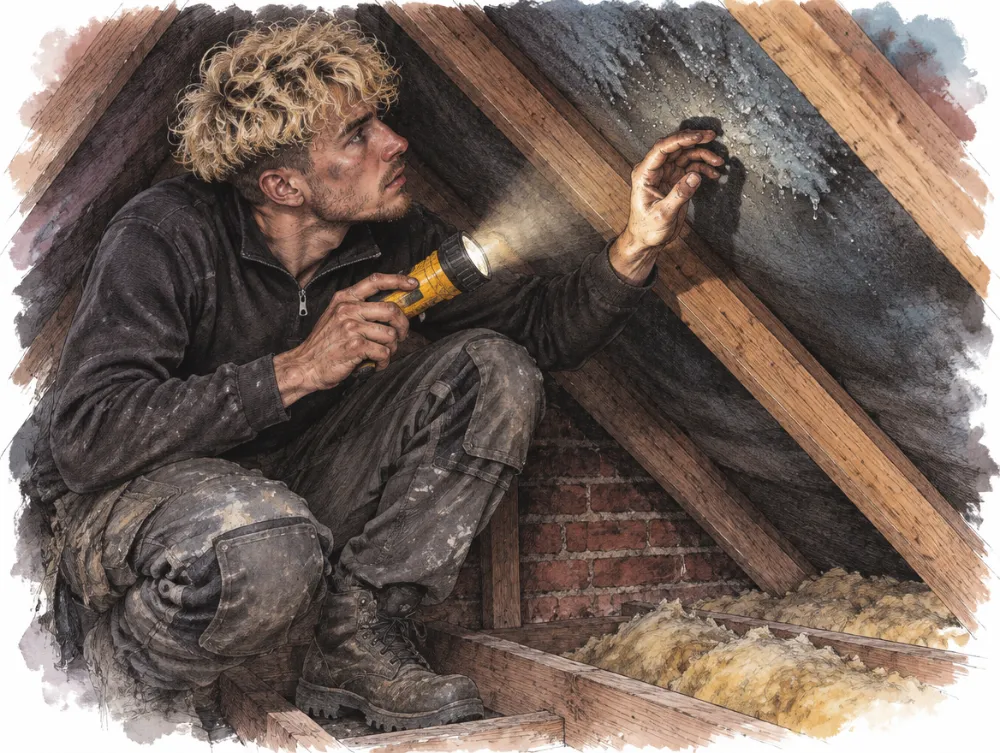
- Water stains on rafters or the underside of the roof round the chimney, seen from the loft.
If water is already coming through, our emergency roof repair guide covers what to do right now.
Want Leo to have a look?
Free survey, one fixed price in writing, and no hard sell. Wisbech, Peterborough and the Fens.
Repair or replace - which do you need?
Not every flashing problem needs new lead.
| Problem | Usual fix | How long it lasts |
|---|---|---|
| Lead sound, mortar fallen out | Re-wedge and repoint the joint | 10 - 20 years |
| Small split in otherwise good lead | Lead-welded patch or new piece lapped in | Many years if done well |
| Split or hole, short-term fix | Flashing tape or sealant | 2 - 5 years |
| Thin, brittle or badly fitted lead | Full replacement | 40 - 60+ years |
| Lead stolen | Replace with lead or a lead alternative | Up to 30 years for alternatives |
MyJobQuote goes further and says correctly installed lead flashing can last over 80 years.
The repointing repair
Often the lead is fine and only the mortar has let go.
If the lead's sound, there's no point paying for new.
The roofer rakes out the joint, pushes the lead back into it, wedges it and repoints it.
NHBC Standards say flashings should be tucked 25mm into the bed joint and wedged at no more than 450mm centres, and that the joint should be pointed with mortar or an exterior-grade sealant.
The patch repair
A small split can be fixed by lead welding a patch over it, or by cutting out the damaged section and lapping in a new piece.
Lead welding is a specialist skill, and DIY Doctor notes that fewer tradespeople do it now than in the past.
The full replacement
If the lead is thin, split in several places or badly fitted, stop patching it and replace it.
The old lead comes off, new pieces are cut and dressed to shape in lengths of no more than 1.5m, and each piece is lapped, wedged, clipped and pointed in.
A good roofer will finish new lead with patination oil, which stops the white powdery staining that fresh lead can leave on brick and render.
How a chimney flashing is replaced, step by step
- Access - a scaffold or tower goes up so the roofer can work safely all round the stack.
- Strip out - the tiles next to the chimney are lifted and the old lead, mortar and any sealant are removed.
- Check underneath - battens, felt or membrane and timbers are checked for rot and replaced if needed.
- Apron first - the front apron is fitted at the bottom, because each piece above has to lap over the one below.
- Soakers and steps - soakers go in with each tile course up the sides, and the step flashing is cut, tucked into the joints and wedged.
- Back gutter - the back gutter is formed behind the stack and dressed up under the tiles above.
- Point and finish - the joints are pointed, the tiles relaid, the lead clipped where needed and patination oil applied.
Water runs downhill, so the order matters - get it wrong and you've built a channel straight into the loft.
Abutment flashing on lean-tos and extensions
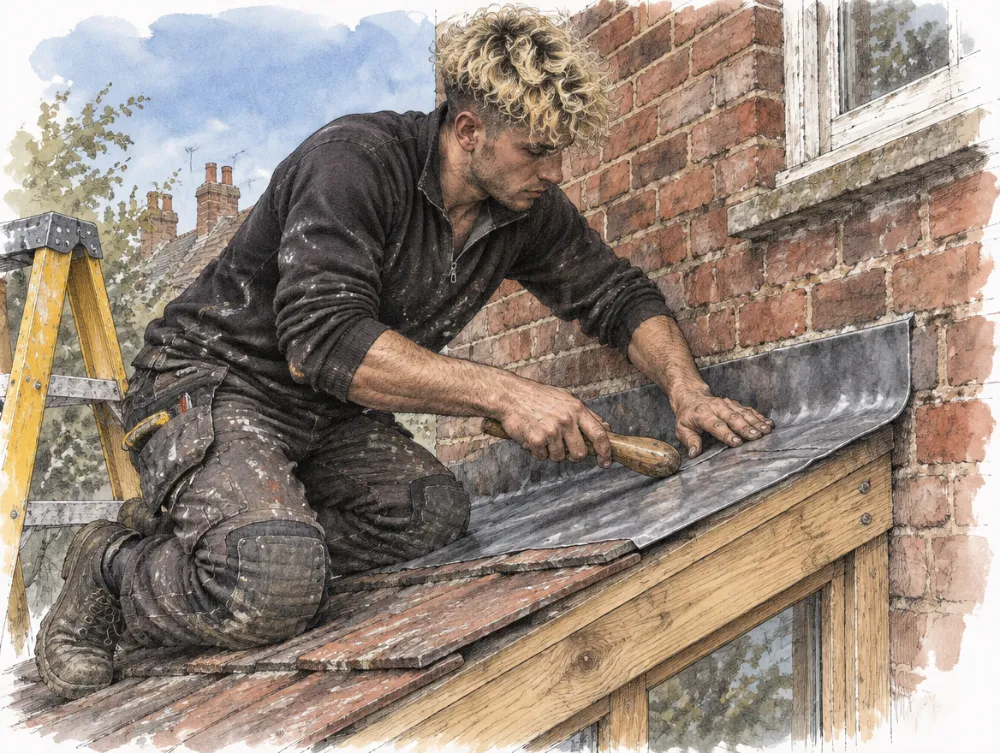
Where a pitched or flat roof meets a house wall, the same rules apply as on a chimney.
NHBC Standards call for a minimum upstand of 75mm up the wall and a minimum lap of 100mm between pieces at abutments.
Step flashings should be cut from a strip at least 150mm wide, and free edges should be clipped so the wind can't lift them.
If your extension flashing is just lead stuck to the face of the wall with mastic, not tucked into a joint, that's a bodge and it will leak.
Lead vs lead alternatives - which is better?
Lead has been the standard for centuries, but modern lead-free flashings are now common, especially where theft is a worry.
| Lead | Lead alternatives | |
|---|---|---|
| Lifespan | Decades, 40 - 80+ years when fitted well | Up to around 30 years |
| Cost | Higher material cost | Around 50% cheaper |
| Theft risk | High - it has scrap value | Low - no scrap value |
| Weight and handling | Heavy, toxic, needs a skilled leadworker | Light, easy to cut and shape |
| Appearance | Traditional, ages to a dull grey | Made to look like lead, several colours |
| Best for | Chimneys, listed buildings, long life | Porches, extensions, theft-prone spots |
Roofing Superstore's March 2026 guide says alternatives are around 50% cheaper than real lead and can last up to 30 years, while Marley notes they are lighter, non-toxic and have no scrap value.
Common brands include Ubiflex, Wakaflex and similar products made from modified bitumen, aluminium or polymer layers.
NHBC Standards also accept aluminium, zinc and copper flashings, and proprietary lead replacements that carry a suitable independent technical approval.
For a chimney you want to forget about for decades, proper lead is still hard to beat.
For a porch or a garage abutment that thieves might target, an alternative can make good sense.
Can you repair lead flashing yourself?
A confident DIYer can do a temporary fix, but only where the flashing can be reached safely.
Self-adhesive flashing tape stuck over a clean, dry split will hold off the rain for a while, and DIY Doctor describes this as a two or three-year fix rather than a permanent one.
Proper lead repairs mean working on a roof and handling lead, which Marley describes as toxic to handle, so wear gloves and wash your hands afterwards.
HSE guidance says ladders should only be used for short, low-risk jobs, so anything round a chimney normally needs a scaffold or tower.
The worst fix is a thick bead of silicone over the lot.
It cracks, it peels, and it costs more to put right later.
Do you need permission to repair flashing?
Like-for-like flashing repairs are maintenance, so planning permission and Building Regulations approval are not normally needed.
If your home is listed or in a conservation area, check with your council before swapping lead for an alternative, because the look and materials may matter.
If the work involves rebuilding a chimney or altering a roof, Building Regulations may apply, so check with building control first.
This is general information rather than legal advice.
Lead flashing repair in Peterborough and the Fens
The Fens are flat and open, so rain doesn't fall straight down here - the wind throws it at walls and chimneys side-on.
That's exactly the weather that finds a lifted flashing edge or an empty mortar joint.
It's why so many leaks in Wisbech, March, Chatteris and Whittlesey only show up when it's blowing a gale.
The older brick terraces in Peterborough and Wisbech are full of chimneys and lean-to back extensions, and a lot of that leadwork is well past its best.
The 1960s to 80s bungalows and ex-council semis across Spalding, Holbeach and King's Lynn often have a flat-roof garage or porch butted up to the house, and the flashing on that joint is a regular leak.
Fen clay moves, and when a house moves, the flashing joint is often the first thing to open up.
If you're in a conservation area, like Wisbech's Georgian Brinks or Peterborough city centre, expect the council to want proper lead rather than an alternative on the front.
Lead has scrap value and porches and outbuildings are easy pickings, so that's where a lead-free flashing often earns its keep.
Whether you're after roofers in Peterborough or a roofer in Wisbech, ask to see photos of the flashing before and after, especially the bits you can't see from the ground.
If a flat roof is the issue rather than the flashing, our guide to flat roof leak repair may help, and bay and porch roofs are covered in our bay window roof replacement guide.
Will insurance cover flashing repairs?
Insurers generally cover sudden damage, such as storms, but not gradual wear and tear.
If your flashing has been stolen, report it to the police and speak to your insurer before replacing it.
How to choose a roofer for leadwork
Good leadwork takes skill, and bad leadwork is easy to hide under a bead of mastic.
- Ask what code of lead they'll use for each piece.
- Ask whether they'll fit lead or an alternative, and why.
- Ask how the lead will be fixed into the wall - wedges, clips and mortar, not just sealant.
- Get a written, itemised price showing scaffold and leadwork separately.
- Ask for photos of the finished work, especially the back gutter you can't see from the ground.
- Get a written guarantee.
Be wary of anyone who knocks on your door saying your flashing is "hanging off", and read our guide to spotting cowboy builders before you agree to anything.
For prices on other common fixes, see our roof repair cost list.
Leo offers a free survey, photographs the flashing so you can see what he sees, and gives one fixed price in writing with a written guarantee.
You can book your free survey here.
Summary
Lead flashing repair typically costs £150 to £400 for a patch or repoint, and £350 to £1,200 for a new chimney flashing, with large scaffolded jobs reaching £2,500.
Most failures come from split lead, lost mortar, wind lift or theft, and many can be fixed without replacing everything.
Proper lead lasts for decades, while lead alternatives are cheaper, theft-proof and last up to around 30 years.
Avoid silicone bodges, ask what code of lead is being used, and get the price in writing.
Get it sorted before winter, and do it properly once.
Questions people ask
Can you put new lead flashing over old flashing?
It is generally better to remove the old lead and fit new pieces with proper laps, wedges and pointing. Laying new lead over old can trap water and hide the original problem.
Is silicone good for sealing lead flashing?
Silicone is at best a short-term fix, because it cracks and peels as the lead moves with the temperature. A proper repair repoints or replaces the lead rather than sealing over it.
How long does flashing tape last?
Self-adhesive flashing tape over a split is a temporary repair, typically lasting two or three years. It buys time until the lead can be repaired properly.
What does patination oil do?
Patination oil is wiped onto new lead to stop it producing white carbonate staining as it weathers. It keeps brick and render below the flashing clean while the lead dulls naturally.
Are lead flashing alternatives any good?
Modern lead alternatives are lighter, around half the price and have no scrap value, so they deter thieves. They are expected to last up to about 30 years, which is shorter than well-fitted lead.
Why does my chimney only leak when it is windy?
Wind-driven rain can blow under lifted flashing edges or into open mortar joints that stay dry in calm rain. That pattern often points to flashing or pointing rather than the tiles.
Do you fix lead flashing in Peterborough and Spalding?
Yes. Roofz covers Wisbech, Peterborough and the Fens, including Spalding, March, Whittlesey and King's Lynn, and every job starts with a free survey and one fixed price in writing.
Sources
- MyJobQuote - Chimney Lead Flashing Repair Cost (updated September 2026)
- Checkatrade - Chimney flashing repair cost guide
- Book a Builder - Lead flashing repair: failures, fixes and replacement (2026)
- DIY Doctor - Repairing lead flashing
- MyBuilder - How to repair lead flashing
- NHBC Standards 7.2.20 - Weathering details
- The Lead Lads - Lead for chimneys: aprons, soakers and back gutters
- Roofing Superstore - Lead alternatives to lead flashing (March 2026)
- Marley - The alternatives to lead flashing explained (August 2025)
- HSE - Work at height FAQs
- MyBuilder - Chimney repair costs (insurance note)
Prices are guide figures from the sources above and vary by job. Your free survey gives one fixed price in writing.