If you need an emergency roof repair right now, do three things first: get people and valuables away from the leak, catch the water, and keep away from any wet electrics or bulging ceilings.
Then take photos and ring a roofer.
Don't go up on the roof yourself, especially in wind, rain or the dark.
In 2026, an emergency roofer call-out typically costs £150 to £300, with £100 to £300 or more on top for nights, weekends and bank holidays, according to MyJobQuote.
A temporary make-safe, like a tarpaulin or re-fixing loose tiles, usually runs £150 to £500.
Here's what to do step by step, what an emergency repair costs, what you can claim on insurance, and how to stop it happening again.
What to do when your roof is leaking right now
- Keep everyone safe. If a ceiling is bulging or sagging, get people out of that room and don't stand under it.
- Watch the electrics. If water is near lights, sockets or a light fitting, switch that circuit off at the consumer unit, but only if you can do it safely.
- Move your stuff. Furniture, rugs, electricals and anything you care about, out of the drip zone.
- Catch the water. Buckets, bowls, a washing-up tub - put a towel in the bottom to stop the splashing.
- Protect the floor. Plastic sheeting, bin bags or old towels.
- Take photos and video. Inside and out, from the ground, before anything gets moved or fixed.
- Ring a roofer. Tell them what you can see, where the water's coming in, and whether it's getting worse.
- Tell your insurer. Most have a claims line, and many want to hear about it quickly.
Checkatrade's leaking roof advice and MyJobQuote's emergency guide both give the same basic list.
Both say the same thing about the roof: don't climb on it, especially in wet or windy weather.
Wet tiles are like ice, and a gust on a ladder will have you off.
Is it actually an emergency?
Not every drip needs a roofer at 2am.
Checkatrade says to call straight away if there's heavy dripping, a bulging or sagging ceiling, exposed roof structure, or water near electrics.
| Call a roofer now | Can usually wait for the morning |
|---|---|
| Water pouring or dripping heavily | A slow drip into a bucket |
| Ceiling bulging, sagging or cracking | A small damp patch that isn't spreading |
| Water near lights, sockets or the fuse board | Water well away from any electrics |
| Tiles or sheets missing and the roof open to the sky | One slipped tile with the felt still holding |
| Chimney or ridge looking unsafe after a storm | A loose gutter or a bit of lifted flashing |
If it can wait, contain it overnight and book a roofer first thing.
Night and weekend rates are higher, so there's no point paying them for a slow drip that a bucket can handle.
But don't sit on it for weeks.
Checkatrade makes the point that small leaks rarely stop on their own.
What to tell the roofer when you ring
The more you can tell them, the quicker they can sort it, and the better the chance they turn up with the right kit.
- Where the water's coming in. Which room, which part of the ceiling, and whether it's near a chimney, a skylight or an outside wall.
- What you can see outside. Missing tiles, a slipped ridge, a flapping bit of felt, a flat roof peeled back.
- The type of roof. Tiles, slate, felt, rubber or a conservatory.
- How high it is. Bungalow, two storeys or more, and whether there's easy access round the side.
- Whether it's getting worse. A steady drip and a ceiling starting to bow are two different call-outs.
- Your photos. Send them over if they'll take them by text or email.
Ask what the call-out fee is, what it covers, and roughly when they can get there.
A straight answer to those three is a good sign.
Check your insurance helpline
Some home insurance policies come with an emergency helpline that can send a contractor out.
It's worth digging your policy out and checking before you book someone yourself, because some insurers want to arrange the work.
Either way, keep the receipt for anything you pay for to stop more damage.
How much does an emergency roof repair cost?
Emergency work costs more than booked work.
You're paying for someone to drop everything and come out, often in bad weather.
MyJobQuote's 2026 figures are the most detailed we found.
| Emergency job | Typical 2026 cost |
|---|---|
| Emergency call-out | £150 - £300 |
| Out-of-hours, weekend or bank holiday surcharge | £100 - £300+ |
| Temporary repair (tarp, patching, securing tiles) | £150 - £500 |
| Missing, slipped or broken tiles | £150 - £350 |
| Emergency roof leak repair | £220 - £550 |
| Ridge tile repair and repointing | £200 - £500 |
| Flat roof leak | £200 - £700 |
| Damaged lead flashing | £250 - £700 |
| Leaking chimney | £300 - £800 |
| Storm damage repair | £300 - £1,200+ |
Source: MyJobQuote emergency roofer cost guide (2026).
Checkatrade, updated in February 2026, puts an emergency call-out fee at around £350, so some firms charge more than the MyJobQuote range.
Ask what the call-out covers before anyone sets off.
Some include the first hour and basic materials, some don't.
Labour and access
MyJobQuote gives roofer rates of £35 to £45 an hour, or £280 to £360 a day, in 2026.
Access is the other big cost.
It lists a small access tower at £150 to £350, a typical domestic roofing scaffold at about £1,000, and a full scaffold round a detached house at £1,400 to £2,500.
On a night call-out, a roofer usually works off ladders and roof ladders to make it safe, and the scaffold comes later if the permanent repair needs it.
Inside damage
The roof is often the cheap bit.
MyJobQuote puts ceiling repairs at £150 to £1,000 or more, and plastering at £150 to £500.
That's why getting the water stopped fast matters.
For prices on planned work once the emergency's over, see our full roof repair cost guide.
Roofz guide
Emergency roof repair: what to do and what it costs
The first steps when the roof is leaking, 2026 emergency prices, and how storm claims work.
Do this first
- Get clear. Out of any room with a bulging ceiling.
- Electrics off at the consumer unit if water is near them - only if safe.
- Move your stuff and catch the water in buckets.
- Take photos inside and out, from the ground.
- Ring a roofer and tell your insurer.
- Stay off the roof. Never in wind, rain, frost or the dark.
2026 emergency prices
£150-£300
Emergency call-out
£100-£300+
Night, weekend or bank holiday extra
£150-£500
Temporary make-safe
£35-£45
Roofer per hour
Emergency repairs: top of the typical range
Access costs
Now or the morning?
Call now
- Heavy dripping or pouring
- Ceiling bulging or sagging
- Water near electrics
- Roof open to the sky
Can wait till morning
- Slow drip into a bucket
- Small damp patch, not spreading
- Water well away from electrics
- One slipped tile, felt holding
Storm claim checklist
- Photos and video of all the damage
- Insurer contacted quickly
- Only urgent work done before approval
- Every receipt and roofer report kept
- Excess checked against the repair cost
- Ombudsman route if a dispute runs past 8 weeks
Temporary roof repairs: what can be done on the night
An emergency visit is usually about making the roof safe and watertight, not finishing the job.
MyJobQuote notes that emergency attendance may only make the roof safe or watertight, with permanent repairs done later in suitable weather.
That's normal, and it's the right way round.
Make it safe tonight, do it properly when it's dry.
Mortar doesn't go off in freezing rain, and nobody does a proper job on a roof in a gale.
What a roofer will typically do
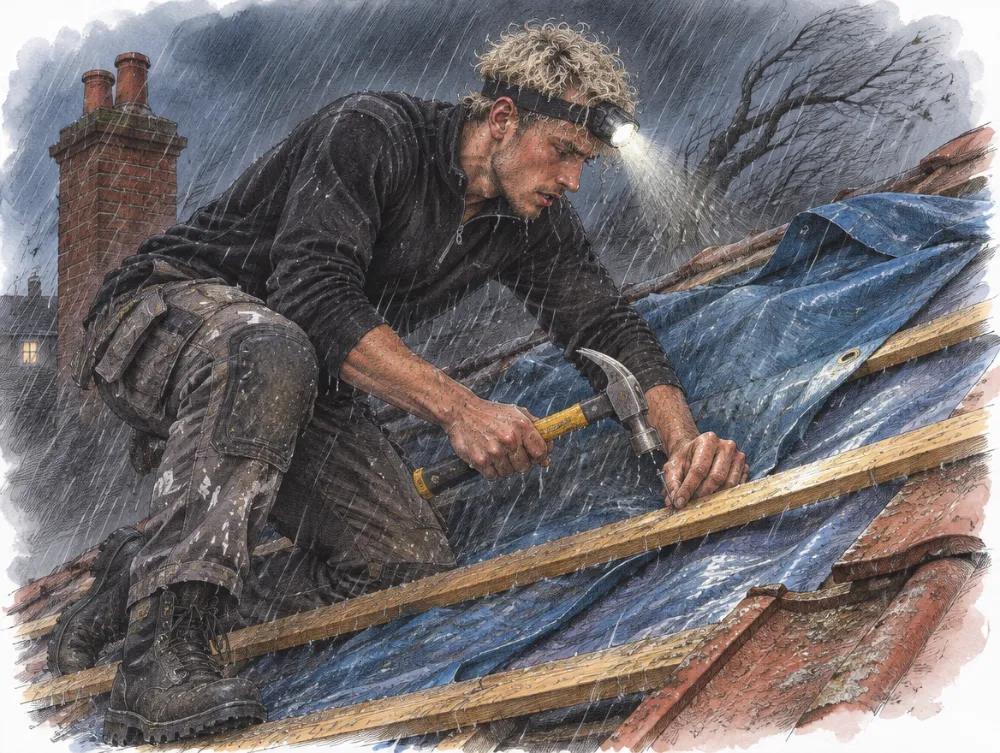
- Tarpaulin the damaged area. Properly weighted or battened down, so the wind can't get under it.
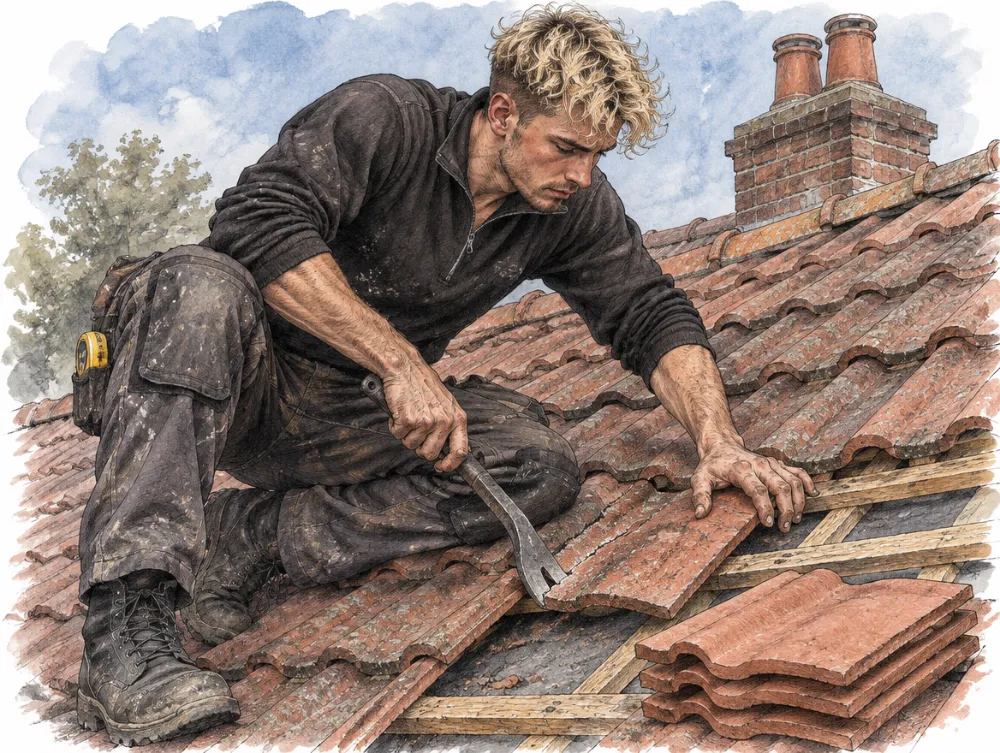
- Re-fix or replace loose tiles. Where it's safe to get to them.
- Patch a flat roof. A temporary seal over a split or lifted seam.
- Dress back lifted flashing. Or seal it temporarily until it can be redone.
- Make loose ridge tiles or chimney pots safe. Anything that could come down on someone gets dealt with first.
- Clear a blocked gutter or outlet. Sometimes the "leak" is just water backing up.
What you can do from inside
Keep catching the water, keep the area clear and keep checking the ceiling.
If you can get into the loft safely, a bucket or a tray under the drip in the loft can stop water reaching the ceiling below.
Step only on the joists, never on the plasterboard between them.
What not to do
- Don't go on the roof. Not in wind, rain, frost or the dark - or at all, unless it's your trade.
- Don't try to seal it permanently from inside. Checkatrade warns this can redirect the water and cause hidden damage.
- Don't stand under a bulging ceiling. Wet plasterboard is heavy and it doesn't give much warning.
- Don't sign up for a new roof on the doorstep. More on that below.
A bodged temporary fix can do more harm than the leak.
Expanding foam stuffed under tiles, or sealant smeared over a crack, just hides the problem and makes the proper repair harder.
Storm damage and insurance
Most emergency call-outs come after a storm, so it's worth knowing how insurance works before you need it.
Buildings insurance generally covers sudden damage from an insured event, like a storm or a falling tree.
MyJobQuote and Checkatrade both note that policies usually don't cover wear and tear, age-related decay, lack of maintenance or long-term leaks.
Lemonade says insurers typically want winds of around 55 mph before they count it as a storm, though the figure varies between policies.
How the Financial Ombudsman looks at storm claims
If your claim is turned down, the Financial Ombudsman Service asks three questions.
- Was there a storm on the date the damage happened?
- Is the damage consistent with what storm damage usually looks like?
- Was the storm the main cause, or would the damage have happened anyway?
The Ombudsman says if an insurer relies on a wear and tear exclusion, the insurer has to prove the exclusion applies.
But it's also unlikely to back you if the roof was already in bad condition and you knew, or the storm just showed up a problem that was already there.
That's why keeping on top of small repairs matters.
Making a claim
- Photograph everything inside and out, and the weather too if you can.
- Contact your insurer quickly. Confused.com stresses getting in touch as soon as possible.
- Get urgent work done to stop more damage. Confused.com says urgent repairs can go ahead straight away, but wait for approval on anything else.
- Keep every receipt and report. Call-out, tarpaulin, the roofer's photos and invoice.
- Check your excess. If the repair is small, it may not be worth claiming.
Confused.com notes that if you dispute a decision, your insurer has eight weeks to respond, and then you can go to the Financial Ombudsman Service for free.
Policies all differ, so read yours and talk to your insurer - this is general information, not insurance advice.
Want Leo to have a look?
Free survey, one fixed price in writing, and no hard sell. Wisbech, Peterborough and the Fens.
Emergency flat roof leaks
Flat roofs leak differently.
Water can sit on a flat roof, find a split and run along the deck before it shows up inside, sometimes a metre or two away.
MyJobQuote puts an emergency flat roof repair at £200 to £700 in 2026.
On an old felt roof, an emergency patch is just that - a patch.
If the felt is cracked and blistered all over, the next leak is only a matter of time.
EPDM rubber is Leo's speciality, and it's usually the long-term fix on a tired flat roof.
Our guide to flat roof leak repair goes into repair versus replace properly.
Watch out for storm chasers
After every big storm, the cold callers come out.
They knock, point at your roof, tell you it's dangerous and offer to fix it today for cash.
Cambridgeshire County Council's advice is not to accept work from anyone who calls at the door, and to always get three quotes.
Its rules on cancelling are worth knowing.
If you agree a contract at home for £42 or more, you normally have 14 days to cancel in writing.
But the council says that doesn't apply if you asked the trader to carry out emergency repairs.
So when it's a genuine emergency, call someone you've chosen, agree a price for the make-safe only, and get proper quotes for the rest once the weather's calmed down.
If you're worried about a trader, the council points people to the Citizens Advice consumer helpline on 0808 223 1133, or the police on 101 if they're still at your property.
Our guide to spotting cowboy builders has the full checklist.
Emergency roof repairs in Peterborough and the Fens
When a storm comes through, Fenland roofs feel it first.
The land is flat and open from Wisbech to March, Chatteris, Whittlesey and out towards King's Lynn, so there's nothing to slow the wind before it hits.
The usual damage round here is lifted verges, loose ridge tiles, slipped tiles and flat roofs peeled back at the edges.
The housing makes a difference too.
There are a lot of 1960s to 1980s bungalows and ex-council semis across Peterborough, Spalding, Holbeach and Long Sutton, many with old mortar-bedded ridges and verges that let go in high wind.
Flat-roof garages and extensions from the same era are everywhere, and old felt is the first thing to fail in a storm.
If the garage roof is grey cement sheeting, the HSE lists asbestos cement roofs among the places asbestos is found, so don't break it up or sweep up broken bits until it's been checked.
Older brick terraces in Peterborough and Wisbech tend to leak at chimneys, lead valleys and where the back addition meets the main roof.
The ground plays a part in the slow leaks.
The British Geological Survey says Oxford Clay underlies much of the Peterborough district beneath the Fen silts, clays and peat.
Clay moves as it wets and dries, and over years that can crack mortar round chimneys and flashings, which is where a lot of surprise leaks start.
If you're in a conservation area, such as Wisbech's North and South Brink or Peterborough city centre, make it safe first and talk to the council before changing materials on the permanent repair.
Roofz is based in Wisbech and covers Peterborough and the Fens for emergency roof repairs and make-safes.
How to stop it happening again
Most emergency leaks start as small problems nobody spotted.
- Look at the roof after every big storm. From the ground, with binoculars if you've got them, for slipped tiles, loose ridges and lifted verges.
- Keep the gutters clear. Blocked gutters cause a lot of "roof leaks" that aren't roof leaks at all - see our gutter cleaning cost guide.
- Get small faults fixed early. A £150 tile job now beats a £1,000 ceiling later.
- Have the roof checked now and then. MyJobQuote puts a roof inspection at £100 to £300 in 2026.
- Know when it's had enough. If you're calling a roofer out every winter, it may be time to look at a new roof.
The grumpy rain cloud always finds the one tile you meant to sort last summer.
Emergency roof repair: the short version
Get people and valuables out of the way, catch the water, keep clear of wet electrics and bulging ceilings, take photos and ring a roofer.
Don't go on the roof.
Expect £150 to £300 for a call-out in 2026, more out of hours, and £150 to £500 for a temporary make-safe.
Storm damage may be covered by insurance, but wear and tear won't be.
Get the roof made safe first, then get proper quotes for the permanent repair.
Ring Roofz or book a free survey and Leo will make it safe, then give you one fixed price in writing for the proper repair.
Questions people ask
How quickly should a roof leak be fixed?
As soon as you reasonably can. A heavy leak, bulging ceiling or water near electrics needs a roofer straight away, while a slow drip can usually be contained overnight and booked for the next day.
Can a roofer fix a leak in the rain?
They can usually make it safe in the rain with a tarpaulin or temporary patch. Permanent repairs, especially mortar work and flat roof membranes, are normally done once the roof is dry.
Is a tarpaulin on the roof a proper repair?
No, it's a temporary make-safe to keep water out until the real repair can be done. A well-fixed tarp can hold for a short while, but wind will eventually get under it.
Does home insurance pay for an emergency roofer?
It may, if the damage was caused by an insured event such as a storm. Wear and tear and long-term leaks are usually excluded, so check your policy and keep every receipt.
Do you do emergency roof repairs in Wisbech, March and King's Lynn?
Yes. Roofz is based in Wisbech and covers Peterborough and the Fens, including March, Whittlesey, Spalding and King's Lynn.
What should I do if a ceiling is bulging with water?
Get everyone out of the room, keep away from it and switch off nearby electrics at the consumer unit if it's safe to do so. Then call a roofer straight away.
Sources
- MyJobQuote - Emergency Roofer Cost (2026)
- Checkatrade - Leaking roof repair advice (updated February 2026)
- Financial Ombudsman Service - Storm damage
- Confused.com - Roof repairs and home insurance
- Lemonade - Does home insurance cover storm damage?
- Cambridgeshire County Council - Rogue traders
- HSE - Locations of asbestos and taking the right action
- British Geological Survey - Geology of the Peterborough district
- Heritage Check - Wisbech Conservation Area
- Peterborough City Council - City Centre Conservation Area Appraisal report (2017)
Prices are guide figures from the sources above and vary by job. Your free survey gives one fixed price in writing.