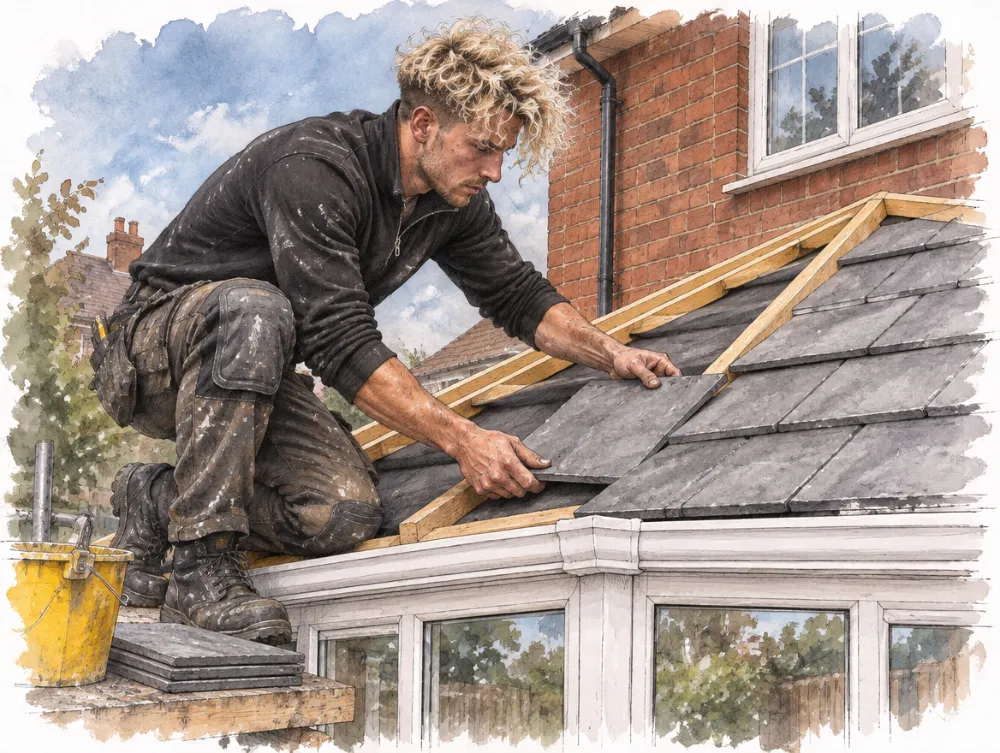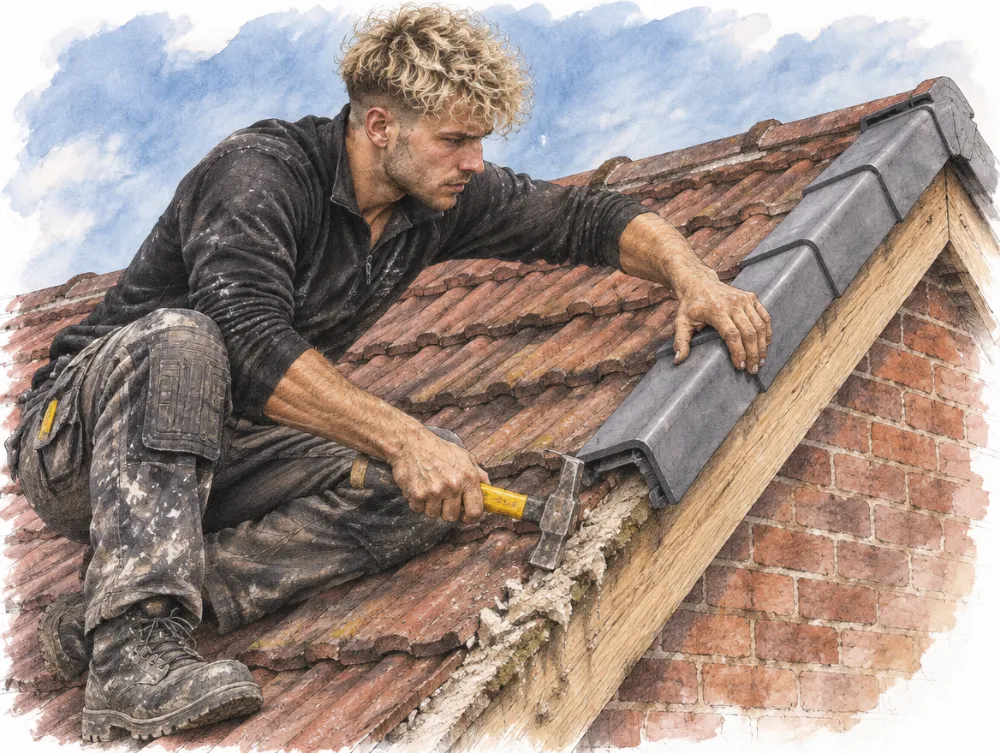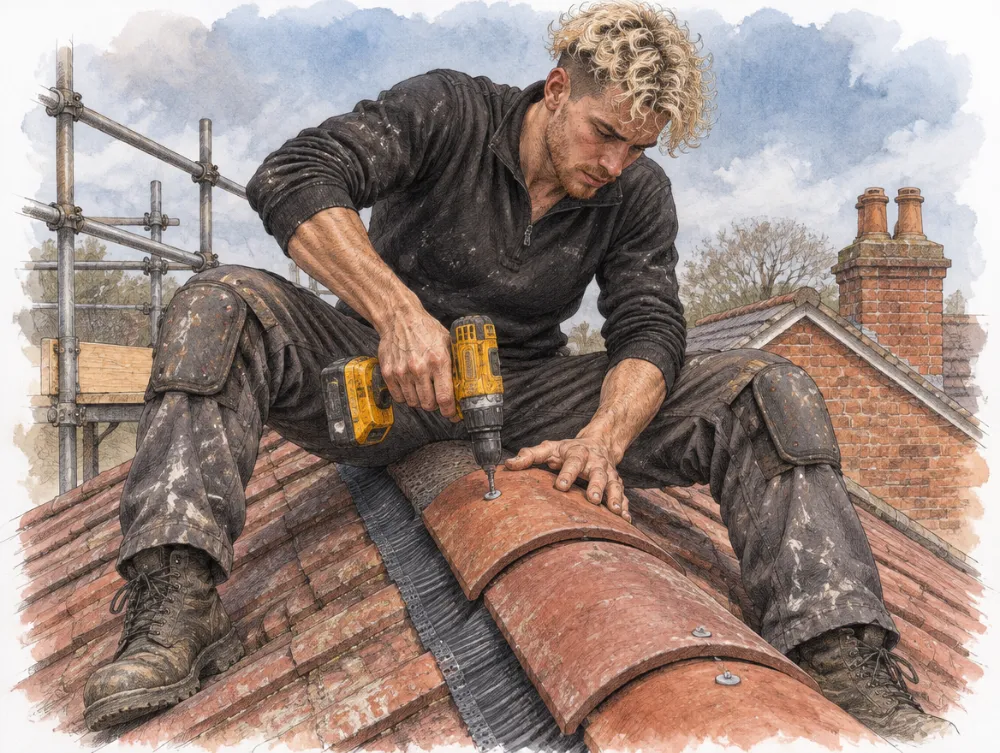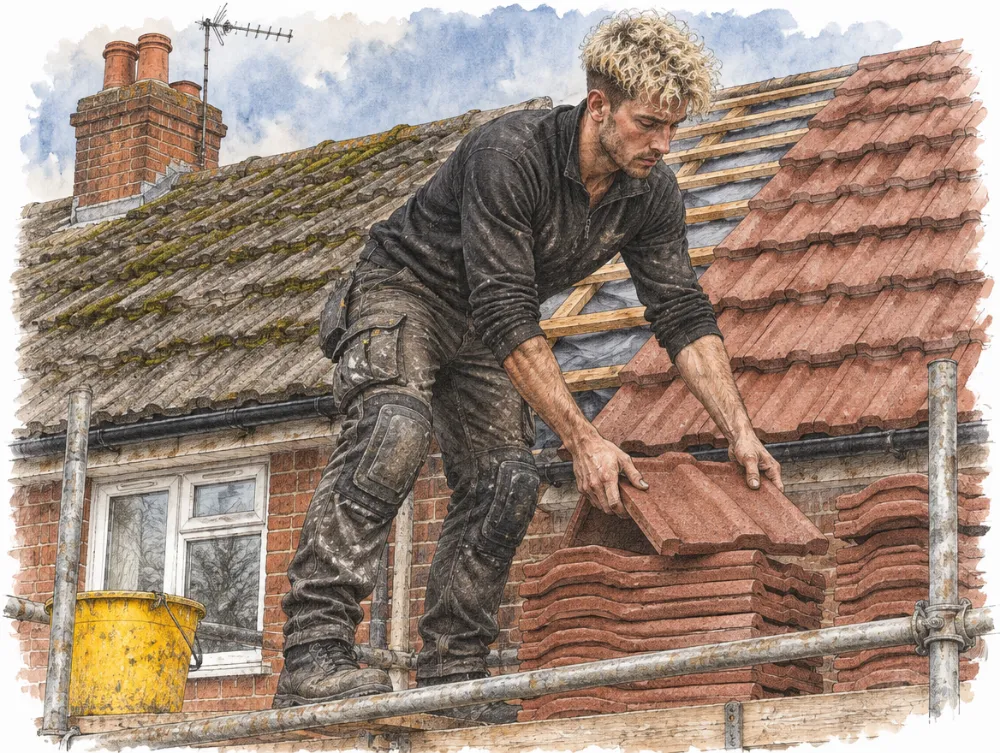
A full roof replacement cost in 2026 is usually somewhere between £5,000 and £15,000 for an ordinary house.
A typical three-bed semi in concrete tiles comes in at roughly £6,500 to £15,000 once scaffolding, skips and strip-off are included.
Small terraces and bungalows sit at the bottom of that range.
Big detached houses, or anything in natural slate, can go past £20,000.
What moves the price most is the material, then the size and shape of the roof, then what turns up when the old tiles come off.
Below, the price is broken down by house type, by material and by every line you're likely to see on a quote, so you can tell a fair figure from a daft one.
How much does a new roof cost in 2026?
The national price guides don't agree on one number, and that's the first thing worth knowing.
Checkatrade puts the average new roof at around £13,000 in its 2026 guide.
HomeBuilding.co.uk, updated in September 2025, puts a standard three-bed semi with a 65m² roof in plain concrete tiles at £10,000 to £15,000, including labour, scaffolding and insulation.
BestBuilders' Q3 2026 figures, which include VAT, scaffolding, skips and building regulations, put the same sort of semi at £6,500 to £10,500 in concrete tiles.
MyJobQuote's November 2026 guide gives a lower average of £5,250, but that leaves the scaffold out.
No scaffold, no roof, so ignore any figure that doesn't include it.
Most re-roofs on an ordinary semi end up in the high four figures to low five figures.
Anyone quoting well outside that should be able to tell you exactly why.
Roof replacement cost by house type
Roof area drives most of the cost, and house type is a quick way to guess the area.
These are BestBuilders' Q3 2026 figures for a full job, including strip-off, battens, breathable membrane, tiles or slates, ridge, leadwork, scaffolding, a skip and VAT.
| House type | Typical roof area | Concrete tiles | Natural slate | Typical time on site |
|---|---|---|---|---|
| 2-bed mid-terrace | 50-60m² | £4,500-£7,500 | £8,500-£15,000 | 3-5 days |
| 2-bed end-terrace | 55-65m² | £4,800-£8,000 | £9,000-£16,000 | 3-5 days |
| 3-bed semi | 70-90m² | £6,500-£10,500 | £12,000-£20,500 | 5-8 days |
| 3-bed detached | 90-110m² | £8,200-£13,000 | £15,000-£25,000 | 6-10 days |
| 4-bed detached | 110-150m² | £10,000-£17,000 | £18,500-£33,000 | 7-12 days |
Bungalows are a slightly different job.
MyJobQuote's 2026 guide puts a two-bed bungalow at £3,000 to £4,000 for a plain gable roof and £4,000 to £5,000 for a hipped one, before scaffolding.
There's a lot of roof on a bungalow for the floor space, but the scaffold is low and quick to put up, so it tends to even out.
Shape matters too.
BestBuilders says to add 15% to 30% for complex roofs with lots of hips, valleys, dormers or chimneys.
MyJobQuote shows the same thing, with a standard hipped semi at £4,250 to £4,750 and a hipped semi with two valleys at £5,750 to £6,250, again before scaffolding.
Roof replacement cost by material
This is where your choices really move the total.
Concrete tiles are the cheapest pitched roof, clay sits in the middle, and natural slate costs the most and lasts the longest.
| Material | Supply and fit per m² (BestBuilders, Q3 2026) | Supply and fit per m² (Checkatrade, 2026) | Typical lifespan (HomeBuilding) |
|---|---|---|---|
| Concrete tiles | £75-£130 | £120-£230 | 40-50 years |
| Clay tiles | £100-£180 | £160-£275 | 60-80 years |
| Synthetic slate | £85-£130 | Not listed | 40-50 years (BestBuilders) |
| Spanish natural slate | £130-£220 | £160-£275 (natural slate) | 75-100 years |
| Welsh slate | £180-£320 | £160-£275 (natural slate) | 100+ years |
| EPDM rubber (flat) | £55-£95 | £80-£100 | 25-30 years |
Checkatrade's rates run higher because they fold in more labour, so treat the two columns as the bottom and top of a fair band.
BestBuilders reckons clay adds 30% to 50% to the cost of a concrete tile re-roof, and natural slate adds 60% to 90%.
If you're thinking of switching material, weight matters as well as looks, because a different covering puts a different load on the timbers.
Flat bits like rear extensions are priced differently again, and our flat roof replacement cost guide covers those.
Roofz guide
What a new roof costs in 2026
Typical re-roof prices by house type and material, what a quote should include, and how the job runs from survey to sign-off.
The big numbers
£6,500-£15,000
3-bed semi, concrete tiles, all in
£280-£360
Roofer day rate (Checkatrade 2026)
£900-£1,800
Scaffolding for a 3-bed semi
3-8 days
Typical time on site for a house
Re-roof cost by house type (concrete tiles, top of range)
How long each covering lasts (upper estimate)
Concrete, clay or slate?
Concrete tiles
- £75-£130 per m² fitted
- 40-50 year lifespan
- Cheapest pitched option
- Common on 1960s-80s Fens homes
Clay tiles
- £100-£180 per m² fitted
- 60-80 year lifespan
- Adds 30-50% vs concrete
- Traditional look, holds colour
Natural slate
- £130-£320 per m² fitted
- 75-100+ year lifespan
- Adds 60-90% vs concrete
- Check structure if switching
How a re-roof runs
- Survey and fixed quote. Roof measured, shape and access checked, price agreed in writing.
- Scaffold up. Usually one to two days at the start.
- Strip off. Old tiles, battens and felt removed and skipped.
- Timber check. Rotten rafters or boards repaired before anything goes back.
- Membrane and battens. Breathable membrane and new battens fixed.
- Tiles or slates. Laid and mechanically fixed to BS 5534.
- Ridge, verge and lead. Dry-fix or bedded ridge, verges and flashings finished.
- Sign-off. Building regulations certificate, guarantee, scaffold down.
Your quote should show
- Tiles or slates, membrane and battens
- Ridge, hip and verge method
- Lead flashings
- Scaffolding and how long it is hired for
- Skip and waste disposal
- How timber repairs will be priced
- Building regulations sign-off
- Whether VAT is included
- A written guarantee
What's included in a roof replacement quote?
A proper quote breaks the job down.
If yours is one line that just says "new roof", ask for more.
BestBuilders' Q3 2026 breakdown for a three-bed semi gives these typical figures.
- Tiles or slates: £2,500 to £8,500, depending on material.
- Breathable membrane: £350 to £600.
- Battens: £180 to £350.
- Ridge and hip tiles, mortar or dry-fix: £250 to £600.
- Lead flashings: £200 to £500.
- Scaffolding: £900 to £1,800 for two to three weeks.
- Skip and waste: £350 to £650.
- Labour: £2,000 to £4,500 for a two-man team.
Roughly 45% goes on materials and 55% on labour and services, on the same breakdown.
HomeBuilding puts scaffolding for a three-bed semi at £1,200 to £1,800, and BestBuilders has detached or multi-lift jobs at £1,500 to £3,500.
For labour alone, Checkatrade's 2026 guide gives a roofer's day rate of £280 to £360, and MyJobQuote gives £200 to £275.
Things that often get left off a quote are rotten rafters, chimney work, fascias and soffits, and guttering.
BestBuilders prices rafter repairs at £200 to £500 each if they're needed, and chimney repairs at £800 to £3,000.
Fascias and soffits add £800 to £2,500, and doing them while the scaffold is up is usually the sensible call.
What makes a new roof cost more or less?
Size and pitch
More square metres means more tiles, more membrane and more days on site.
Steeper roofs are slower and need more safety kit, so they take more labour.
Shape
Hips, valleys, dormers and chimneys all mean cutting, lead and extra time.
A plain gable on a terrace is the cheapest roof there is to re-cover.
Access
Tight gardens, a conservatory in the way or a busy road out front all make the scaffold slower and dearer.
What's under the tiles
HomeBuilding warns that opening up an old roof can turn up rotten timber or perished felt, and that puts the price up.
NFRC, the National Federation of Roofing Contractors, says the same, and that estimates can change once the old covering is off.
If a rafter's rotten, it's rotten, and it has to be sorted before anything goes back on.
A decent roofer tells you up front how they'll price timber repairs, so there are no surprises halfway through.
Where you live
MyJobQuote's regional figures put the East of England around 5% to 10% above the national average, behind London and the South East but ahead of the Midlands and the North.
Do you need building regulations or planning permission to replace a roof?
This is where people get caught out.
The Planning Portal says that in most cases re-roofing will need Building Regulations approval.
NFRC says that if you're doing 50% or more of the roof, you either use a roofer registered with a competent person scheme or contact Local Authority Building Control before work starts.
Registered competent person scheme members can sign off their own work, so you don't have to book inspections yourself.
The Planning Portal also says re-covering a roof should include improving its insulation, which comes under Part L of the Building Regulations.
If you swap to a much heavier or lighter covering, it advises checking with a structural engineer or surveyor first.
Planning is a separate thing.
Horsham District Council's guidance says like-for-like re-covering normally needs no planning consent, but changing the materials or raising the roof might.
Listed buildings and conservation areas have tighter rules, so talk to the council's planning team before you change how a roof looks.
We go into more detail in our guide to building regulations for roof replacement.
Bats, asbestos and other things that can hold a job up
Bats
GOV.UK guidance says all bat species, their breeding sites and resting places are fully protected by law, and it lists repairing or replacing a roof as work that can harm them.
If bats are using your roof, you'll need a bat survey, and maybe a licence from Natural England, before work goes ahead.
The penalty is up to six months in prison, an unlimited fine, or both.
Don't ignore it.
Asbestos
The HSE says asbestos can be found in any home built or refurbished before the year 2000, including asbestos cement roof tiles, slates, soffits and fascias.
MyJobQuote's 2026 guide puts an asbestos survey at about £325 and asbestos removal from a roof at typically around £2,750.
If you've got an older extension or a garage with cement sheets, mention it at the survey so it's checked before anyone starts breaking it up.
Want Leo to have a look?
Free survey, one fixed price in writing, and no hard sell. Wisbech, Peterborough and the Fens.
Should you repair or replace your roof?
Not every tired roof needs replacing.
A good roofer will tell you straight when a repair will do.
BestBuilders gives a rule of thumb, which is to keep repairing while the repair costs less than about 25% of a new roof.
The same guide puts typical spot repairs at £800 to £2,500 in total, against £6,500 to £22,500 for a full replacement.
Signs it's time for a new one include lots of slipped or cracked tiles, sagging, daylight in the loft, damp patches in several places and a roof that's simply worn out.
Our roof repair cost guide lists prices for common fixes, and our checklist of signs you need a new roof helps you decide.
How can you keep the cost of a new roof down?
- Book early. Spring and summer slots go fast, and early bookings get more choice of dates.
- Do the extras together. Gutters, fascias, chimney pointing and loft insulation all cost less while the scaffold is up.
- Stick with like-for-like. The same type of covering avoids structural checks and keeps planning simple.
- Compare line by line. Line quotes up item by item, not just the bottom figure.
Don't save money on membrane, battens or fixings.
Those are the bits that keep the weather out for the next forty years.
What happens during a re-roof?
It's the same job on most houses, start to finish.
- Scaffold up. Usually a day or two, with edge protection at the eaves.
- Strip off. Old tiles, battens and felt come off and go in the skip, a section at a time.
- Check the timbers. Rotten rafters, wall plates or boards get sorted while they're open.
- Membrane and battens. New breathable membrane goes on, then new treated battens.
- Tiles or slates. Laid and fixed to BS 5534, with every edge properly secured.
- Ridge, verge and lead. Ridge and hips fixed, verges finished, flashings dressed in.
- Sign-off. Building regs certificate, guarantee, scaffold down and the site cleared.
Your loft stays covered at the end of each day, or it should do.
If a roofer leaves a stripped roof open overnight with nothing over it, that's a bodge.
How long does a roof replacement take?
MyJobQuote says a typical semi or detached re-roof takes three to five days, and a small terrace two to three.
Checkatrade gives three to four days for an average three-bed house with medium or large tiles.
BestBuilders allows five to eight days for a semi, plus one to two days at the start to put the scaffold up and about a day at the end to take it down.
Weather is the wildcard, and BestBuilders says April to September is the best time.
It also says booking lead times can run to six to twelve weeks in peak season, so don't wait for the first winter leak.
The rain cloud certainly won't.
What a new roof costs round here: Peterborough and the Fens
If you're getting quotes from roofers in Peterborough, Wisbech or anywhere in the Fens, there are a few local things worth knowing.
The Fens are flat and open, so roofs out here take the full force of the wind with no hills or trees to slow it down.
Since the 2015 changes to BS 5534, the British Standard for slating and tiling, Marley explains that mortar can't be relied on as the only way of holding the roof covering on.
Marley also says the standard now covers normal re-roofing and repairs, so a new roof should have mechanically fixed ridge and hip tiles and properly secured edges.
That's why most re-roofs now use dry ridge and dry verge systems instead of mortar alone.
Clay soils across the area shrink and swell with the weather, and older houses that have moved can have roofs that aren't quite straight any more.
That doesn't stop a re-roof, but it can mean extra work on the battens to get the lines looking right.
Wisbech, March, Whittlesey, Chatteris and Spalding are full of 1960s to 1980s bungalows and ex-council semis with concrete interlocking tiles, and a lot of them are now at the age where a new roof makes more sense than another patch.
Peterborough and Wisbech also have plenty of older brick terraces, often with slate roofs, chimneys and lead valleys that need more careful work.
If you live in a conservation area, such as Wisbech's Georgian Brinks or parts of Peterborough city centre, check with the council before changing the look of your roof.
Leo is a roofer in Wisbech, covering roofing in the Fens and Peterborough, including March, Whittlesey, Chatteris, Ely, Spalding, Holbeach, Long Sutton, King's Lynn, Downham Market, Market Deeping, Stamford and Huntingdon.
How to choose a roofer for a new roof
NFRC says to get up to three roofers to look at the job, and not to just take the cheapest.
Get the agreed price in writing, and agree the payment terms before anything starts.
NFRC recommends an insurance-backed guarantee, because even good firms can go bust, and then their own guarantee is worth nothing.
It also warns that cash or VAT-free deals are hard to chase if things go wrong.
Ask to see public liability insurance, and ask who's handling the building regs sign-off.
If someone knocks on your door saying they've spotted a problem and can start today, read our guide to spotting cowboy builders first.
At Roofz, Leo comes out, has a proper look, tells you what he finds and gives you one fixed price in writing, with a written guarantee.
Roof replacement cost: the short version
Most re-roofs in 2026 cost about £5,000 to £15,000, with a three-bed semi in concrete tiles usually around £6,500 to £15,000 all in.
Terraces and simple bungalows cost less, and big detached houses or natural slate can be well over £20,000.
Scaffolding, skips, VAT and rotten timber explain most of the gap between quotes.
Make sure your roofer deals with building regs, checks for bats and asbestos and gives you a written guarantee.
Book a free roof survey and Leo will give you a fixed price for your roof, not a national average.
Questions people ask
Does home insurance pay for a new roof?
Home insurance usually covers sudden damage such as a storm, not a roof that has simply worn out with age. Check your policy wording and speak to your insurer before work starts if you think you have a claim.
Can you re-roof over the existing tiles?
On a pitched tiled or slate roof the old covering is normally stripped off so the battens, membrane and timbers can be checked and replaced. Layering new tiles over old ones would add weight and hide any rot.
Do I need to move out while my roof is replaced?
Most people stay at home during a re-roof. The loft is sealed from below by the ceilings, though it can be noisy and dusty in the loft itself, so clear anything valuable out of it first.
Do you replace roofs in Peterborough, Wisbech and King's Lynn?
Yes. Roofz covers Wisbech, Peterborough and the Fens, including King's Lynn, March, Spalding, Ely and Stamford, with a free survey and one fixed price in writing.
Should I replace my fascias and gutters at the same time?
Usually yes, if they are tired, because the scaffold is already up and that is one of the biggest single costs. Doing it later means paying for scaffolding twice.
How do I know if my roof can be repaired instead?
If the damage is limited to a few tiles, a ridge or a flashing, a repair is often enough. A free survey will tell you whether repair or replacement is better value for your roof.
Sources
- Checkatrade - Roof installation cost guide for 2026
- MyJobQuote - Roof Replacement Cost (2026 prices, updated 3 Nov 2026)
- MyBuilder - New roof cost full guide (2026)
- HomeBuilding.co.uk - How much does a new roof cost? (updated September 2025)
- BestBuilders - Average cost of a new roof 2026 UK (Q3 2026 figures)
- Planning Portal - Building regulations: re-roofing
- Planning Portal - Building regulations: insulation and thermal elements
- Horsham District Council - Guidance for re-roofing projects
- NFRC - Choosing a roofing contractor: homeowners
- GOV.UK - Bats: protection, surveys and licences
- HSE - Diagrams showing where asbestos can occur in buildings
- Marley - What are the fixing requirements of BS 5534?
Prices are guide figures from the sources above and vary by job. Your free survey gives one fixed price in writing.