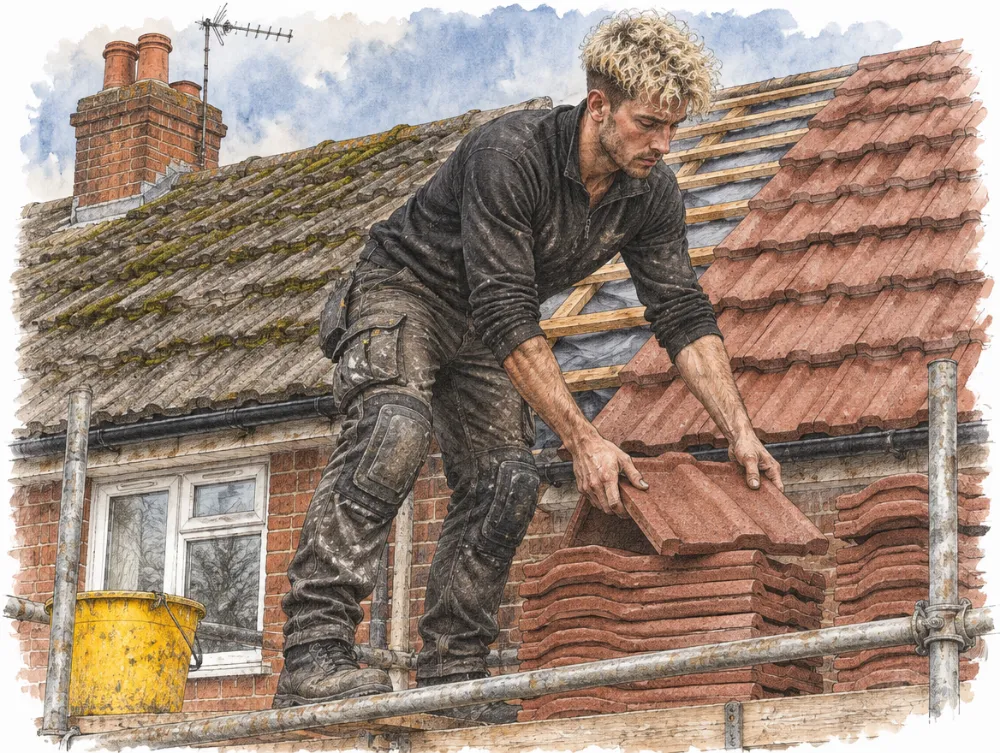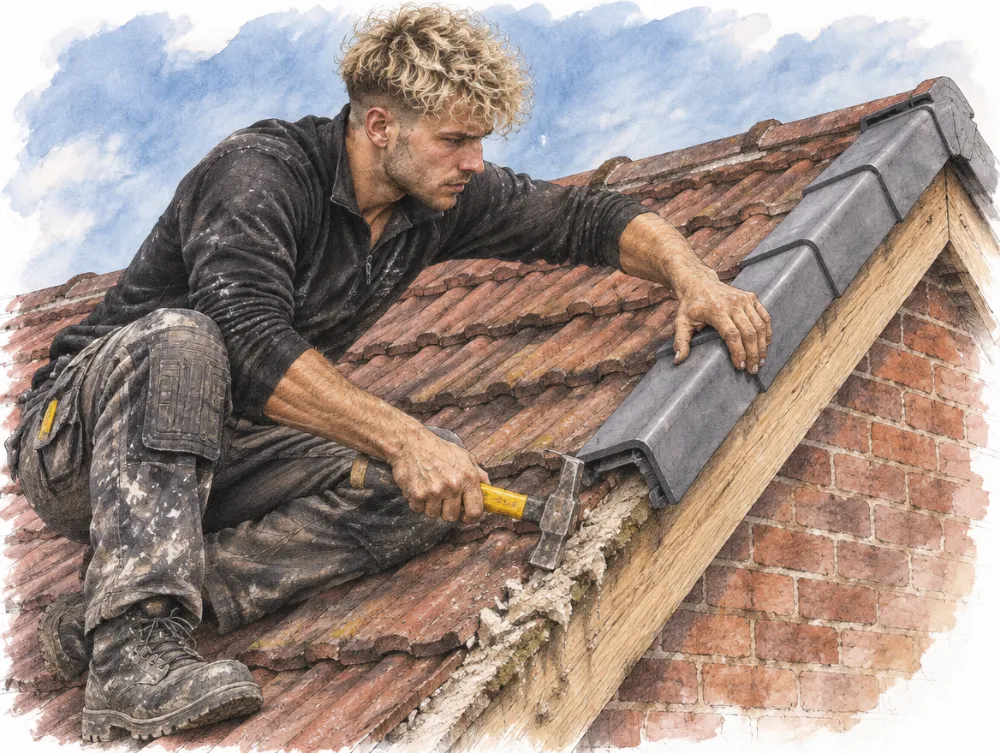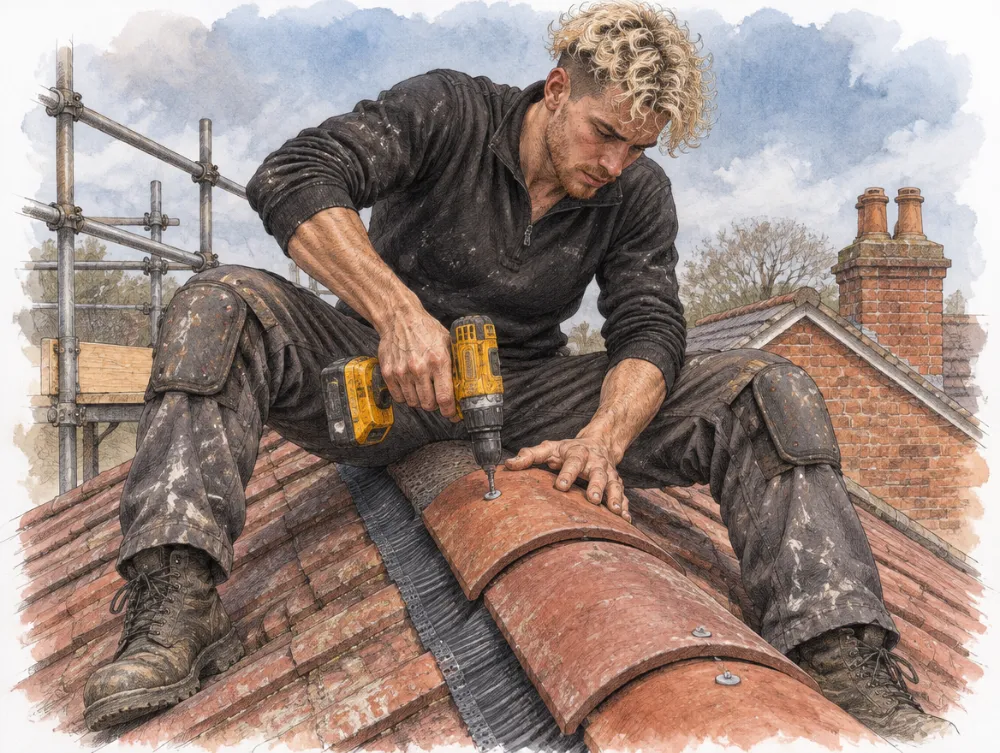
A dry ridge system holds the ridge tiles on top of your roof with screws, clips and a breathable roll, instead of sand and cement.
In 2026, a dry ridge on a typical semi usually costs around £900 to £1,800.
By the metre, it's somewhere between £40 and £110 fitted, depending on whose guide you read and how much old mortar has to come off.
Just repointing the old mortar ridge is cheaper, at about £200 to £300 per 10 metres, but it's a patch, not a fix.
Here's how a dry ridge works, what it costs, how it stacks up against mortar, and when repointing will still do.
What is a dry ridge system?
The ridge is the line of tiles along the very top of the roof, where the two slopes meet.
For most of the last hundred years, those tiles were just bedded on a fat line of mortar.
A dry ridge does away with the mortar and fixes everything mechanically.
As the Roofing Superstore guide puts it, it means fixing ridge and hip tiles to a roof without sand or cement mortar.
A typical kit has these parts.
- Ridge batten and brackets: a timber batten along the apex on adjustable metal brackets, so the ridge tiles have something solid to screw into.
- Ridge roll: a flexible, breathable strip that goes over the batten and sticks down onto the tiles either side.
- Screws and clips: every ridge tile is screwed or clipped to the batten.
- Ridge unions: plastic joints under the gap between each pair of ridge tiles to keep water out.
- End caps: closures at each end of the ridge.
On a hipped roof, the same thing goes on the sloping hips, which is called a dry hip system.
Most systems also leave a continuous vent gap along the ridge so moisture can get out of the loft.
How much does a dry ridge system cost in 2026?
These are fully fitted prices, materials and labour, from recent cost guides.
| Job | Typical cost | Usual time |
|---|---|---|
| Small terraced roof or porch (short ridge) | £500 to £900 | 1 day |
| Standard semi-detached house | £900 to £1,600 | 1 to 2 days |
| Large or complex ridge line | £1,600 to £2,500 | About 2 days |
| Each hip on a hipped roof (on top) | £300 to £400 | - |
| Fitted price per metre | £40 to £110 | - |
The roof-type prices and the hip figure are from MyJobQuote's October 2026 guide, which gives an average of about £1,250.
The per-metre range is wide because the guides don't agree.
MyJobQuote says £40 to £75 a metre, and Bookabuilder's June 2026 guide says £70 to £110.
Bookabuilder puts a full ridge replacement on a semi at £900 to £1,800, which is close enough to MyJobQuote.
Neither is clear on VAT, so check your quote.
Where the money goes
The kit is cheap.
MyJobQuote puts a dry ridge kit for 6 to 10 metres at £80 to £150, with unions and clamps at £2 to £5 each.
The bill is mostly labour and getting up there safely.
- Labour: about £200 to £350 a day, according to MyJobQuote.
- Taking off the old mortar ridge: £150 to £300.
- Scaffold: £300 to £900 on most houses.
- Skip and waste: £80 to £200.
- New ridge tiles: £4 to £10 a tile, or £40 to £70 a metre fitted if the old ones can't go back.
- Timber or batten repairs: £150 to £400 if there's rot once the ridge is off.
Old ridge tiles often crack when the mortar's knocked off them.
Ask whether the price assumes reusing them or buying new.
Roofz guide
Dry ridge systems: costs and choices
What a dry ridge costs in 2026, how it compares with repointing or rebedding in mortar, and what goes into one.
Typical 2026 dry ridge prices
£500-£900
Short ridge, terrace or porch
£900-£1,800
Typical semi-detached house
£300-£400
Extra for each hip
£40-£110
Fitted price per metre
Ridge options on a semi (top of range)
Where the money goes (top of range)
Dry ridge vs mortar ridge
Dry ridge
- Screwed and clipped to a ridge batten
- Guarantees up to 15 years
- Flexes with the roof
- Fits in most safe weather
- Built-in ridge ventilation
Mortar ridge
- Bedded on sand and cement
- Mortar often guaranteed 2 years
- Cracks as the roof moves
- Needs dry weather, 5°C to 25°C
- Must still be mechanically fixed
How a dry ridge goes on
- Strip. Lift the old ridge tiles and clean off the mortar.
- Check. Repair top tiles, felt and battens.
- Batten. Fix brackets and a ridge batten along the apex.
- Roll. Lay the breathable ridge roll and seal it to the tiles.
- Fix. Screw or clip each ridge tile, with a union under every joint.
- Finish. Fit the end caps and check every tile is tight.
Signs your ridge needs work
- Cracked or missing ridge mortar
- Mortar in the gutters or on the ground
- Ridge tiles out of line or rocking
- Damp near the top of upstairs ceilings
- Daylight or drips at the apex in the loft
- Rattling from an existing dry ridge in wind
Dry ridge vs mortar bedded ridge: which is better?
Mortar looks traditional and costs less to put on.
But it's rigid, and roofs aren't.
The timbers move with the seasons, the mortar cracks, water gets in behind and freezes, and sooner or later lumps fall out and ridge tiles work loose.
A dry ridge is screwed down, so it flexes with the roof instead of cracking.
| Dry ridge | Mortar bedded ridge | |
|---|---|---|
| Cost on a semi | £900 to £1,800 fitted | £500 to £700 to rebed, £200 to £300 per 10m to repoint |
| Guarantee | Up to 15 years on many systems | Many roofers guarantee mortar for 2 years |
| Expected life | Can last as long as the roof | Typically needs repair within 10 to 15 years |
| Weather when fitting | Most conditions that are safe to work in | Needs dry weather, roughly 5°C to 25°C |
| Ventilation | Built in along the ridge | None |
| Look | Clean, even ridge line | Traditional, suits period homes |
The guarantee and weather figures are from Marley, the lifespans from MyBuilder, and the mortar prices from MyJobQuote's October 2026 ridge tile guide.
MyBuilder reckons a well-fitted dry ridge can last 50 years or more.
Maybe.
The 15-year product guarantee is the number you can actually hold someone to.
The weather matters more than you'd think
Marley says mortar needs dry weather and temperatures between 5°C and 25°C to cure.
That rules out a good chunk of a Fenland winter.
A dry ridge can go on in most weather that's safe to work in, which helps when you need the roof sorted before the next storm, not next May.
Is mortar still allowed on ridges under BS 5534?
Yes, but it can't be the only thing holding the ridge on.
BS 5534 is the British Standard for slating and tiling.
Marley's summary says mortar can't be relied on as the only fixing for roofing components.
Since the 2014 revision, bedded ridge and hip tiles should have mechanical fixings as well, mortar or not.
A 2018 amendment linked it to BS 8612, the standard for dry ridge, hip and verge systems, and made it cover normal re-roofing and repairs too.
BS 5534 isn't law on its own, but Marley points out it carries weight once it's written into a contract.
NHBC standards, home warranties and building control generally expect mechanical fixing as well.
There's an exception for some heritage and listed buildings, where a traditional mortar look has to be kept, but that work sits outside the standard and needs agreeing carefully.
So if a roofer offers to "just rebed it in muck" on an ordinary house, ask how the tiles will be fixed down as well.
If the answer is they won't be, that's a bodge.
Want Leo to have a look?
Free survey, one fixed price in writing, and no hard sell. Wisbech, Peterborough and the Fens.
Should I repoint my ridge or go for a dry ridge?
This is the question most people actually have, and it depends how bad it is.
When repointing is fine
If the ridge tiles are still solid and only the outside of the joints has cracked, repointing will buy you a few years.
MyJobQuote's October 2026 guide puts it at about £200 to £300 per 10 metres, and one bungalow quote it lists was about £180 for repointing only.
It's a sensible stopgap if you're planning a full re-roof in the next few years anyway, which our roof replacement cost guide covers.
When it needs more than that
If ridge tiles rock when you touch them, mortar has come out in chunks, or you can see daylight at the apex from the loft, repointing is just painting over it.
At that point it's either rebed in mortar with mechanical fixings, or switch to a dry ridge.
MyJobQuote puts a full ridge on a semi, 8 to 10 metres, at £500 to £700.
A dry ridge costs more up front, but you shouldn't be calling anyone back in ten years.
Signs your ridge needs attention
Most of this you can spot from the street, ideally with binoculars rather than a ladder.
- Cracked, crumbling or missing mortar along the ridge.
- Bits of mortar in the gutters or on the ground.
- Ridge tiles out of line, lifted or missing.
- Damp or staining near the top of upstairs ceilings.
- Daylight, damp timber or drips at the apex when you look in the loft.
- On a dry ridge, rattling in high winds, which MyBuilder says can mean loose tiles or fixings.
If the loft is damp but the ridge looks fine, it could be condensation rather than a leak, which our guide to condensation in the loft explains.
Does a dry ridge help with loft ventilation?
It helps, but it won't fix it on its own.
Marley says its dry ridge systems give 5mm of continuous ventilation along the ridge, in line with BS 5250, the standard on condensation.
That lets warm, wet air out at the top.
But Bookabuilder makes the key point: a dry ridge won't sort condensation if there's no air coming in at the eaves.
Air needs a way in low down and a way out up high.
That's why ridge vents usually go with soffit or eaves vents, and our guide to roof ventilation goes into the options.
Common dry ridge problems
When a dry ridge goes wrong, it's nearly always the fitting, not the kit.
- Loose ridge tiles: usually tiles that weren't lined up or fixed properly in the first place.
- Water getting in: often a ridge roll that wasn't sealed down onto the tiles.
- Rattling in the wind: fixings or unions working loose.
- Wrong kit for the roof: MyBuilder notes not every system suits every roof pitch.
MyBuilder suggests a professional check once a year and a look after heavy rain or high winds.
How a dry ridge is fitted
On an existing roof, it goes like this.
- Scaffold goes up on a two-storey house.
- The old ridge tiles come off and the mortar is cleaned off them, with any broken ones set aside.
- The top courses of tiles and the felt underneath are checked and repaired.
- Brackets go onto the rafters and a ridge batten is fixed along the apex.
- The ridge roll goes over the batten and is pressed down onto the tiles each side.
- Ridge tiles go on with a union under each joint, screwed or clipped to the batten.
- End caps go on, and every tile is checked for tight and straight.
BMI's South African arm, which makes Redland tiles, says its dry ridge takes about 2.5 hours per 10 metres to fit, against about 6 hours for mortar, though stripping an old ridge first adds time.
MyJobQuote says most jobs take one to two days.
Dry ridges in Peterborough and the Fens
The Fens are about as flat and open as England gets.
The wind comes across miles of fields with nothing in the way, and the ridge is the highest, most exposed part of the roof.
So a cracked mortar ridge round here gets found out quickly.
The clay soils across the area add to it, because houses that shift a bit over the years crack rigid mortar faster.
There are plenty of 1960s to 1980s bungalows in Wisbech, March, Holbeach, Long Sutton and Chatteris, and where they're hipped, the hips matter as much as the ridge.
With MyJobQuote putting each hip at £300 to £400 extra, a fully hipped bungalow can cost more than you'd expect for a single-storey roof.
The upside is bungalows usually need less scaffold.
A plain gable roof with one straight ridge, like you see on a lot of ex-council semis across Peterborough and Whittlesey, is about as easy as dry ridge work gets.
On older brick terraces and period houses in conservation areas, like Wisbech's Georgian Brinks or Peterborough city centre, a properly fixed mortar ridge may suit the look better.
If you're looking for roofers in Peterborough or the Fens for ridge work, ask them straight out which they'd recommend for your house and why.
Choosing a roofer for your ridge
Ask anyone quoting these questions.
- Are you repointing, rebedding or fitting a dry ridge, and why?
- Which dry ridge system, and does it suit my tiles and roof pitch?
- How will the ridge tiles be mechanically fixed, as BS 5534 expects?
- Does the price include scaffold, getting the old mortar off and any new tiles?
- What's the guarantee, and is it in writing?
If someone turns up uninvited, points at your ridge and says it needs doing today, walk away, and our guide to spotting cowboy roofers explains why.
Leo will come out, look at the ridge and the rest of the roof, tell you straight whether repointing will do, and give you one fixed price in writing.
Book your free roof survey here.
The short version
A dry ridge fixes your ridge tiles with screws, clips and a vented roll instead of mortar.
Expect about £900 to £1,800 on a typical semi in 2026, plus £300 to £400 for each hip.
Repointing a sound mortar ridge is much cheaper, about £200 to £300 per 10 metres, but it's short term.
Either way, ridge tiles should be mechanically fixed under BS 5534, not just stuck on with mortar.
Do it once, do it properly.
Questions people ask
Is a dry ridge better than a mortar ridge?
For most ordinary homes, yes, because it flexes with the roof instead of cracking and needs little maintenance. A properly fixed mortar ridge can still be the right look on period or listed buildings.
How long does a dry ridge last?
Many dry ridge systems come with guarantees of up to 15 years, and a well-fitted one can last much longer. Mortar ridges typically need repair within 10 to 15 years.
Can a dry ridge be fitted to an existing roof?
Yes, the old ridge tiles are lifted, the mortar is cleaned off, and a ridge batten, roll and fixings are installed before the tiles go back on. Old ridge tiles can often be reused if they come off intact.
Do I need scaffolding for a dry ridge?
On most two-storey houses, yes, because working safely along the apex needs proper edge protection. Some bungalows can be done with less, which helps keep the cost down.
Does a dry ridge stop condensation in the loft?
It helps by letting moist air escape at the top of the roof, but it won't fix condensation on its own if there is no airflow coming in at the eaves.
Do you fit dry ridges in Peterborough and the Fens?
Yes, Roofz covers Wisbech, Peterborough and the Fens, from March and Chatteris to Spalding and King's Lynn. Leo will check your ridge and give you one fixed price in writing after a free survey.
Sources
- MyJobQuote - Dry Ridge System Installation Cost (updated 12 Oct 2026)
- MyJobQuote - Ridge Tile Replacement Cost (updated 1 Oct 2026)
- Bookabuilder - Roof tile ventilation, dry ridge and condensation (Jun 2026)
- Marley - Why a dry ridge system is the best choice for your roof
- Marley - Should I use mortar or dry fix for my ridge and hip tiles?
- Marley - Changes to BS 5534
- MyBuilder - What is a dry ridge system?
- MyBuilder - Dry ridge problems
- Roofing Superstore - Why opt for a dry ridge system on your roof
- BMI Group South Africa - Dry Ridge System
Prices are guide figures from the sources above and vary by job. Your free survey gives one fixed price in writing.