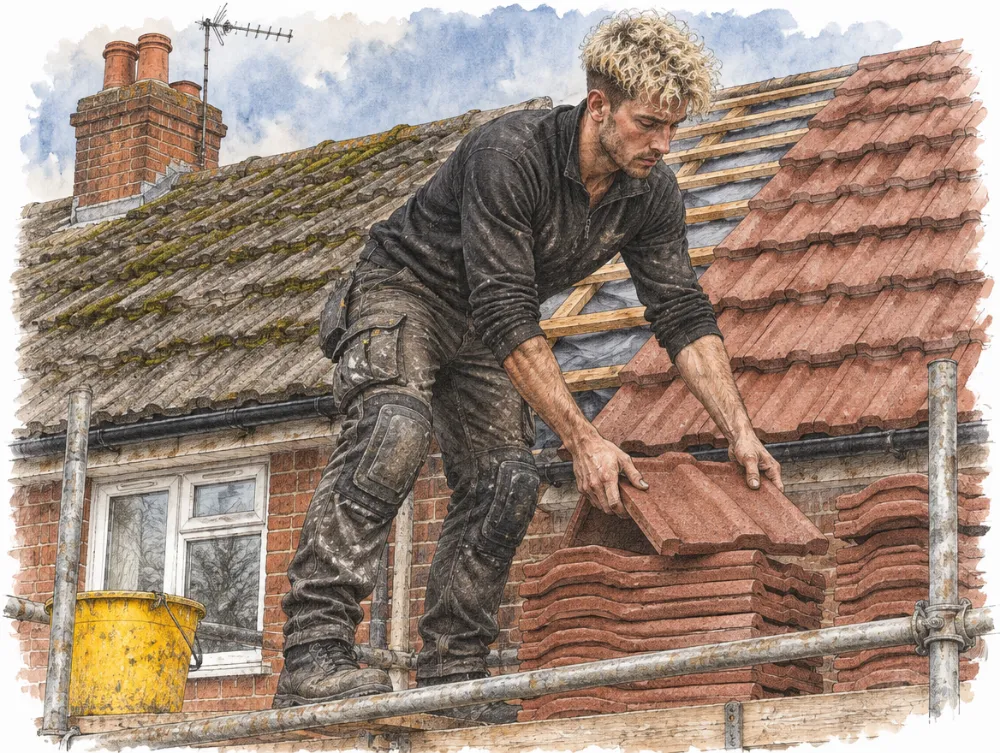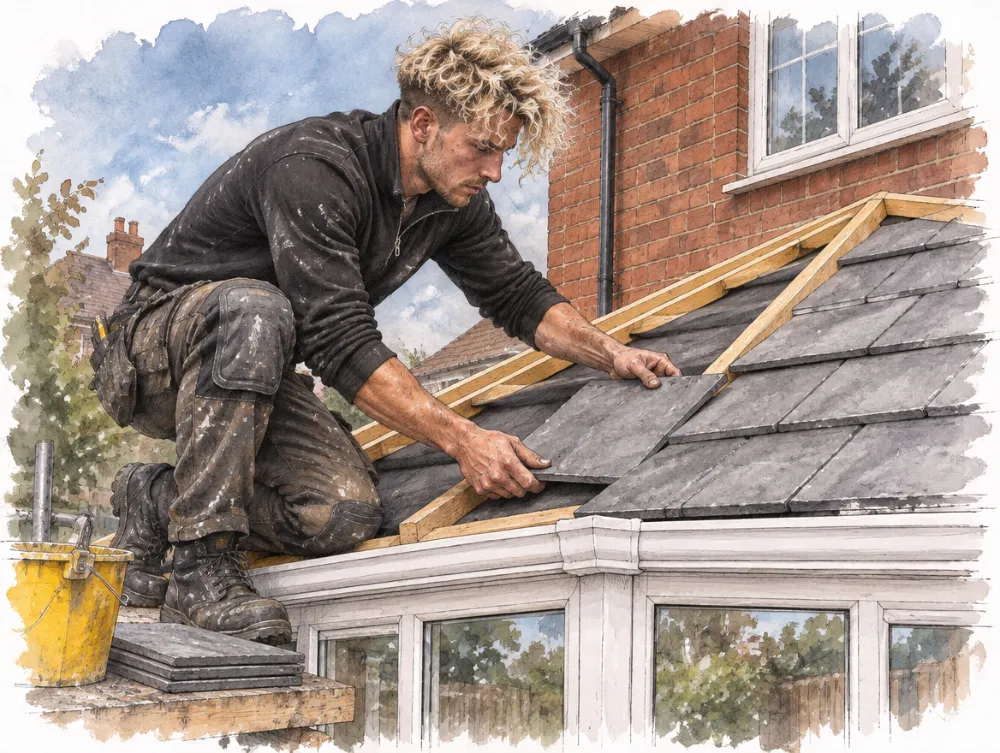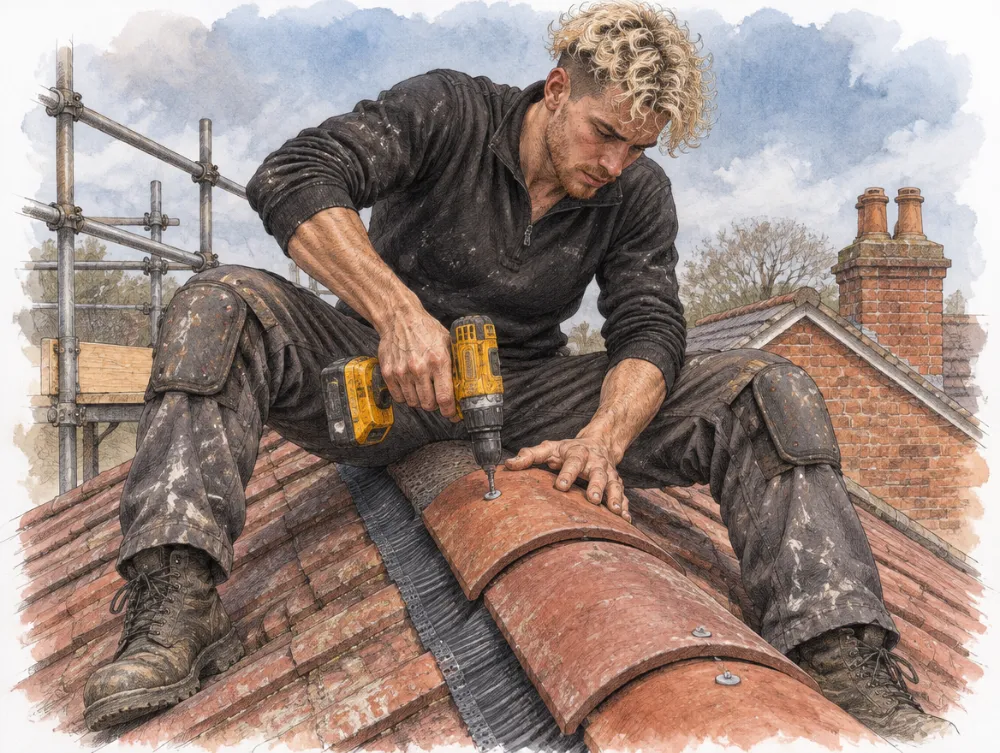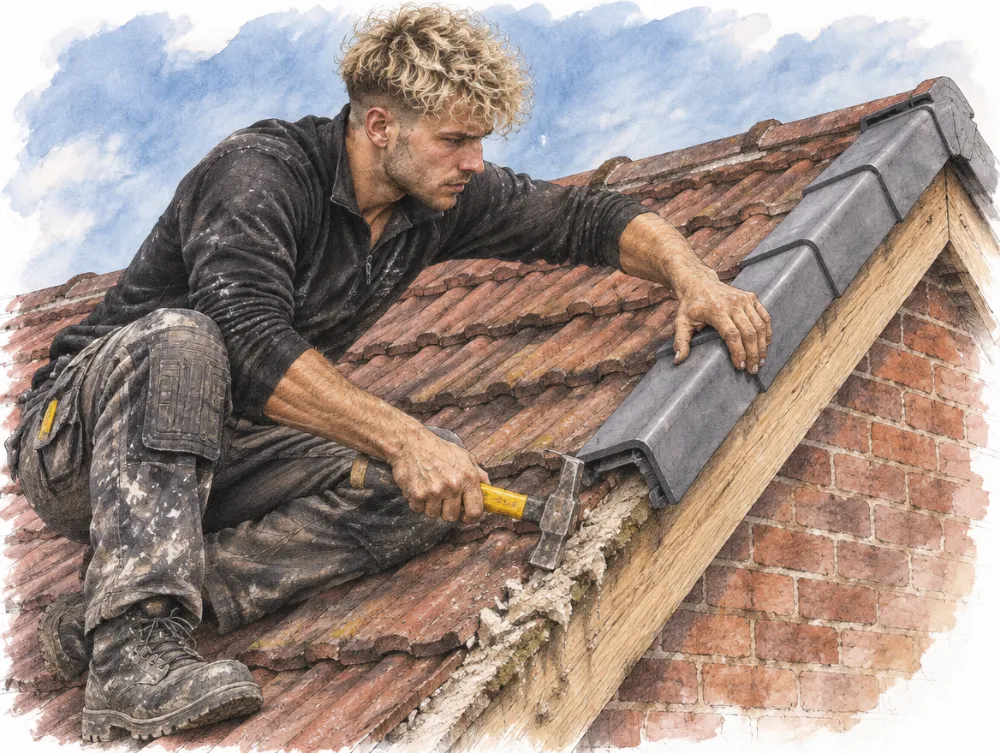
A dry verge is a row of plastic caps screwed over the end tiles on the gable edge of your roof, in place of the old sand and cement mortar.
In 2026, a dry verge on a typical semi costs somewhere between £500 and £1,500, depending on how long the verges are and whether you need scaffold.
By the metre, it's roughly £60 to £100 fitted.
Repointing the old mortar instead is about £30 to £50 a metre.
So mortar is cheaper on the day, and a dry verge is usually cheaper over the life of the roof.
Here's what you're paying for, how the two compare, and how to tell if yours needs doing.
What is a dry verge?
The verge is the sloping edge of the roof where the tiles stop at the gable wall.
On most older houses, that edge was finished with a strip of mortar packed under the end tiles, sat on a thin strip of board or fibre cement called an undercloak.
A dry verge does the same job without the mortar.
A run of plastic units clips over the tile ends and screws into the ends of the battens underneath.
Marley, one of the big tile makers, says it forms a weathertight seal on the roof edge and keeps out wind, rain, birds and pests.
A full system has a starter unit at the gutter end, a run of verge units up the slope, and a ridge end cap at the top.
One thing worth knowing: "dry" means no mortar, not fully watertight.
Wienerberger, another tile maker, points out that some water does get into a dry verge, so a decent system is designed to drain it into the gutter, not down your wall.
How much does a dry verge cost in 2026?
The guides don't all agree, so here are the ranges.
| Job | Typical cost | Usual time |
|---|---|---|
| Small roof (porch, bungalow, short verges) | £400 to £800 | 1 day |
| Standard semi-detached house | £500 to £1,500 | 1 to 2 days |
| One gable side on a semi, including labour | £800 to £1,500 | 1 day |
| Large detached or complex roof | £1,200 to £2,500 or more | 2 to 3 days |
| Fitted price per metre of verge | £60 to £100 | - |
The per-job figures are from MyJobQuote's October 2026 guide.
The per-metre and per-gable figures are from Bookabuilder's June 2026 guide.
Older guides from MyBuilder and Checkatrade had a semi at £750 to £1,000, which sits inside those newer ranges.
None of them is clear on VAT, so ask whether your quote includes it.
Where the money goes
The plastic is the cheap bit.
One big builders' merchant sells a universal verge unit for £2.84 including VAT.
MyBuilder puts uPVC units at £5 to £10 each and aluminium at £15 to £25 each.
MyJobQuote prices a basic kit at £150 to £300, and a mid-range branded system at £250 to £500.
The rest is labour, access, and whatever turns up when the old mortar comes off.
- Labour: MyJobQuote has roofers at £180 to £300 a day, or £250 to £400 for a specialist firm.
- Getting the old mortar off: £200 to £600.
- Replacement end tiles: £15 to £40 each, because old ones often crack when the mortar is chipped out.
- Scaffold: £300 to £1,200 or more, and on a two-storey gable it's often the biggest single item.
- Skip and waste: £100 to £300.
MyJobQuote says keep 10% to 20% back for hidden repairs, like rotten batten ends or a perished undercloak.
That's sound advice.
You don't know what's under there until it's off.
Roofz guide
Dry verge: costs, lifespan and what to check
What it costs to swap a mortar gable edge for a dry verge in 2026, how it compares with repointing, and the faults to watch for.
Typical 2026 dry verge prices
£400-£800
Small roof, porch or bungalow
£500-£1,500
Standard semi-detached house
£1,200-£2,500+
Large detached or complex roof
£60-£100
Fitted price per metre
Cost per metre: dry verge vs mortar (top of range)
Extras that change the price
Dry verge vs mortar verge
Dry verge
- Screwed-on plastic caps
- 25 to 40 year typical lifespan
- Moves with the roof, no cracking
- No repointing
- Tested to BS 8612
Mortar verge
- Sand and cement bedding
- 10 to 20 years before repairs
- Cracks as the roof moves
- Cheaper to repoint on the day
- Tiles still need mechanical fixing under BS 5534
How a dry verge is fitted
- Access. Scaffold or tower for two-storey gables.
- Strip. Chip out all the old mortar and replace cracked end tiles.
- Battens. Extend or replace short or rotten batten ends.
- Starter. Fix the eaves unit and bird closure first.
- Run. Screw each unit into the batten and lock it to the one below.
- Cap. Finish with a ridge end cap and check drainage into the gutter.
Signs your verge needs attention
- Cracked or missing mortar on the gable edge
- Mortar pieces on the ground below
- Slipped or loose end tiles
- Damp on the gable wall inside the loft
- Streaks or moss down the outside of the gable
- Birds getting in at the roof end
- Dry verge caps cracked, slid down or missing
Dry verge vs mortar verge: which is better?
Both keep the weather out when they're done right.
They just fail differently.
Mortar is rigid.
The roof timbers move with the seasons, the mortar cracks, water gets in, and eventually it drops out in lumps on your patio.
A dry verge is screwed on, so it moves with the roof and never needs repointing.
| Dry verge | Mortar (wet) verge | |
|---|---|---|
| Cost to fit or redo | £60 to £100 per metre fitted | £30 to £50 per metre to repoint, £50 to £80 to rebed |
| Typical lifespan | 25 to 40 years | 10 to 20 years before repairs |
| Maintenance | A look from the ground once or twice a year | Repointing as it cracks |
| Copes with roof movement | Yes | No, it cracks |
| Look | Neat plastic edge in a matching colour | Traditional, suits older and period houses |
| Fixing standard | BS 8612 for dry-fix systems | Tiles must still be mechanically fixed under BS 5534 |
The lifespan and per-metre figures come from Bookabuilder's 2026 guide.
Product guarantees vary, and MyJobQuote says they start at around 15 years.
Checkatrade is more cautious and says at least 10 years.
So treat 40 years as what a well-fitted verge can do, not a promise.
When mortar is still the right call
On a period house, a listed building or in a conservation area, a plastic edge can look wrong.
The Planning Portal says that in a conservation area you may need planning permission before changing the outside of your house, and listed buildings need consent for significant work.
If that's you, check with the council before swapping mortar for plastic.
A mortar verge done properly, with the tiles mechanically fixed as well, is still a proper job.
Are mortar verges still allowed under BS 5534?
Yes, but mortar on its own isn't enough any more.
BS 5534 is the British Standard for slating and tiling, and it was tightened up in 2015.
Marley's summary says mortar can no longer be relied on as the only thing holding the roof covering on, and tiles round the edge of the roof must be fixed twice.
In plain English, verge tiles need a nail, screw or clip, mortar or no mortar.
A 2018 amendment made it cover normal re-roofing and repairs as well as new builds.
The same year, BS 8612 set out how dry verge, ridge and hip systems should perform and be tested.
Wienerberger notes that since 2018, nails shouldn't go into the end grain of battens, so units are fixed with the right screw or a batten end bracket.
None of that means you have to rip off a sound old mortar verge.
It does mean that if a roofer redoes it, it should be done to the current standard, and you're entitled to ask how.
Want Leo to have a look?
Free survey, one fixed price in writing, and no hard sell. Wisbech, Peterborough and the Fens.
Signs your verge needs doing
You can check most of this from the garden.
- Cracked, gappy or missing mortar along the gable edge.
- Bits of mortar on the ground, the patio or the conservatory roof below.
- End tiles that have slipped, lifted or look loose.
- Damp or staining on the inside of the gable wall in the loft.
- Green or dark streaks down the outside of the gable.
- Birds going in and out at the end of the roof.
- On a dry verge, caps that are cracked, slid down the slope or missing.
MyJobQuote notes that mortar verges crack over time and can fall out in bad weather.
That's exactly what happens on an exposed gable.
Falling mortar can hurt someone, and missing end tiles let the rain straight in, so don't sit on those.
Common dry verge problems
A dry verge is only as good as whoever fitted it.
Nearly every problem you read about online is down to fitting, not the product.
The old mortar was left on
eRoofing's guide to dry verge repairs calls this the most common fault.
Caps get clipped straight over old mortar, they don't sit right, and the wind gets under them and rips them off.
That's a bodge.
Look up at the underside of the verge from below and you can often see it.
The starter unit wasn't fixed properly
Writing in RCI magazine, Marley says the NHBC has seen numerous cases of eaves starter units coming loose and taking the units above with them.
They can be fiddly, especially once the gutter is already up, so they need fitting exactly as the maker says.
The batten ends are too short
With a mortar verge, battens were often cut flush with the wall.
Dry verge units need something to screw into, so on a retrofit the roofer may need batten extension brackets or new batten ends.
eRoofing gives 20mm of exposed batten as a common figure, but each system has its own.
The units don't suit the tiles
Units are made for particular tile shapes.
A unit made for interlocking concrete tiles won't fit a small plain clay tile.
"Universal" on the box doesn't always mean universal on your roof.
Water is staining the gable
Cheaper systems can let water run down the gable, which leads to moss, staining and frost damage.
The NHBC recommends the verge sits slightly off the wall, has nibs to hold it off, or has drainage channels to carry the water away.
How a dry verge is fitted
On an existing roof, it goes like this.
- Safe access goes up, which on a two-storey gable usually means scaffold or a tower.
- All the old mortar is chipped out, and cracked end tiles are replaced.
- Batten ends are checked, then extended or replaced if they're short or rotten.
- The undercloak is checked and replaced if it's perished.
- The eaves starter unit goes on first, with the bird closure piece.
- Verge units go up the slope, each one screwed to the batten and locked into the one below.
- A ridge end cap finishes the top.
- The roofer checks the water drains into the gutter, not down the wall.
If your ridge is mortar bedded and cracking too, it's often worth doing both at once, which our guide to the dry ridge system covers.
Can I fit a dry verge myself?
The kits are sold to DIYers, and on a low single-storey roof a handy person can do it.
The plastic isn't the hard part.
Working safely on a gable edge is, because it's one of the most exposed spots on the house.
eRoofing's own guide says get a professional in if you're not comfortable on a ladder or roof.
On anything two storeys, that's a scaffold job, full stop.
Dry verges in Peterborough and the Fens
Round here, gables take a hammering.
The Fens are flat and open, so the wind comes across the fields with nothing to slow it down, and a gable end takes the lot.
That's hard on mortar verges, which crack as the roof moves and then get picked apart by wind-driven rain.
The clay soils across the area don't help either, because a house that moves a bit over the years puts more stress on rigid mortar.
A screwed-on verge copes with both.
There are plenty of 1960s to 1980s bungalows and ex-council semis with concrete interlocking tiles in Wisbech, March, Whittlesey, Spalding and Holbeach, and those are some of the easiest roofs to fit a dry verge to.
Bungalows have lower gables, so the scaffold bill is usually smaller too.
Older brick terraces in Peterborough and Wisbech can go either way, depending on the tiles.
If you're in a conservation area, like Wisbech's Georgian Brinks or Peterborough city centre, a proper mortar verge may be the better choice, and it's worth asking the council first.
Any decent roofer in Wisbech or Peterborough should be able to tell you which suits your house in five minutes on the driveway.
How to choose a roofer for your verge
Get two or three quotes, and make sure they're pricing the same job.
- Ask which dry verge system they'll use and whether it suits your tile.
- Ask if the price covers getting the old mortar off, any new tiles and batten work.
- Ask about scaffold, and whether it's in the price.
- Get the price, VAT and any guarantee in writing before they start.
- Don't deal with anyone who knocks on the door, says your verge is about to fall off, and wants cash to do it today.
Our guide to spotting cowboy roofers has more on that.
If the verge is one of a few jobs, our roof repair cost guide and fascia and soffit replacement costs will help you price the lot together.
Leo will come out, look at your verges and the rest of the roof edge, tell you straight what it needs, and give you one fixed price in writing.
The short version
A dry verge swaps the mortar on your gable edge for screwed-on plastic caps that don't crack or need repointing.
Expect about £500 to £1,500 for a typical semi in 2026, or £60 to £100 a metre, with scaffold the big variable.
Repointing the mortar is cheaper up front at £30 to £50 a metre, but it'll usually need doing again within 10 to 20 years.
Either way, under BS 5534 the verge tiles must be mechanically fixed.
Done right, it's sorted for years.
Questions people ask
Is a dry verge better than a mortar verge?
For most modern concrete tiled roofs, yes, because it is mechanically fixed, moves with the roof and doesn't need repointing. Mortar can still be the better look on period, listed or conservation area homes.
How long does a dry verge last?
A well-fitted system typically lasts 25 to 40 years, according to 2026 industry guides, and product guarantees usually start at around 15 years. Mortar verges tend to need repairs within 10 to 20 years.
Can a dry verge be fitted to an existing roof?
Yes, dry verges are regularly retrofitted to existing roofs. The old mortar has to be removed fully and the batten ends may need extending so the units have something solid to screw into.
Do I need planning permission for a dry verge?
Usually not, as it is treated as roof repair work. If your home is listed or in a conservation area, check with the council first because changes to the outside can need consent.
Why are my dry verge caps falling off?
The usual causes are old mortar left underneath, starter units that were not fixed properly, or caps that don't suit the tile. It is normally an installation fault rather than a product fault.
Do dry verges need maintenance?
Very little. A look from the ground once or twice a year for cracked, slipped or missing caps is normally enough.
Do you fit dry verges in Peterborough and Wisbech?
Yes, Roofz covers Wisbech, Peterborough and the Fens, including March, Whittlesey, Spalding and King's Lynn. Leo will look at your verges and give you one fixed price in writing after a free survey.
Sources
- MyJobQuote - Dry Verge System Installation Cost (updated 8 Oct 2026)
- Bookabuilder - Roof Dry Verge vs Mortar Bedding (Jun 2026)
- MyBuilder - Dry Verge Installation Cost
- Checkatrade - How Much Does Dry Verge Cost (Apr 2024)
- MyJobQuote - Roof verge mortar repair cost (Aug 2026)
- Marley - Changes to BS 5534
- Marley - What is a dry verge and what is its function?
- Wienerberger - Dry verge systems
- RCI magazine - Technical troubleshooting: dry verge systems
- eRoofing - How to repair dry verge
- Plastic Centre - Dry verge systems
- Planning Portal - Is permission needed for installing new roof tiles?
Prices are guide figures from the sources above and vary by job. Your free survey gives one fixed price in writing.