Fascia and soffit replacement costs around £1,500 to £3,000 for a typical semi in 2026, in white uPVC, fitted, VAT included.
A mid-terrace is usually £1,000 to £2,200, a bungalow £1,500 to £3,000, and a detached house £2,500 to £4,500, according to a November 2026 guide from Less.
New gutters at the same time add a few hundred quid.
Scaffold can add £400 to £1,800 if it isn't already in the price.
Capping over the old timber instead can save you 40% to 50%, but only if the wood underneath is sound.
Here's the breakdown, capping vs full replacement, uPVC vs timber, and the two things that catch people out: asbestos and bats.
What are fascias, soffits and bargeboards?
They're the boards round the edge of your roof, usually called the roofline.
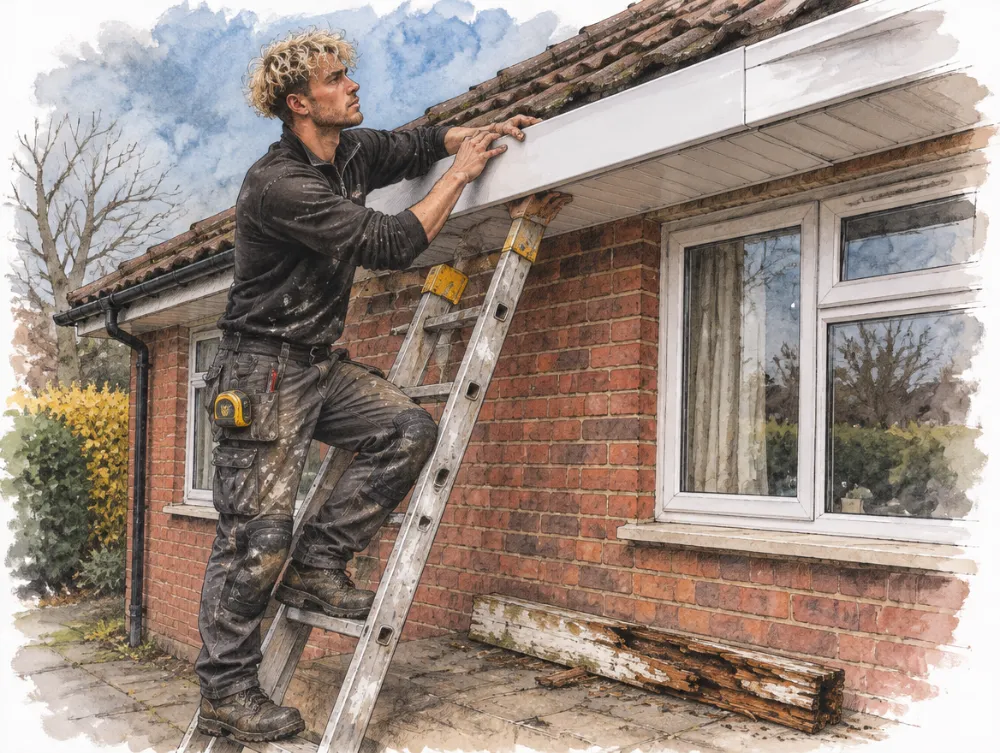
- Fascia: the upright board fixed to the rafter ends along the bottom edge of the roof, which your gutters screw onto.
- Soffit: the flat board underneath, running back from the fascia to the wall and closing off the eaves.
- Bargeboard: the sloping board on a gable end, following the line of the roof.
Between them, they hold up the gutters, keep weather and wildlife out of the roof, and stop the rafter ends rotting.
On older houses they're usually painted timber.
On most houses done in the last 30 years or so, they're uPVC.
How much does fascia and soffit replacement cost in 2026?
It mostly comes down to how many metres of roofline you've got, and that depends on the house.
These are white uPVC fascias and soffits, fitted, VAT included, from Less's guide updated in November 2026.
| Property | Typical roofline | Fascias and soffits | With new guttering |
|---|---|---|---|
| Mid-terrace | 12 to 20m | £1,000 to £2,200 | £1,200 to £2,500 |
| Semi-detached or end-terrace | 20 to 30m | £1,500 to £3,000 | £2,000 to £3,500 |
| Bungalow | 25 to 35m | £1,500 to £3,000 | £1,500 to £4,000 |
| Detached | 30 to 50m | £2,500 to £4,500 | £3,000 to £5,500 |
Less puts the typical semi at about £2,200 nationally.
Bookabuilder's June 2026 guide lands in the same place, at £1,200 to £2,500 for a uPVC semi and £1,800 to £3,500 for fascias and soffits together.
Checkatrade's older guide, last updated in September 2024, had about £2,750 for a small semi without scaffold, so some firms do price higher.
Cost per metre by material
If you know roughly how long your roofline is, per-metre prices are a quick sense check.
| Material or job | Fitted price per metre | Typical lifespan |
|---|---|---|
| Capping over existing timber (uPVC) | £40 to £85 | Depends on the timber underneath |
| uPVC fascia and soffit, full replacement | £80 to £150 | 20 to 35 years |
| Painted timber fascia and soffit | £100 to £200 | 10 to 25 years, repainting every 3 to 5 years |
| Aluminium fascia and soffit | £120 to £220 | 30 to 50 years |
| uPVC bargeboards | £30 to £60 | As uPVC fascias |
| New uPVC guttering and downpipes | £30 to £55 | - |
All of those are from Less's November 2026 guide.
Long straight runs are cheaper per metre than short fiddly ones.
So a porch or bay can work out dearer per metre than the main house.
Can I just replace the fascia, or just the soffit?
You can, and Less gives a rough £40 to £100 a metre for either board on its own.
But it also says few firms price them separately, because the two boards are fixed together and the scaffold costs the same either way.
If it's one short rotten bit, like a corner above a downpipe, and the rest is sound, a repair can be good value.
The extras that move the price
- Scaffold: Less puts it at £600 to £1,000 for a mid-terrace, £700 to £1,200 for a semi, £1,000 to £1,800 for a detached house and up to about £400 for a bungalow, and says about half of installers include it.
- Rotten rafter ends: £100 to £300 for a few, £300 to £800 if there's a lot.
- Coloured or woodgrain boards: 10% to 20% more per metre for black, grey or woodgrain.
- Waste: Bookabuilder says £100 to £300.
- Dry verge at the same time: typically £500 to £1,000 on a semi, according to Less.
On VAT, roofline work is charged at 20%.
Less points out that a sole trader turning over less than £90,000 a year doesn't have to register for VAT, so compare quotes on the final figure you'll actually pay.
Roofz guide
Fascia and soffit replacement costs
What new uPVC fascias and soffits cost in 2026, capping vs full replacement, how long each material lasts, and the checks to make before work starts.
Typical 2026 prices, white uPVC, fitted, inc. VAT
£1,000-£2,200
Mid-terrace
£1,500-£3,000
Semi-detached
£1,500-£3,000
Bungalow
£2,500-£4,500
Detached
Fitted price per metre (top of range)
How long each material lasts (upper figure)
Capping vs full replacement
Capping
- Around £800 on a semi
- About a day
- Thin uPVC over old timber
- Rafter ends not checked
- Only for sound, dry wood
Full replacement
- £1,500 to £3,000 on a semi
- 1 to 3 days
- Old boards removed
- Rot found and repaired
- Best for tired or soft timber
Extras to budget for
- Scaffolding. Up to £400 on a bungalow, £700 to £1,200 on a semi.
- Rotten rafter ends. £100 to £300 for a few, up to £800 for many.
- New guttering. £30 to £55 per metre with downpipes.
- Coloured boards. 10% to 20% more per metre.
- Asbestos test. £25 to £50 for a postal sample.
Check before work starts
- Pre-2000 house? Test old soffits for asbestos
- Bats suspected? Get advice first, roosts are protected
- Active bird nests? Wait until chicks have left
- Eaves ventilation kept or added
- Conservation area or listed? Ask the council
- Scaffold, gutters and VAT included in the quote
Should I cap my fascias or replace them?
Capping, or overboarding, means fixing thin uPVC boards straight over your old timber fascias and soffits.
Bookabuilder notes capping boards are only about 8mm to 10mm thick, so they rely completely on the wood behind them.
Less puts capping at £40 to £85 a metre, roughly 40% to 50% less than full replacement.
MyJobQuote's September 2026 guide gives average capping prices of about £770 for a two-bed terrace, £800 for a three-bed semi, £700 for a bungalow and £1,500 for a four-bed detached house.
| Capping | Full replacement | |
|---|---|---|
| Cost on a semi | Around £800 on average | £1,500 to £3,000 |
| Time on a semi | About a day | 1 to 3 days |
| Old timber | Stays in place, hidden | Removed and checked |
| Rafter ends | Not inspected | Exposed and repaired if needed |
| Best for | Sound, dry timber | Rotten, soft or damaged timber |
Here's the catch.
If it's rotten, it's rotten.
Covering soft timber in plastic just hides the rot while it carries on spreading, and one day the gutter comes away with it.
That's a bodge, however neat it looks from the road.
Any roofer worth having will stick a screwdriver in the old boards before agreeing to cap them, and tell you straight if they're past it.
uPVC, timber or aluminium: which is best?
For most houses, uPVC.
Less gives white uPVC 20 to 35 years, and says white boards usually come with a guarantee of about 20 years.
No painting, and a wipe down now and then is about all it needs.
Painted timber is the traditional option and suits period houses, but Less says it needs repainting every three to five years and lasts 10 to 25 years.
Bookabuilder puts repainting at £300 to £800 a time, and that adds up.
Aluminium lasts longest at 30 to 50 years and looks sharp on modern houses, but it's the dearest.
Signs your fascias and soffits need replacing
You can check most of this from the ground.
- Flaking paint, soft spots or obvious rot on timber boards.
- Boards bowed, cracked or pulling away from the rafters.
- Gutters sagging, dripping at the joints, or pulling off the fascia.
- Water stains or green streaks on the wall just under the eaves.
- Gaps where birds, wasps or squirrels are getting in.
- Damp or mould in the loft near the eaves.
- Old uPVC that's badly discoloured or gone brittle.
If overflowing gutters are the main problem, it might just be a blockage, and our gutter cleaning cost guide says what that should cost.
Checkatrade suggests that if your gutters are more than ten years old, it's worth replacing them at the same time as the fascias.
Want Leo to have a look?
Free survey, one fixed price in writing, and no hard sell. Wisbech, Peterborough and the Fens.
Could my soffits have asbestos in them?
They could, if the house was built or done up before 2000.
Less notes asbestos was banned in 1999, and the HSE lists external soffits as one of the places asbestos insulating board, or AIB, was used.
The HSE also shows asbestos cement used as undercloak under roof overhangs.
The two are treated very differently.
- Asbestos cement: trained workers can usually remove it without a licence, and Less puts removal on a semi at £600 to £1,500 plus scaffold.
- Asbestos insulating board: the HSE says most work to remove AIB has to be done by an HSE-licensed contractor, and Less puts that at £1,500 to £3,500 or more.
The HSE says you can't reliably tell AIB from non-asbestos board by looking at it.
Less says a postal sample test is about £25 to £50, and advises getting it done before anyone cuts, drills or pulls the boards off.
If someone offers to rip out flat soffit boards on a 1960s or 70s house without mentioning asbestos at all, that's a red flag.
Our guide to garage roof replacement covers asbestos cement in more detail.
What about bats and nesting birds?
The Bat Conservation Trust says bats often roost behind soffits and fascias, or use them to get into roosts elsewhere in the roof.
All UK bats are legally protected.
Devon Wildlife Trust's guide to bats in buildings says it's illegal to damage or destroy a bat roost, whether there are bats in it at the time or not.
It lists the gaps behind fascias and bargeboards as places bats use, so if you know or suspect you've got bats, get advice before any work starts.
The Trust says some jobs need a licence, and Natural England gives free advice in England.
Where bats are present, it recommends replacing like for like where you can, and roughening the underside of new uPVC near their way in so they can still grip it.
The National Bat Helpline is 0345 1300 228.
Nesting birds are protected too.
The RSPB says it's an offence under the Wildlife and Countryside Act 1981 to intentionally take, damage or destroy an active wild bird's nest, and you have to let the chicks leave before removing a nest or blocking the way in.
Swifts often get in through rotten soffit boarding, and sparrows through the gap between the tiles and the gutter, which is exactly the area this job covers.
The RSPB suggests waiting until winter, when birds aren't nesting, to close up gaps.
It also notes pigeons can nest all year round.
Will new fascias and soffits affect roof ventilation?
They can, either way.
A lot of older lofts rely on air coming in at the eaves, and solid new soffits fitted without vents can block it off.
Less says over-fascia or soffit vents cost about £5 to £15 a metre and are usually included.
Bookabuilder cites 10mm of continuous eaves ventilation as the norm for a standard cold roof, where the insulation is on the loft floor.
Ask how they'll keep air getting into the loft, especially if you've had condensation, which our guide to roof ventilation explains.
Do I need planning permission or building regs?
Usually not.
Bookabuilder says fascia and soffit replacement is normally permitted development, but planning can apply on listed buildings and in conservation areas, especially swapping timber for uPVC.
It adds that building regs generally aren't needed unless there's structural work, like replacing big sections of rafter.
In a conservation area, check with the council before you commit to uPVC.
Can I do it myself?
On a bungalow or a low extension, a handy DIYer can fit uPVC boards.
The hard bits are working safely at height for a day or more, dealing with rotten rafter ends, and knowing whether the old soffits have asbestos in them before you start pulling.
On a two-storey house it's a scaffold job.
And once the scaffold's paid for, the labour is often the smaller part of the bill.
What happens on the day
A full replacement on a semi is usually one to three days with two of the lads.
- Scaffold or a tower goes up, and the gutters come down.
- The old fascias, soffits and bargeboards come off, once asbestos has been ruled out or dealt with.
- Rafter ends are checked, and rotten ones are cut back and repaired.
- Eaves ventilation goes in, along with eaves protection where the old felt has perished.
- New soffits go on, then the fascias and bargeboards.
- Gutters and downpipes go back up and are checked for fall.
- Everything's cleared up and the old boards are taken away.
How long it takes
Less puts a mid-terrace or bungalow at one to two days, a semi at one to three, and a detached house at two to five.
Capping a semi is usually about a day.
Rotten rafter ends, asbestos or a run of bad weather will add to that, so don't book the decorators for the following morning.
A good firm will tell you up front how long the scaffold is likely to be up, because you'll be living with it.
Fascias and soffits in Peterborough and the Fens
Round here, rooflines take a battering.
The Fens are flat and open, so wind-driven rain comes straight across the fields, and old timber fascias usually rot first on the most exposed side of the house.
Clay soils that shrink and swell don't help, because a bit of movement opens up joints and lets water get behind boards and gutters.
There are plenty of 1960s to 1980s bungalows in Wisbech, March, Whittlesey, Holbeach and Spalding.
Bungalows have more roofline than you'd think, about 25 to 35 metres, but much cheaper scaffold, so the total often ends up close to a semi.
If your ex-council semi or bungalow still has its original timber or flat-sheet soffits, that's exactly where a £25 to £50 asbestos test is money well spent.
Less also says the East of England runs about 5% above the UK average, with a typical semi around £2,300.
Older brick terraces in Peterborough and Wisbech, and houses in conservation areas like Wisbech's Georgian Brinks or Peterborough city centre, may need to keep timber to get past the council.
If you're after fascia and soffit replacement in Peterborough or anywhere in the Fens, get the roofer to check the rafter ends and the soffit material before they price it, not after.
Choosing a roofer for your roofline
Ask every installer the same questions so you're comparing like with like.
- Is this full replacement or capping, and why for my house?
- Does the price include scaffold, gutters, bargeboards, vents and taking the old stuff away?
- Will you check for asbestos before anything comes off?
- What happens if you find rotten rafter ends, and what does that cost?
- Is VAT included, and is the guarantee in writing?
Roofline work is a favourite with doorstep sellers, so read our guide to spotting cowboy roofers before you sign anything.
Leo will look at your fascias, soffits, gutters and verges, tell you straight whether capping will do, and give you one fixed price in writing.
The short version
Expect about £1,500 to £3,000 for uPVC fascias and soffits on a typical semi in 2026, or £2,000 to £3,500 with new gutters.
Capping is much cheaper, but only if the timber underneath is sound.
uPVC lasts 20 to 35 years with next to no maintenance, which is why most people go for it.
Get old soffits tested for asbestos before anyone pulls them off, and get advice first if you think there are bats behind your boards.
Proper job, and you won't think about your roofline again for twenty-odd years.
Questions people ask
How long do uPVC fascias and soffits last?
Typically 20 to 35 years, and white uPVC boards usually come with a guarantee of around 20 years. They need little more than an occasional clean.
Is it worth capping fascias instead of replacing them?
Only if the timber underneath is sound and dry. Capping over soft or rotten wood hides the problem while it gets worse, so it should always be checked first.
How long does fascia and soffit replacement take?
Most terraced houses and bungalows take one to two days, a semi one to three days and a detached house two to five days, depending on the weather and any rot found.
Should I replace my gutters at the same time as fascias?
It usually makes sense, because the gutters have to come down anyway and the scaffold is already paid for. Gutters more than about ten years old are good candidates.
Do old soffit boards contain asbestos?
They can on homes built or refurbished before 2000, as some soffits were made from asbestos insulating board or asbestos cement. A sample test costs around £25 to £50 and should be done before the boards are disturbed.
Do I need planning permission for new fascias and soffits?
Usually not, as it counts as permitted development. Listed buildings and homes in conservation areas may need consent, especially when changing from timber to uPVC.
How much are fascias and soffits in Peterborough?
Less puts a typical semi in the East of England at around £2,300 for uPVC fascias and soffits, slightly above the UK average. Roofz covers Wisbech, Peterborough and the Fens, and gives one fixed price in writing after a free survey.
Sources
- Less - How much does fascia and soffit replacement cost in 2026? (updated 4 Nov 2026)
- Bookabuilder - Fascia replacement cost 2026: uPVC and timber (Jun 2026)
- Bookabuilder - Roof tile ventilation, dry ridge and condensation (Jun 2026)
- MyJobQuote - Capping soffits and fascias cost (updated 17 Sep 2026)
- Checkatrade - How much does fascia and soffit replacement cost? (Sep 2024)
- HSE - Locations of asbestos and taking the right action
- Bat Conservation Trust - Cladding, soffits and fascias
- Devon Wildlife Trust - Bats and Buildings
- RSPB - Birds in the roof
Prices are guide figures from the sources above and vary by job. Your free survey gives one fixed price in writing.