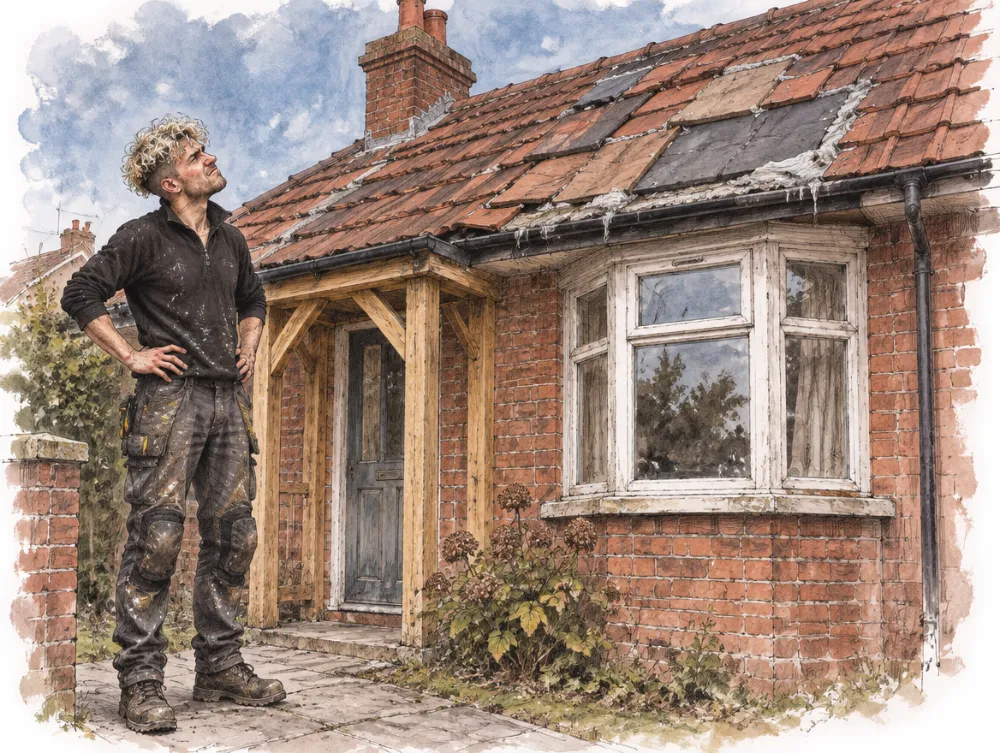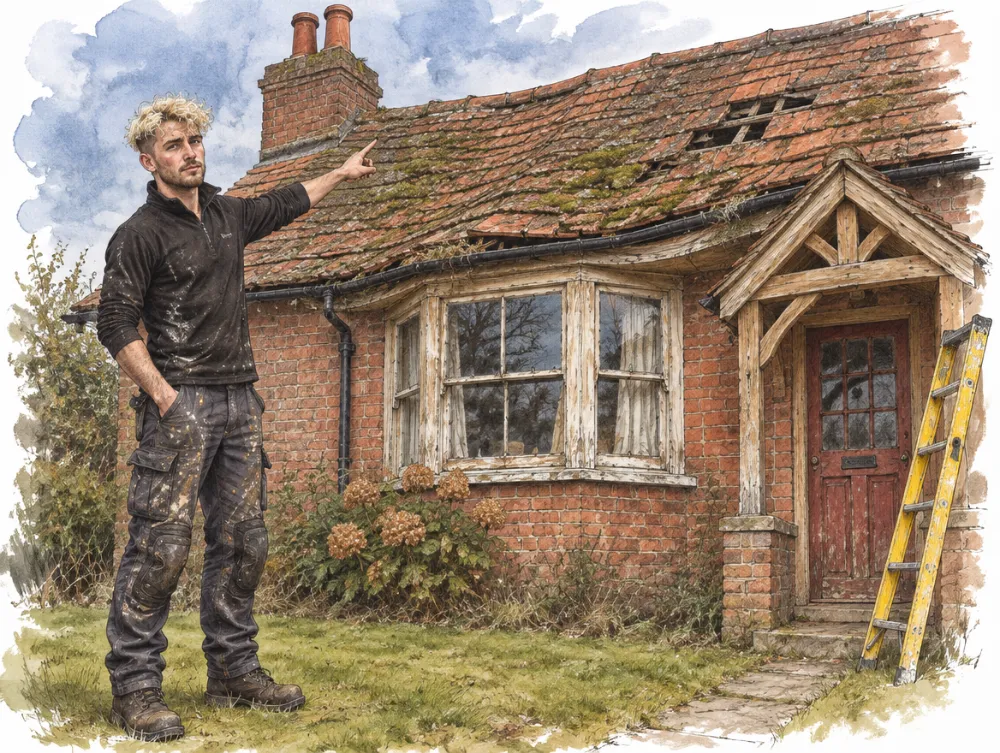
The main signs you need a new roof are daylight or damp showing through the loft, sagging between the rafters, tiles slipping all over the place after every storm, and a roof that's simply reached the end of its life.
One cracked tile or a loose ridge is a repair.
Lots of slipped tiles, rotten felt and soft battens all at once means the roof's worn out, and patching it is throwing good money after bad.
Repairs typically run £300 to £1,800, while a full re-roof on a three-bed semi is somewhere around £7,500 to £14,000 in 2026, depending on the tiles and who's pricing it.
Here's how to tell which side of that line your roof is on.
Signs you need a new roof: the quick checklist
If you can tick three or more of these, it's time to get a proper survey and talk about a re-roof.
- Daylight through the loft on a dry day, which usually means the underlay has failed.
- The roof line sags or dips between rafters when you look along it from the road.
- Tiles slip in every storm, not just one or two in a big blow.
- Damp in the upstairs rooms after rain, coming back again and again.
- Old felt that crumbles or hangs in strips when you touch it in the loft.
- Soft or rotten battens you can push a screwdriver into.
- Ridge tiles loose or missing after the mortar's given up.
- Grit from concrete tiles collecting in the gutters.
- The roof is old, and the tiles, felt or fixings are past their realistic life.
Most of that list comes from Bestbuilders' 2026 guide to roof tile lifespans, and it matches what we see on real roofs.
Why the tiles usually aren't the problem
People look at the tiles and think the roof's fine, but the tiles are normally the last thing to go.
What fails first is the stuff underneath: the felt, the battens, the nails and the mortar.
Bestbuilders puts it plainly: the underlay is the main trigger for re-roofing, and the tiles themselves are the last to fail.
| Part of the roof | Realistic life | What happens when it goes |
|---|---|---|
| Bitumen felt underlay (1960s to 80s) | 30 to 40 years | Tears, sags, lets water and daylight in |
| Modern breathable membrane | 40 to 50 years | Long life if fitted properly |
| Untreated pre-1990s battens | 25 to 40 years | Rot, nails pull out, tiles slip |
| Galvanised nails | From about 30 years in exposed spots | Rust through, tiles slide in storms |
| Mortar on ridges and verges | 15 to 30 years | Cracks and falls out, ridges come loose |
| Concrete interlocking tiles | 40 to 60 years | Surface wears, porous, grit in gutters |
| Machine-made clay tiles | 60 to 100 years | Frost damage, cracking |
| Welsh slate | 100 to 150+ years | Nails fail before the slate does |
Bestbuilders also says exposed sites can knock 25% to 40% off those figures, which matters out here.
Ideal Home's 2025 guide gives similar ballparks: well over 100 years for slate, around 100 for clay and a minimum of 30 for concrete tiles.
For the full breakdown by material, see our guide to how long a roof lasts.
The signs in more detail
Daylight or damp in the loft
Get up in the loft on a bright day with the light off.
If you can see daylight through the felt, or the felt's black, brittle and hanging down, the underlay has had it.
Stains on the timbers, damp insulation and drip marks all point the same way.
Not every damp loft is a roof leak, though, because condensation looks very similar, so check whether it's worse in cold weather than in wet weather.
A sagging roof line
Stand across the road and look along the ridge and the slopes.
Ideal Home's guide notes that a sag or curve in the roof line can mean weakened rafters or trusses.
A slight dip between rafters can be old battens, but a real sag in the middle of a slope needs looking at properly, and soon.
Tiles slipping every time it blows
One tile off after a big storm is normal.
Tiles coming off every winter, in different places, usually means the nails or battens are failing across the whole roof.
That's nail sickness, and putting the odd tile back just moves the problem along a row.
Ridge tiles and mortar
Bestbuilders says mortar bedding on ridges and verges starts cracking and falling out from about 15 years.
On its own that's a repair, with re-bedding at about £5 to £12 per linear metre or a dry ridge conversion at £18 to £28 per metre.
But loose ridges plus rotten felt plus slipped tiles is a worn-out roof, not a ridge problem.
Grit in the gutters
Old concrete tiles shed their surface as they age, and Bestbuilders says you'll typically see that grit in the gutters 35 to 45 years in.
On its own it's cosmetic, but it tells you roughly how old the roof is.
Leaks that keep coming back
If the same room gets damp after every downpour, and it's been "fixed" twice already, the fix isn't working.
Sometimes that's poor repairs, and sometimes the whole underlay is gone and water's finding new routes every time.
Roofz guide
Signs you need a new roof
Repair or replace? The warning signs, what fails first, and what each option costs in 2026
The numbers
£300-£1,800
Typical roof repairs
£7,500-£14,000
Re-roof, three-bed semi, all in
5-10 years
What repairs buy on a tired roof
25-40%
Life lost on exposed sites
What fails first (top of realistic life)
Repair or replace?
Repair it
- Damage in one spot
- Felt sound and dry
- Battens firm
- Only the ridge mortar has gone
- One split flashing
Replace it
- Felt failed across the roof
- Rotten battens, nails letting go
- Tiles slipping every winter
- Sagging roof line
- Same leak patched again and again
Check it yourself, from the ground
- From the road. Look for sagging, gaps and patched tiles.
- With binoculars. Check ridge, verges and chimney flashing.
- In the gutters. Grit, mortar and broken tile.
- In the loft. Daylight, torn felt, stains, damp insulation.
- Upstairs ceilings. Stains, especially round the chimney.
Warning signs checklist
- Daylight through the loft on a dry day
- Roof line dipping or sagging
- Tiles slipping in every storm
- Damp upstairs after rain, again and again
- Crumbling felt in the loft
- Soft or rotten battens
- Loose or missing ridge tiles
- Concrete tile grit in the gutters
Repair or replace: what does each cost?
Price guides don't agree on a full re-roof, mainly because some include scaffolding and some don't.
| Job | Typical cost | Source (2026) |
|---|---|---|
| General roof repairs | £300 to £1,800 | Bestbuilders |
| Re-bed ridge or verge mortar | £5 to £12 per metre | Bestbuilders |
| Convert to dry ridge or verge | £18 to £28 per metre | Bestbuilders |
| Re-lead a patch of flashing | £120 to £320 | Bestbuilders |
| Re-roof, semi-detached, standard hip (no scaffold) | £4,250 to £4,750 | MyJobQuote |
| Re-roof, bungalow, standard hip (no scaffold) | £4,000 to £5,000 | MyJobQuote |
| Re-roof, three-bed semi (all in) | £7,500 to £14,000 | Bestbuilders |
| Front scaffold, six-week hire | £3,750 to £4,950 | MyJobQuote |
Checkatrade's 2026 guide puts the average UK roof installation at around £13,000.
So for a typical semi, you're looking at four figures for the roof itself and a big chunk on top for the scaffold, which is why you should always check a quote says whether scaffolding's in.
Bestbuilders reckons repairs on a tired roof buy you roughly 5 to 10 years.
That's fine if you're moving soon, but if you're staying put, a re-roof usually works out cheaper than a decade of patching.
Full prices by house type are in our guide to how much a new roof costs, and repairs are in our roof repair cost guide.
When a repair is the right call
Not every problem means a new roof, and anyone who says otherwise without going in the loft is guessing.
A repair makes sense when:
- the damage is in one spot, like a few tiles after a storm;
- the felt in the loft is sound and dry;
- the battens are firm;
- the ridge or verge mortar has gone but the rest of the roof is fine;
- a flashing round the chimney has split.
When it's time for a new roof
A re-roof is the right call when:
- the felt has failed across most of the roof;
- the battens are rotten and nails are letting go;
- tiles are slipping in different places every winter;
- the roof line is sagging;
- repairs have been done over and over and it still leaks;
- the roof is near the end of its realistic life anyway.
A full re-roof is usually notifiable building work, and the insulation has to come up to standard, as we explain in our guide to building regulations for a roof replacement.
If you're thinking about solar panels, do the roof first, because Bestbuilders says taking panels off for a re-roof later can add £1,500 to £2,500.
Want Leo to have a look?
Free survey, one fixed price in writing, and no hard sell. Wisbech, Peterborough and the Fens.
Will my insurance pay for a new roof?
Usually not, if the roof's just worn out.
MoneyWeek's 2025 guide says most home insurance policies cover storm damage as long as the structure, such as the roof, has been kept in good condition.
The same guide says many insurers define a storm as gusts of at least 55mph, and may check local wind data before paying out.
So if a gale strips tiles off a sound roof, that's a claim, but if old nails and rotten battens let go in a breeze, expect the insurer to call it wear and tear.
If you think a claim's been turned down unfairly, complain to the insurer first, and then the Financial Ombudsman if that gets nowhere.
How to check your roof yourself, safely
You don't need to go up a ladder to spot most of these signs, and please don't.
- From the road. Look along the ridge and slopes for sagging, gaps and odd-coloured patches where tiles have been swapped.
- With binoculars. Check the ridge, the verges and the flashing round the chimney.
- In the gutters. From the ground, look for grit, bits of mortar and broken tile.
- In the loft. Torch on, light off, on a dry day: look for daylight, torn felt, stains and damp insulation.
- Inside the house. Look for stains on upstairs ceilings and round the chimney breast.
Then get a roofer to look properly before you decide anything.
What to ask if a roofer says you need a new roof
A decent roofer won't mind any of these.
- Have you been in the loft? Nobody can judge the felt and battens from the drive.
- Can you show me photos of the problem? A straight roofer will.
- Could a repair do it, and for how long? Get both prices if it's borderline.
- Is the scaffold in the price? It can add thousands.
- Who's handling building control? It should be agreed before work starts.
- Is it one fixed price in writing, with a guarantee? If not, walk away.
Anyone knocking on your door saying they've "noticed a few loose tiles" and can start tomorrow is a different story, and our guide to cowboy builders explains why.
Roofs in Peterborough and the Fens: what wears them out
Round here, a lot of roofs are hitting the age where the felt and battens give up all at once.
There are a lot of 1960s to 80s bungalows and ex-council semis in Wisbech, March, Whittlesey, Chatteris and Spalding with concrete interlocking tiles on old bitumen felt.
Put that against Bestbuilders' figures of 30 to 40 years for that felt and 40 to 60 for the tiles, and plenty of them are due.
The Fens are flat and open, so the wind has nothing to slow it down, and exposed roofs lose years off their life.
It also means a roof with tired nails will shed tiles in winds a sheltered roof would shrug off.
The clay soils move as they wet and dry, and when a house has moved over the years, it can show up as a kink in the roof line, so we look at the walls as well as the roof.
The older brick terraces in Peterborough and Wisbech often have slate or clay roofs where the slates are fine but the nails have rusted through, and those can sometimes be stripped and relaid rather than replaced.
In Wisbech's Georgian Brinks and Peterborough city centre conservation areas, check with the council before changing the roof covering.
If you're after roofers in Peterborough or a roofer in Wisbech to tell you straight whether it's a repair or a re-roof, that's what the free survey is for, and we cover roofing in the Fens from Ely and Huntingdon up to Holbeach, Long Sutton, King's Lynn and Downham Market.
Summary: signs you need a new roof
The big signs are daylight or damp in the loft, a sagging roof line, tiles slipping every winter, rotten felt and battens, and a roof that's past its realistic life.
One-off damage is a repair, and repairs typically cost £300 to £1,800.
Widespread failure underneath the tiles is a re-roof, which for a typical semi costs somewhere around £7,500 to £14,000 all in.
The tiles are usually the last thing to go, so judge the roof on what's underneath.
If you're not sure which side of the line yours is on, book a free survey and Leo will go in the loft, look at the whole roof and give you one fixed price in writing, whether that's a repair or a new roof.
Questions people ask
How do I know if my roof needs replacing or just repairing?
If the problem is in one spot and the felt and battens in the loft are sound, it's usually a repair. If the felt has failed across the roof, battens are rotten and tiles slip every winter, it's a re-roof.
Can you replace the felt without replacing the tiles?
Only by stripping the tiles off, replacing the battens and underlay, then relaying the tiles. Old concrete tiles often break on removal, so expect to buy some new ones, and on a tired roof it's often better value to re-tile at the same time.
Is daylight in the loft always a problem?
Some older roofs without underlay always showed a bit of light, but on a felted roof daylight through the felt means the underlay has torn or rotted. Get it looked at before the next spell of heavy rain.
Should I re-roof before fitting solar panels?
If the roof is near the end of its life, yes. Taking panels off and refitting them for a re-roof later can add £1,500 to £2,500.
How long does a re-roof take?
MyJobQuote's 2026 guide puts a small terraced house at 2 to 3 days and a semi or detached house at 3 to 5 days, plus time for the scaffold. Weather and any rotten timber can add to that.
Do you check roofs in Wisbech, March and Spalding?
Yes. Roofz covers Wisbech, Peterborough and the Fens, including March, Whittlesey, Chatteris, Spalding, Holbeach, King's Lynn and Ely. The survey is free and you get one fixed price in writing, whether it's a repair or a new roof.
Sources
- Bestbuilders - How long does a roof tile last in the UK? (2026)
- Ideal Home - How often does a roof need replacing? (July 2025)
- MyJobQuote - Roof Replacement Cost (2026)
- Checkatrade - Roof installation cost (2026)
- MoneyWeek - Home insurance and storm damage: the 55mph definition (January 2025)
- Financial Ombudsman Service - Storm damage claim case study
Prices are guide figures from the sources above and vary by job. Your free survey gives one fixed price in writing.