How long does a roof last?
Most pitched roofs last 40 to 100 years, depending on what's on them: concrete tiles typically last 40 to 60 years, clay tiles 60 to 100 years or more, and natural slate 75 to 100 years or more, according to a March 2026 guide from Less.
Flat roofs don't last as long, at roughly 10 to 20 years for felt, 25 to 40 years for fibreglass and 30 to 50 years for EPDM rubber.
The catch is that the bits holding the roof together, like nails, battens, mortar and flashings, usually pack up long before the tiles do.
Here's the lifespan of each material, the parts that go first, what shortens a roof's life, and how to tell if yours is on its way out.
Roof lifespan by material
Every source gives slightly different numbers.
That's because lifespan comes down to quality, how well it was laid, how exposed it is and whether anyone looks after it.
The table uses Less's 2026 ranges, with other published figures next to them so you can see how much they vary.
| Roof covering | Typical lifespan (Less, 2026) | Other published figures |
|---|---|---|
| Natural slate | 75 to 100+ years | 100+ years (Checkatrade, 2024) |
| Clay tiles | 60 to 100+ years | Minimum 60 years (Marley, citing the BRE Green Guide) |
| Zinc or copper | 60 to 80 years | 40 to 70 years for metal (Roofing Superstore) |
| Concrete tiles | 40 to 60 years | At least 30 years (Ideal Home, 2025) |
| Man-made slate | 30 to 50 years | 50 to 60 years (Checkatrade, 2024) |
| EPDM rubber (flat) | 30 to 50 years | 30 to 50 years (Checkatrade, 2026) |
| GRP fibreglass (flat) | 25 to 40 years | Up to 30 years (Checkatrade, 2026) |
| Felt (flat) | 10 to 20 years | 15 to 20 years for torch-on (MyBuilder, 2026) |
Treat these as rough guides, not promises.
Cheap tiles laid badly on an exposed plot won't get near the top of the range.
Good tiles laid properly on a sheltered house can beat it easily.
How long do roof tiles last?
Concrete tiles
Concrete interlocking tiles are on most post-war houses and bungalows.
Less puts them at 40 to 60 years, and Roofing Superstore says makers commonly design them for around 30 years, with plenty lasting a lot longer.
Concrete is porous.
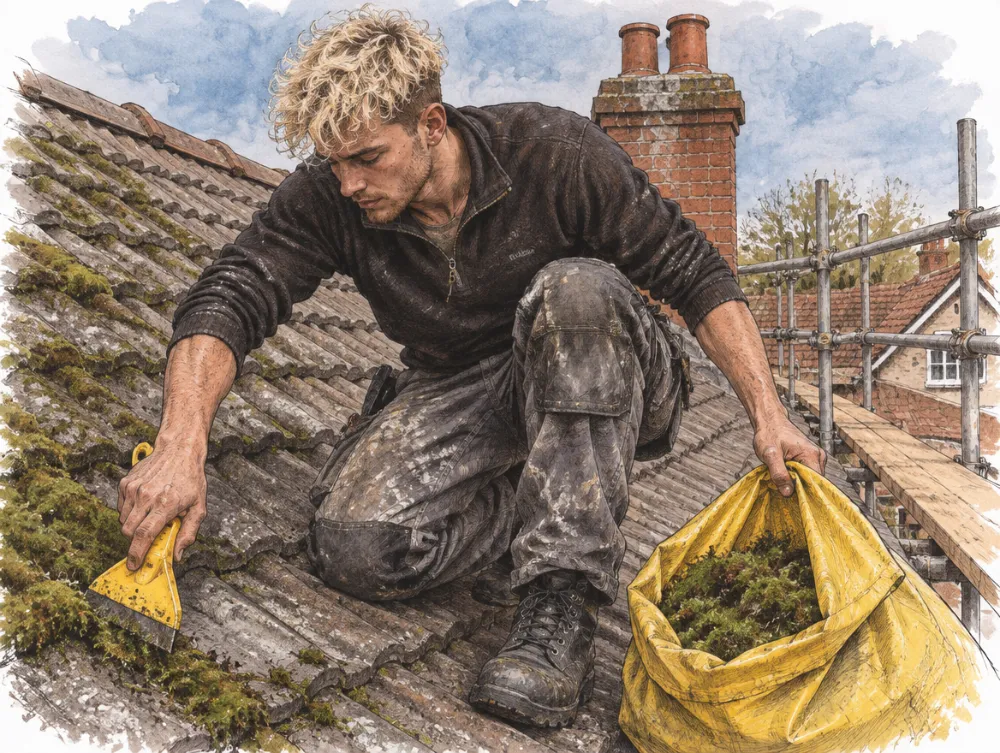
Over the decades the surface wears, the colour goes, and moss gets a grip.
Less points out that moss holds water against the tile, and frost then cracks it.
If your concrete tiles have gone soft, chalky and green, they're telling you something.
Clay tiles
Clay tiles are fired in a kiln, so they're denser and stand up to the weather better than concrete.
Marley says clay tiles have a minimum life expectancy of 60 years under the BRE Green Guide to Specification, and could last a lot longer.
Less gives 60 to 100 years or more.
On older houses, clay tiles often get stripped and reused, because the tiles are still sound when the nails and battens have rotted.
How long does a slate roof last?
Natural slate lasts longest of the lot, with Checkatrade saying it can go 100 years or more if it's looked after.
Less gives 75 to 100 years or more, and Ideal Home's July 2025 guide says well over 100 years.
Quality is everything with slate.
Less warns that poor-quality slate can start flaking within 20 to 30 years.
Good slate goes the distance.
Man-made slates, made from fibre cement or resin, are lighter and cheaper but don't last as long.
Checkatrade reckons 50 to 60 years, while Less says 30 to 50.
Our tile vs slate roof guide goes through the options properly.
How long does a flat roof last?
Flat roofs wear faster, because water sits on them longer and the sun hits them full on.
- Felt: 10 to 20 years according to Less, and 15 to 20 years for a three-layer torch-on roof according to MyBuilder.
- GRP fibreglass: 25 to 40 years according to Less, and up to 30 years according to Checkatrade.
- EPDM rubber: 30 to 50 years according to both Less and Checkatrade.
EPDM is what Roofz specialises in, because it lasts and it goes on cold, with no flame on your roof.
Our EPDM roof cost guide has the prices and how it stacks up against felt and fibreglass.
Roofz guide
How long does a roof last?
Typical lifespans for every common roof covering, the parts that fail first, and how to get the most years from yours.
The headline numbers
75-100+ yrs
Natural slate
60-100+ yrs
Clay tiles
40-60 yrs
Concrete tiles
30-50 yrs
EPDM rubber flat roof
Lifespan by material (top of typical range)
What usually fails first
Fails early
- Ridge and verge mortar
- Rusting nails
- Old bitumen underlay at the eaves
- Flashing wedges and pointing
Built to last
- Good natural slate
- Clay tiles
- Lead sheet itself
- Modern breathable underlay
Make your roof last longer
- Look twice a year. Binoculars from the ground after autumn and after storms.
- Clear the gutters. Overflows rot fascias and back water under tiles.
- Fix small things fast. One slipped tile is cheaper than a wet ceiling.
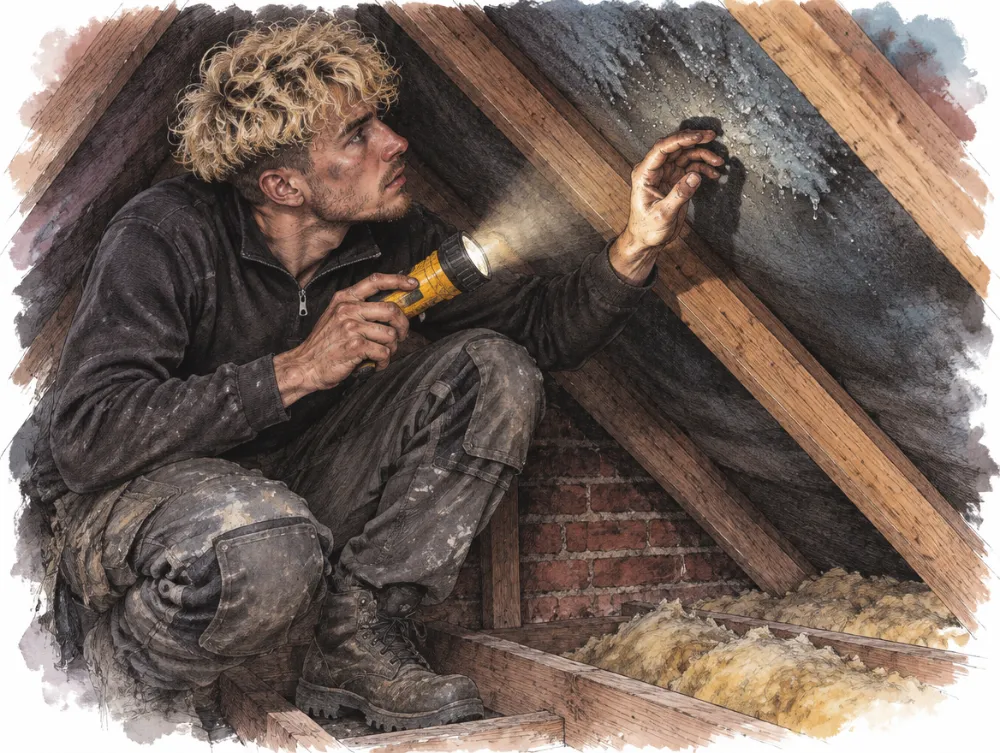
- Check the loft. Daylight, damp and mould are early warnings.
- Treat moss gently. No pressure washers on tiles.
- Get an inspection. Especially when a roof nears its expected age.
Signs the end is near
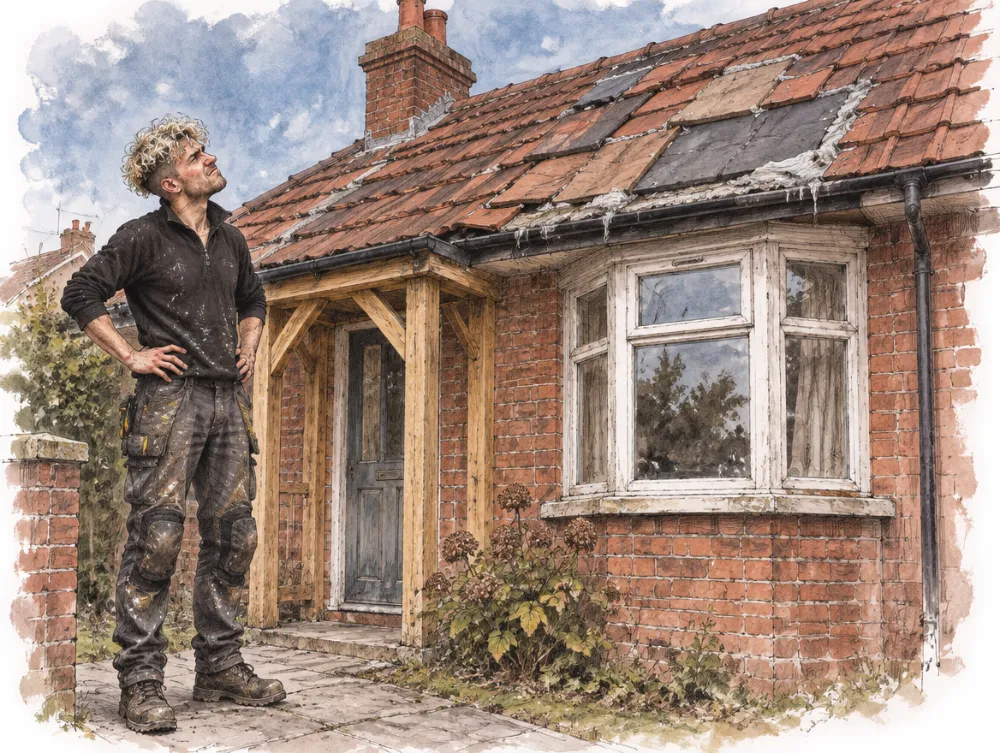
- Slipped tiles in several places
- Soft, flaking or delaminating tiles and slates
- Sagging roofline
- Daylight in the loft
- Repeated leaks in different spots
- Brittle, torn underlay
Which parts of a roof wear out first?
A roof isn't just tiles.
The bits underneath and around them usually go first.
That's why a roof can look fine from the road and still leak.
Ridge and verge mortar
Mortar is often the first thing to fail.
Marley says mortar on ridge and hip tiles can fail, often within the first few years of the roof being finished, because the joints crack and weather, especially where there's movement.
Since the 2014 revision of BS 5534, the code of practice for slating and tiling, mortar alone can't be relied on to hold ridge and hip tiles.
Bedded tiles should have mechanical fixings too.
That's one reason a lot of roofers now fit dry ridge and dry verge systems instead.
See our dry ridge system guide for more.
Nails and battens
Less notes that nails corrode over the decades and timber battens break down.
Once enough nails rust through, tiles and slates start slipping, even though the tiles themselves are fine.
On slate roofs that's called nail sickness, and it's one of the main reasons old slate roofs get stripped and relaid.
Underlay
Modern breathable underlays are made to last as long as the tiles.
The BBA certificate for IKO's breathable membranes, for example, says they'll have a service life comparable to a traditional underlay, as long as they're not left in sunlight for long periods.
The old bitumen felt under a lot of 1960s to 1980s roofs is another story.
It often goes brittle and tears at the eaves, where it's exposed.
Plenty of really old roofs have no underlay at all.
Lead flashings
Lead itself lasts for ages, and the Building Conservation Directory notes lead sheet has been known to last over two hundred years.
Flashings usually fail for other reasons.
Pieces too big, too many fixings so the lead can't move with the heat, or wedges and pointing that work loose.
What shortens the life of a roof?
- Exposure: Less notes that exposed sites take more weather, and wind is murder on loose tiles and badly fixed ridges.
- Poor workmanship: wrong laps, too few fixings and bad detailing knock years off any material.
- Blocked gutters: overflowing water backs up under the tiles and rots the fascias.
- Poor loft ventilation: Less points out condensation can rot battens and timbers from the inside.
- Moss: heavy moss holds water against tiles and fills gutters.
- Overhanging trees: branches scrape tiles, and leaves block valleys and gutters.
- Ignored small jobs: one slipped tile left all winter can let in enough water to rot battens and bring a ceiling down.
- Cheap materials: low-grade slate or thin felt just won't last.
Blocked gutters and poor loft ventilation are two of the cheapest to sort, and both cause damage way out of proportion to the fix.
Want Leo to have a look?
Free survey, one fixed price in writing, and no hard sell. Wisbech, Peterborough and the Fens.
How to make your roof last longer
You can't stop a roof getting old.
You can stop it getting old early.
- Look at it twice a year: after the leaves come down and after the worst storms, use binoculars from the ground to check for slipped tiles, gaps and cracked mortar.
- Keep the gutters clear: it protects the roof edge and the fascias behind.
- Fix small problems fast: a slipped tile is a small job, a soaked ceiling isn't.
- Check the loft: look for daylight, damp patches, drips on the underlay and mould on the timbers.
- Go easy on moss: careful removal is fine, but a pressure washer can wreck tile surfaces.
- Get it inspected: before you buy a house, after a big storm, or when the roof's getting near the end of its expected life.
Don't go up there yourself.
Working at height without the right kit is how a simple job ends in A&E.
Insurance is another reason to stay on top of it.
Tesco Insurance's roof guide, for example, says roof damage caused by wear and tear or lack of maintenance won't be covered by your policy.
Check your own policy wording, because every insurer is different.
How do you know your roof is on its way out?
Age alone doesn't decide it.
Age plus several of these usually does.
- Tiles or slates slipping in several places, not just one.
- Tiles that are soft, flaking, chalky or badly faded.
- Slates flaking into thin layers, which is called delaminating.
- A roofline that dips or sags.
- Daylight through the roof from inside the loft.
- Leaks that keep turning up in different places.
- Torn or brittle underlay hanging down in the loft.
- Rotten battens or timbers.
- Ridge and verge mortar crumbling along the whole length.
One or two of these can usually be repaired.
If the list describes your whole roof, it's time for a new one, and patching it every winter is just throwing money at it.
Our signs you need a new roof guide has a repair-or-replace checklist.
How long do roofs last in Peterborough and the Fens?
Roofs round here take a battering.
The Fens are flat and open, and there's nothing between the weather and your ridge tiles.
That's hard on mortar-bedded ridges and verges, which is why a windy night so often ends with a ridge tile on the lawn.
The villages around Wisbech, March, Chatteris, Whittlesey and Spalding are full of 1960s to 1980s bungalows and ex-council semis, mostly with concrete interlocking tiles.
If concrete tiles typically last 40 to 60 years, a lot of those original roofs are now at the age where they need a proper look.
The same era gave us loads of flat-roof garages, and many are on their third felt covering by now.
The older brick terraces in Peterborough and Wisbech often have natural slate, which can still be sound even when the nails holding it have rusted through.
Wisbech's Georgian Brinks and parts of Peterborough city centre are conservation areas, where like-for-like materials usually matter, so check with the council before swapping slate for something else.
Clay soils across the area shrink in dry summers and swell in wet winters.
If you've got new cracks in the walls as well as roof trouble, get both looked at.
Any good roofer in Wisbech or Peterborough should be able to tell you roughly how much life your roof has left after one visit.
Should you repair or replace an old roof?
Repair it when the tiles are sound and the problem's local, like a few slipped tiles, a cracked ridge or a tired flashing.
Replace it when the tiles or slates are failing across the roof, the underlay's gone, or you're paying for repairs every winter.
With slate and clay, a roofer can often strip the roof, fit new battens and membrane, and relay the good original slates or tiles.
That keeps the look and saves on materials.
Whichever way you go, get the quote in writing and make sure it says what's being replaced, what's being reused and what happens if rotten timber turns up.
If two quotes are miles apart, they're usually not quoting for the same job.
For full replacement prices, see our guide to how much a new roof costs.
Replace enough of a roof and Building Regulations can require insulation upgrades, which a decent roofer will explain up front.
The short version
A roof lasts anywhere from about 10 years for basic felt to well over 100 for good natural slate.
Concrete tiles typically give 40 to 60 years, clay 60 to 100 or more, and EPDM rubber 30 to 50 years on a flat roof.
Mortar, nails, battens and flashings usually go first, so regular checks and quick repairs make the biggest difference.
If your roof's getting on, book a free survey and Leo will tell you straight whether it needs a repair or a new roof, with one fixed price in writing.
Questions people ask
What is the average lifespan of a roof?
For a typical tiled house roof, 40 to 60 years is a fair average for concrete tiles, with clay and natural slate lasting much longer. Flat roofs are shorter-lived, from around 10 to 20 years for felt up to 30 to 50 years for EPDM rubber.
Do I need a new roof after 30 years?
Not necessarily. A concrete tile roof at 30 years is often still serviceable, and clay or slate roofs are only part-way through their life, but the ridge mortar, nails and underlay may need attention.
Can you just replace the battens and underlay and keep the old tiles?
Often, yes, especially with natural slate and clay tiles, which are frequently sound when the fixings have failed. The roof is stripped, new battens and membrane are fitted, and the good tiles or slates are relaid with replacements for any that are damaged.
How often should a roof be inspected?
A look from the ground twice a year and after big storms is sensible, with a professional inspection if you spot problems or the roof is nearing its expected age. Flat roofs benefit from a check every two to three years.
Does a roof last longer in a sheltered area?
Generally yes, because wind, driving rain and frost are what wear roofs out. Exposed sites like the open Fens are harder on ridge mortar, verges and loose tiles than a sheltered town street.
Is a slate roof worth it for longevity?
Good natural slate is the longest-lasting common roof covering and can exceed 100 years, but it costs more and quality varies, as poor slate can flake within 20 to 30 years. Our tile vs slate guide covers the trade-offs.
How long do roofs last on Fenland bungalows?
Most 1960s to 1980s bungalows around Wisbech, March and Spalding have concrete tiles, which typically last 40 to 60 years, so many original roofs are now due a proper check. Roofz covers Wisbech, Peterborough and the Fens and the survey is free.
Sources
- Less - How long does a roof last? A realistic guide (28 March 2026)
- Ideal Home - How often does a roof need replacing (8 July 2025)
- Roofing Superstore - How long do roofs last
- Marley - What is the life expectancy of roof tiles
- Checkatrade - Slate vs tile roof (updated November 2024)
- Checkatrade - Flat roof replacement costs (updated February 2026)
- MyBuilder - Roof re-felt cost price guide (2026)
- Marley - Should I use mortar or dry fix for my ridge and hip tiles
- IKO - BBA certificate 07/4457 Rubershield breathable underlays
- Building Conservation Directory - Repairs to lead sheet roofing and flashings
- Tesco Insurance - Roof maintenance tips
Prices are guide figures from the sources above and vary by job. Your free survey gives one fixed price in writing.