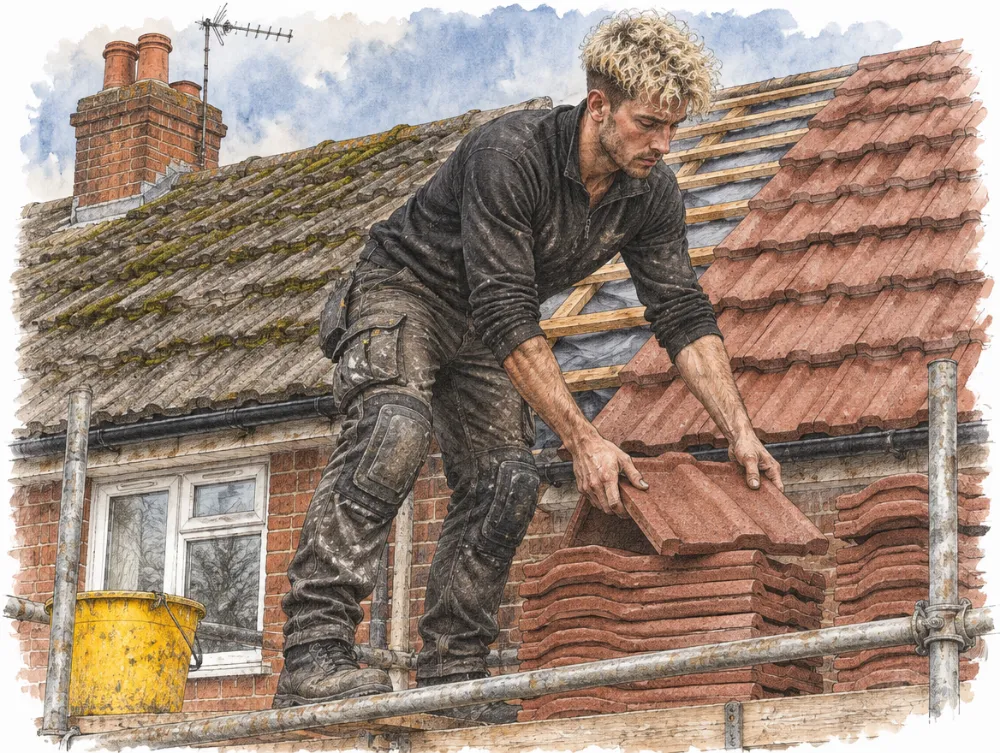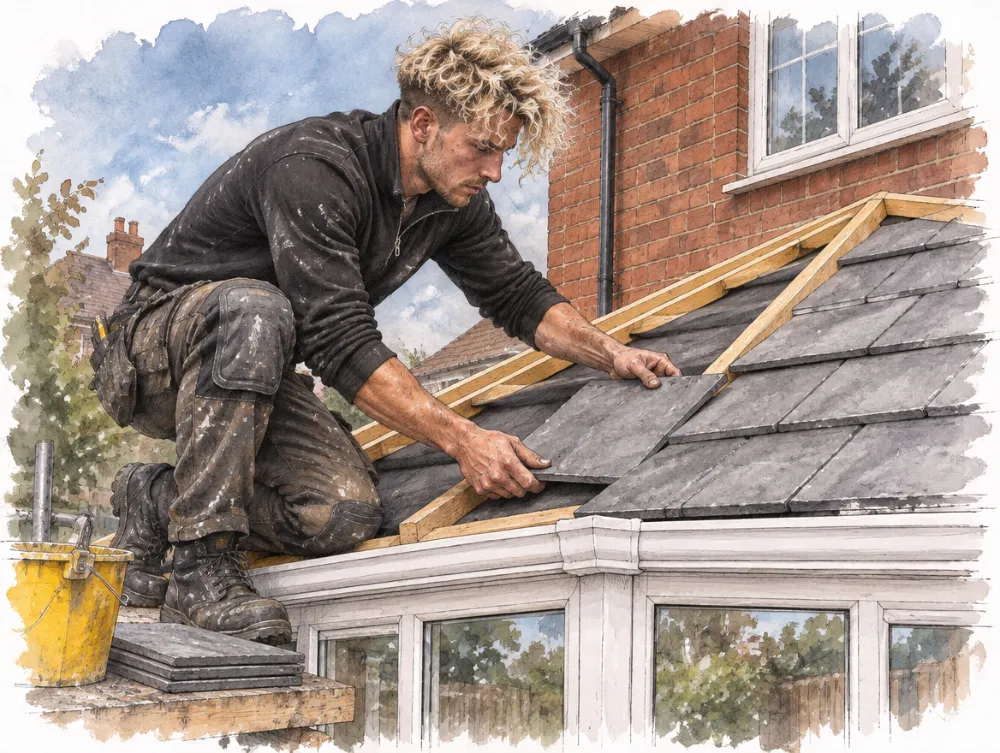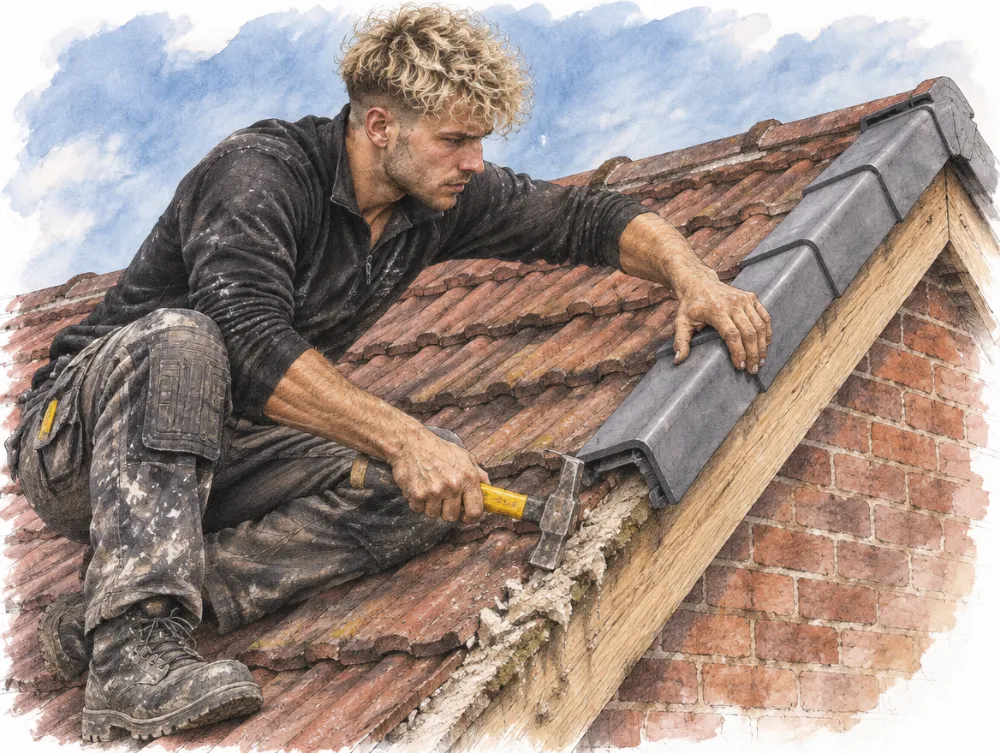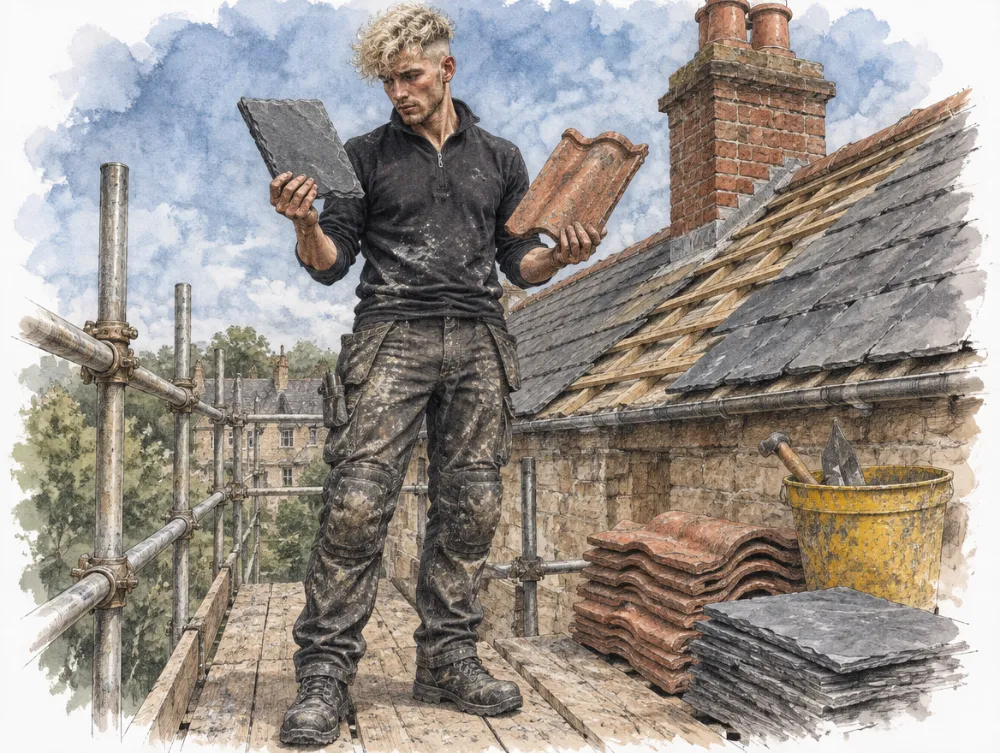
Tile vs slate roof comes down to money against lifespan.
Concrete tiles are the cheapest at about £40 to £70 per square metre fitted, clay tiles run about £60 to £100, and natural slate costs about £100 to £180 depending on where it's quarried, according to MyBuilder's 2026 price guide.
Good natural slate can last 100 years or more, while concrete tiles typically give 30 to 60 years and clay sits somewhere in between.
Man-made slate is the halfway house, with the slate look at about £70 to £100 per square metre but a much shorter life than the real thing.
Here's how the four options compare on cost, lifespan, weight and looks, plus the rules on swapping one for another.
Tile vs slate roof: the quick comparison
| Material | Fitted cost per m² (2026) | Typical lifespan | Good for |
|---|---|---|---|
| Concrete tiles | £40 to £70 | 30 to 60 years | Tight budgets, post-war houses and bungalows |
| Clay tiles | £60 to £100 | 40 to 100+ years | Older brick houses, character and colour |
| Man-made slate | £70 to £100 | 30 to 60 years | The slate look for less |
| Spanish slate | £100 to £130 | 75 to 100 years | Natural slate at a middle price |
| Welsh slate | £140 to £180 | 100+ years | Period homes and conservation areas |
Costs are from MyBuilder's 2026 slate roof price guide.
Lifespans are ranges across MyBuilder, Less (2026) and Checkatrade, because every source gives slightly different numbers.
Checkatrade's 2024 guide gives higher prices across the board, at £160 to £275 per square metre for slate and £110 to £230 for tiles, which shows how much quotes can vary.
Prices vary by region, roof shape and access, so treat them as a guide.
The free survey gets you one fixed price in writing for your roof.
Concrete tiles
Concrete interlocking tiles are on most houses built since the war.
They're cheap, quick to lay, and come in loads of colours and profiles.
Marley points out concrete tiles are cheaper to make, fit and maintain, and easier and cheaper to repair than slate.
The downside is lifespan.
MyBuilder puts concrete tiles at 30 to 50 years and Less at 40 to 60.
Concrete is porous, so over time the surface wears, the colour fades and moss moves in.
Checkatrade notes tiles can crack under impact and in freeze-thaw weather.
That said, a concrete tile roof laid properly and looked after is a perfectly good roof.
Clay tiles
Clay tiles are fired in a kiln, so they're denser and hold their colour better than concrete.
Plain clay tiles and pantiles have been used on English houses for centuries and suit older brick properties.
Marley says clay tiles are better insulators than slate and easier to recycle and reuse at the end of their life.
Lifespan figures vary a lot.
MyBuilder says 40 to 60 years, while Less says 60 to 100 years or more.
The difference comes down to quality, because a good handmade clay tile can outlast the nails and battens holding it several times over.
On old roofs, sound clay tiles often get stripped, stacked and relaid on new battens.
Natural slate
Natural slate is split stone, so it doesn't soak up water and the sun doesn't fade it.
Marley says slate can last up to 150 years and copes well with freezing weather.
Checkatrade says 100 years or more if it's looked after.
Marley also notes slate has lower embodied carbon than tiles, because it's quarried and split rather than manufactured.
Not all slate is equal
Where the slate comes from matters a lot, both for price and for how long it lasts.
- Welsh slate: about £140 to £180 per square metre fitted, and MyBuilder says it regularly lasts over a century.
- Spanish slate: about £100 to £130, with a lifespan of 75 to 100 years according to MyBuilder.
- Brazilian slate: about £95 to £125.
- Chinese slate: about £80 to £110, with a shorter lifespan than Welsh or Spanish.
- Reclaimed slate: about £110 to £150, handy for matching an old roof.
All those prices are from MyBuilder's 2026 guide.
Less warns that poor-quality slate can start flaking within 20 to 30 years.
Cheap slate is a false economy.
The downsides of slate
- Cost: it's the dearest of the four, and Marley notes it's dearer to buy, fit and repair.
- Labour: MyBuilder says labour is typically 50 to 60% of the total cost, because slating is slow, skilled work.
- Colour: it's grey, more or less, and Marley calls it limited to deep grey tones.
- Nails: Checkatrade notes the nail fixings can corrode and often need replacing before the slates do.
- Weight: slate is heavier than clay tile, according to Checkatrade, and Marley says it often needs a reinforced structure.
Roofz guide
Tile vs slate roof
Concrete tiles, clay tiles, man-made slate and natural slate compared on 2026 price, lifespan, repairs and the rules on switching.
Fitted cost per m² in 2026 (top of range)
Typical lifespan (top of range)
Whole roof in Spanish slate (2026)
£5,000-£8,000
Terraced house
£5,500-£9,000
Bungalow
£7,000-£12,000
Semi-detached
£10,000-£18,000
Detached
Tiles vs natural slate
Tiles
- £40-£100 per m²
- Loads of colours and profiles
- Can go as low as 15° pitch
- Quicker to lay
- Easier and cheaper to repair
Natural slate
- £100-£180 per m²
- Grey tones only
- Needs at least 25° pitch
- Slow, skilled work
- Can last 100 years or more
Switching material? Check first
- Building Regulations approval is likely
- Structural check if over 15% heavier (East Suffolk example)
- Roof pitch suits the new covering
- Insulation upgrade included
- Conservation area or listed building rules
- Wisbech and Bowthorpe Article 4 Direction
Man-made slate
Man-made slates are made from fibre cement or concrete and look like slate from the road.
MyBuilder puts them at about £70 to £100 per square metre fitted, and says choosing synthetic slate knocks roughly 20% off a whole-roof price.
They're uniform, light and quick to fix.
The trade-off is life.
Less gives 30 to 50 years and Checkatrade 50 to 60, against 100 years or more for good natural slate.
Weight varies by product.
Marley's Edgemere concrete slates are about 44kg per square metre, which Marley says isn't that different from natural slate.
What does a whole roof cost in tile or slate?
MyBuilder's 2026 guide gives whole-roof prices using Spanish slate as the benchmark.
| Property | Spanish slate roof (2026) |
|---|---|
| Terraced house | £5,000 to £8,000 |
| Bungalow | £5,500 to £9,000 |
| Semi-detached house | £7,000 to £12,000 |
| Detached house | £10,000 to £18,000 |
MyBuilder says Welsh slate adds roughly 20 to 30%, and synthetic slate takes off about 20%.
Concrete and clay tiles come in lower again, because the materials are cheaper and they go on faster.
On top you've got scaffold, stripping the old roof, new battens and membrane.
MyBuilder puts strip-out and disposal at about £400 to £600 and new roof membrane at about £20 to £40 per square metre.
Our guide to how much a new roof costs breaks it down by house type.
Which is easier to repair, tile or slate?
Tiles, nearly always.
Marley and Checkatrade both say tiles are easier and cheaper to repair than slate.
A broken concrete tile usually just gets lifted out and a matching one slotted in.
A slipped slate is fiddlier, because the nail holes are hidden under the slates above, so it usually gets held with a metal strip or clip known as a tingle.
Checkatrade puts slate roof repairs at around £150 to £220 per square metre for larger areas.
Matching matters too, because a bright new slate in an old weathered roof sticks out a mile, which is where reclaimed slate earns its keep.
Our guide to the cost to replace roof tiles covers repair prices in more detail.
Weight, pitch and structure
Don't just swap one covering for another.
The roof has to be able to take it.
Checkatrade says slate is heavier than clay tile but can be comparable to concrete, and recommends a structural check before fitting either.
Pitch matters too.
Checkatrade notes tiles can go on pitches as low as 15 degrees, while slate needs at least 25 degrees.
Exact limits depend on the product, the size of slate and how exposed the roof is, so the manufacturer's figures are what count.
A shallow roof built for interlocking concrete tiles may not suit slate at all.
Want Leo to have a look?
Free survey, one fixed price in writing, and no hard sell. Wisbech, Peterborough and the Fens.
Do you need permission to change from tile to slate, or slate to tile?
Often, yes.
The Planning Portal says re-covering a roof will in most cases need Building Regulations approval, and switching to a different material, like slate to tiles, is one of the times it's likely to apply.
It also says to get a structural engineer or surveyor to check if the new covering is significantly heavier or lighter than the old one.
East Suffolk Council's guidance, for example, uses a 15% limit, so a new covering more than 15% heavier than the original needs a structural engineer to confirm the roof can take it.
Your local building control may set things out differently, so check.
The Planning Portal adds that re-covering a roof should include improving its insulation.
In conservation areas and on listed buildings, planning rules can apply too, so changing slate to concrete tiles on a period house may not be allowed.
See our guide to building regulations for roof replacement for the full picture.
Tile vs slate roofs in Peterborough and the Fens
Round here, what's on your roof mostly comes down to when the house was built.
The 1960s to 1980s bungalows and ex-council semis across Wisbech, March, Whittlesey, Chatteris and Spalding are mostly concrete interlocking tiles.
Many of those are now at the age where they need a proper look, and for most of them like-for-like concrete tiles are the sensible, affordable choice.
The older brick terraces in Peterborough and Wisbech often have natural slate, and some have clay tiles or pantiles.
On those, the slate itself is often still sound even when the nails have rusted through, so stripping and relaying with some reclaimed slate can be a proper job at a fair price.
Conservation areas need extra care.
Fenland District Council's Article 4 Direction for the Wisbech and Bowthorpe conservation areas, which takes in the Georgian Brinks, removes automatic permission for things like changing a roof or taking down a chimney stack.
Parts of Peterborough city centre are also conservation areas, so check with Peterborough City Council before changing materials.
Then there's the weather.
The Fens are flat and open, and wind across the fields is what lifts loose tiles and strips ridges.
Whatever you choose, it needs fixing properly for an exposed site, with every tile or slate nailed or clipped as the manufacturer specifies.
Clay soils that shrink and swell can also move walls a bit, and a dipping roofline on an old terrace is sometimes the walls talking, not the roof.
If you're after roofers in Peterborough or a roofer in Wisbech who'll tell you straight which material suits your house, Roofz covers the city and the Fens, out to King's Lynn, Downham Market, Ely, Huntingdon and Stamford.
Which should you choose?
- Pick concrete tiles if budget matters most, the house was built with them, and you're happy with 30 to 60 years.
- Pick clay tiles if you want colour and character, especially on an older brick house, and can stretch the budget a bit.
- Pick man-made slate if you want the slate look on a modern house for less, and accept a shorter life.
- Pick natural slate if the house already has it, you're in a conservation area, or you plan to stay long enough to get the value out of it.
Matching what the house was built with is usually right, because the roof structure was designed for it.
Whatever goes on top, the membrane and battens underneath matter just as much, so see our breathable roof membrane guide.
For lifespans of every roof type side by side, see how long a roof lasts.
Questions to ask your roofer
- Exactly which tile or slate are you quoting, and where is it made or quarried?
- Can any of the existing tiles or slates be reused?
- Is the roof structure suitable for the new covering, or does it need checking?
- Does the job need Building Regulations approval, and who's sorting it?
- Does the price include new battens, membrane, ridge and verge?
- What guarantee do I get, and does the manufacturer give one too?
If a roofer can't tell you where the slate comes from, that's a red flag.
The short version
Tile vs slate roof is a trade between upfront cost and lifespan.
Concrete tiles are cheapest at about £40 to £70 per square metre in 2026, clay tiles about £60 to £100, and natural slate about £100 to £180.
Good natural slate can last over 100 years, but it's heavier, slower to lay, and needs the right pitch.
Changing material often needs Building Regulations approval, and in conservation areas like Wisbech's Brinks it may need planning permission too.
Book a free survey and Leo will tell you which suits your house, with one fixed price in writing and a written guarantee.
Questions people ask
Is slate more expensive than tiles?
Yes. MyBuilder's 2026 guide puts natural slate at about £100 to £180 per square metre fitted, against £40 to £70 for concrete tiles and £60 to £100 for clay. Slate also takes longer to lay, which adds labour.
Can I put slate on a roof that had concrete tiles?
Sometimes, but the roof pitch and structure have to suit it, and it will usually need Building Regulations approval. Slate generally needs a steeper pitch than interlocking tiles, so a shallow tiled roof may not be suitable.
Is man-made slate any good?
It is a decent budget option if you want the slate look, and it is uniform and quick to fit. Expect roughly 30 to 60 years rather than the century or more good natural slate can manage.
Which is better in high winds, tile or slate?
Both cope well if they are fixed properly, which is what really matters on exposed sites. Current British Standards call for mechanical fixings, so every tile or slate should be nailed or clipped as the manufacturer specifies.
Can old slates be reused on a new roof?
Often, yes. If the slates are sound and it was the nails that failed, they can be stripped, sorted and relaid on new battens and membrane, topped up with reclaimed slate where needed.
Do you fit slate and tile roofs in Wisbech and King's Lynn?
Yes. Roofz covers Wisbech, Peterborough and the Fens, including March, Whittlesey, Chatteris, Ely, Spalding, King's Lynn, Downham Market, Stamford and Huntingdon, with a free survey and one fixed price in writing.
Sources
- MyBuilder - Slate roof cost price guide (2026)
- MyBuilder - Tile vs slate
- Marley - Tile roofs vs slate roofs (July 2026)
- Checkatrade - Slate vs tile roof (updated November 2024)
- Less - How long does a roof last? (March 2026)
- Marley - If fibre cement slates are too light, can concrete slates replace them?
- Planning Portal - Building Regulations: re-roofing
- East Suffolk Council - Replacing your roof covering and roof repairs
- Fenland District Council - Article 4 Direction: household extensions and alterations in Wisbech and Bowthorpe conservation areas
- Marley - Should I use mortar or dry fix for my ridge and hip tiles (BS 5534 fixings)
Prices are guide figures from the sources above and vary by job. Your free survey gives one fixed price in writing.