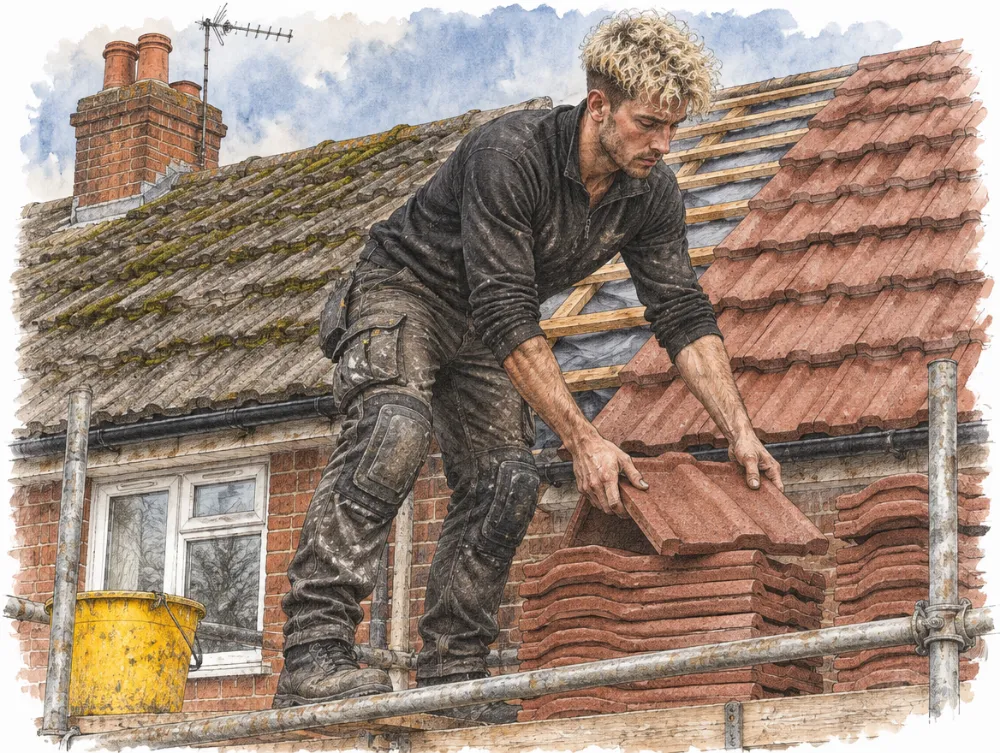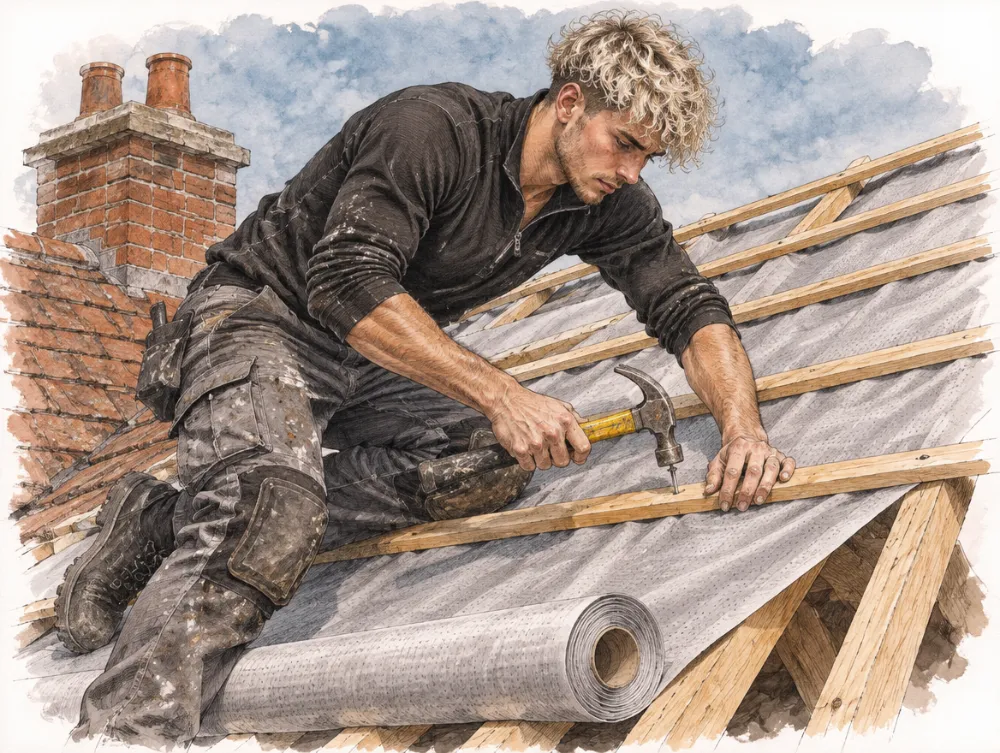
A breathable membrane on a roof is the waterproof sheet that sits under your tiles or slates, keeps out rain that blows under them, and lets damp air from the house escape.
It's the modern replacement for old black bitumen roofing felt, which keeps water out but traps moisture in.
The membrane itself is cheap, at roughly £4 to £10 per m² in 2026 against £3 to £6 for felt.
Fitting it is the expensive bit, because every tile has to come off first.
Re-felting a typical semi with new battens and a breathable membrane is usually somewhere around £2,500 to £7,300, depending on scaffold, timber and whether the tiles go back on.
This guide explains what a breathable roof membrane does, felt versus membrane, what re-felting costs, and how to tell if yours needs doing.
What is a breathable membrane on a roof?
It's a thin, tough synthetic sheet, usually polypropylene, laid over the rafters before the battens and tiles go on.
Tiles and slates aren't fully watertight on their own.
Wind drives rain and snow up under them, so the membrane is the second line of defence.
The "breathable" bit means it's vapour permeable.
Water won't get through it, but water vapour can.
So warm, damp air rising from the house into the loft can get out instead of condensing on the timbers.
It sits on the cold side of the insulation, with any vapour control layer on the warm side underneath.
Trade names you'll hear include breather membrane, vapour permeable underlay, LR underlay and roofing membrane.
They all mean much the same thing.
Felt vs breathable membrane: what's the difference?
Old bitumen felt is a high resistance (HR) underlay.
It keeps water out, but it doesn't let vapour through, so the loft has to be well ventilated to stop condensation.
A breathable membrane is low resistance (LR), so moisture can pass through it and out between the tiles.
| Bitumen felt (HR) | Breathable membrane (LR) | |
|---|---|---|
| Material cost per m² (2026) | £3 - £6 | £4 - £10 |
| Lets vapour out | Poorly | Yes |
| Loft ventilation needed | High | Reduced, but usually still some |
| Typical lifespan under tiles | 20 - 30 years | 25 - 50 years, depending on grade |
| Weight | Heavy rolls | Light and easy to handle |
| Common on | Roofs from the 1960s - 1990s | Most new roofs and re-roofs today |
Breathable membranes come in different grades, and manufacturers' warranties typically run 10 to 30 years.
Felt is still sold and still has a place on a properly ventilated cold roof.
But on most re-roofs now, a breathable membrane is the sensible choice for the small extra cost.
Does a breathable membrane mean you don't need roof ventilation?
Usually not, and this is where a lot of jobs go wrong.
Marley warns that vapour permeable underlays are often wrongly used as the only means of ventilating a roof.
NHBC standards, based on BS 5250, still set eaves ventilation for most cold roofs with an LR underlay.
For a typical pitched roof that's around 7,000 mm² per metre at the eaves with an LR membrane, against 10,000 mm² per metre with old HR felt.
NHBC only allows a cold roof with no ventilation at all when the membrane is a certified air-permeable type that meets strict test figures.
So a breathable membrane cuts the ventilation you need, it doesn't cancel it.
Stuffing insulation into the eaves and blocking the airflow is a bodge, membrane or not.
Our guides to roof ventilation and condensation in the loft go into this properly.
Roofz guide
Breathable roof membrane vs old felt
What the membrane under your tiles does, what re-felting costs in 2026, and the signs your felt has had it.
The headline numbers
£4-£10
Breathable membrane per m²
£3-£6
Bitumen felt per m²
£2,500-£7,300
Typical re-felt on a semi
3-5 days
Typical time for a semi
Where the money goes: semi re-felted in membrane (bar = top of range)
How long they last under tiles (bar = top of range)
Felt or membrane?
Bitumen felt (HR)
- Keeps water out
- Traps vapour
- Needs plenty of loft ventilation
- Eaves vent about 10,000 mm²/m
Breathable membrane (LR)
- Keeps water out
- Lets vapour escape
- Less ventilation, not none
- Eaves vent about 7,000 mm²/m
Fitted properly
- Eaves tray into the gutter first
- Overlap the tray by at least 150mm
- Drape 10-15mm between rafters
- Lap each course with a batten under the lap
- Valleys 300mm each side, walls turned up 100mm
- Ridge cut back for a vent, or lapped over
- Battens and tiles fixed to BS 5534
Signs your felt has had it
- Sagging badly between rafters
- Brittle, torn or cracking
- Rotted away at the eaves
- Daylight showing through
- Damp rafters or battens
- Musty smell or mould in the loft
How much does re-felting a roof with breathable membrane cost?
There's no proper way to swap the underlay without stripping the tiles.
Every tile comes off, the old felt and battens are stripped, new membrane and battens go on, then the tiles go back.
That's most of the work of a re-roof, which is why the price is mostly labour and scaffold.
| Item (typical semi, 2026) | Bitumen felt | Breathable membrane |
|---|---|---|
| Materials | £300 - £600 | £500 - £1,000 |
| Labour | £1,200 - £2,000 | £1,400 - £2,200 |
| Scaffolding | £800 - £1,500 | £800 - £1,500 |
| New battens | £800 - £1,500 | £800 - £1,500 |
| Waste removal | £200 - £500 | £200 - £500 |
| Typical extras | Ventilation £300 - £800 | Detailing tapes £200 - £600 |
| Total | £3,300 - £6,900 | £3,900 - £7,300 |
Those figures come from one 2026 guide.
Others land in the same area, with full re-felts on an average semi quoted at £2,000 to £7,300 and £2,500 to £5,000.
One 2026 guide reckons going for a breathable membrane instead of felt adds about £500 to £1,500 to a re-roof.
A small patch of felt, say round a leak at the eaves, is more like £200 to £250.
What pushes the price up
- Rotten timber. If it's rotten, it's rotten. Rafter repairs can add £2,000 to £5,000.
- Broken tiles. Old concrete and clay tiles don't all survive coming off, and you may need replacements or reclaims.
- Scaffold. Tall houses, awkward access and pavement licences all add up.
- Ridges and verges. Switching to dry fix while the roof's open is common and worth it.
- Chimneys and lead. Flashings often need redoing when the underlay changes.
A semi usually takes around 3 to 5 days, weather permitting.
A decent roofer will sheet the roof at the end of each day, so an open roof isn't left to the weather overnight.
Re-felt or new roof?
If the tiles are sound, re-using them saves serious money.
If they're crumbling, sliding or a profile you can't match, it often makes more sense to put new tiles on while the roof's stripped anyway.
See how much a new roof costs for that side of it.
Want Leo to have a look?
Free survey, one fixed price in writing, and no hard sell. Wisbech, Peterborough and the Fens.
Can you replace roof felt without taking the tiles off?
Not properly, no.
The felt sits under the battens, and the tiles hang on the battens, so every tile has to come off to get at it.
Anyone offering to "re-felt" a pitched roof from inside the loft for a few hundred quid isn't doing the same job.
It might patch a hole, but it won't give you a new underlay.
If someone pitches a quick fix like that on your doorstep, get a second opinion first.
How long does a breathable membrane last?
Longer than felt, if it's fitted right and kept out of the sun.
2026 guides give anything from 25 to 50 years depending on grade, against 20 to 30 years for bitumen felt.
UV light is what kills underlays, which is why the strip at the eaves rots first and why eaves trays matter.
Under sound tiles, the membrane should outlast the battens on most roofs.
Signs your roof felt needs replacing
Go in the loft with a torch and look at the underside of the felt.
- Felt sagging badly between the rafters
- Felt that's brittle, torn or cracking
- Daylight showing through
- Felt rotted away at the eaves, often where it dips into the gutter
- Damp patches or water stains on the rafters and battens
- Musty smell, mould or black spotting in the loft
- Drips on the insulation after heavy rain
One or two of these on an old roof doesn't always mean a full re-felt.
A torn bit at the eaves can often be sorted with a new eaves support tray and a patch.
But if the felt's gone brittle all over and the tiles are slipping too, patching is just throwing money at it.
Our guide to replacing roof tiles covers the smaller repairs.
How a breathable membrane should be fitted
The membrane's only as good as whoever's fitting it.
Roofing Superstore's installation guide sets out the basics.
- Eaves tray first. An eaves support tray or UV-resistant strip goes in, running into the gutter, so the membrane doesn't rot at the edge.
- Lay it along the eaves. Printed side out, overlapping the tray by at least 150mm.
- Leave a drape. About 10 - 15mm of sag between rafters or counter battens, so any water runs down to the gutter.
- Proper laps. Each course overlaps the one below by the manufacturer's figure, with a batten under the lap.
- Valleys and walls. At least 300mm each side of a valley centre, and turned up at least 100mm against walls.
- Ridge. Cut back each side if there's a ridge vent, or lapped over the top if there isn't.
- Battens and tiles. New graded battens, then tiles fixed to BS 5534.
Wind uplift and ballooning
BS 5534 was amended to deal with membranes "ballooning", where air pressure pushes the membrane up against the tiles and can lift them.
Manufacturers have to state which UK wind zones their membrane suits.
Roofing Superstore also flags higher pressure on garages and carports, coastal sites and sites over 100m above sea level.
So the right grade for your house and exposure matters, not just the cheapest roll at the merchant's.
Do you need building regulations to re-felt a roof?
Often, yes, because re-felting means re-covering the whole roof.
The Planning Portal says building control approval isn't normally needed for repairs or re-covering if less than 25% of the building envelope and less than 50% of the roof is affected.
Go over that and approval is likely needed, and you may have to bring the roof insulation up to current standards.
It's also needed if the new covering is 15% or more heavier, or the fire performance changes significantly.
Ask your roofer who's handling building control before the scaffold goes up.
Keep the paperwork when it's done, because a buyer's solicitor may ask for it when you sell.
Our guide to building regulations for roof replacement covers it in more detail.
Re-felting and roofing in Peterborough and the Fens
A lot of the roofs we see round here are right at the age where the felt gives up.
There are loads of 1960s to 1980s bungalows, ex-council semis and estate houses across Wisbech, March, Whittlesey, Chatteris and Ely, most roofed with concrete tiles over bitumen felt.
Twenty to thirty years is a fair life for that felt, and plenty of it is well past that now.
The usual story is felt rotted at the eaves where it's dipped into the gutter, with damp timbers along the bottom of the roof.
The Fens are flat and open, so wind-driven rain gets pushed up under the tiles harder than it would in a sheltered valley.
That makes the underlay work harder, and it's why the right wind-zone grade of membrane matters.
Bungalows are the cheapest to re-felt because scaffold is low and simple.
The older brick terraces in Peterborough and Wisbech are a different job.
Many have slate, and some older roofs have no underlay at all.
If you're on the Brinks in Wisbech or in Peterborough city centre, you're likely in a conservation area, so the slates or tiles that go back on may need to match.
Flat-roof garages are everywhere too, but they don't use this kind of underlay, so see our rubber roofing cost guide for those.
Out towards Spalding, Holbeach, King's Lynn and Downham Market it's the same housing and the same weather, so the same problems.
If you're looking for roofing in the Fens or roofers in Peterborough to look at your felt, ask them to show you photos from inside the loft.
Breathable membrane roof: the short version
A breathable membrane keeps rain out from under your tiles and lets damp out of your loft.
It's cheap to buy, but changing it means stripping the tiles, so a re-felt on a semi is typically £2,500 to £7,300.
It reduces the ventilation a roof needs, but it doesn't replace it.
If your felt's sagging, brittle or rotten at the eaves, get it looked at before the timber goes too.
Don't let anyone talk you into a re-felt without showing you photos of what's actually wrong up there.
And if the tiles are sound, ask whether they can be stripped, stacked and put back on, because that can take a fair chunk off the bill.
Roofz does a free survey and one fixed price in writing.
Questions people ask
Which way up does breathable membrane go?
Printed side facing out, towards the tiles. Fitting it upside down can affect how it performs, so always follow the manufacturer's instructions.
Is breathable membrane waterproof?
Yes, it's designed to stop liquid water while letting water vapour pass through. That's what lets damp air out of the loft without letting rain in.
Should breathable membrane sag between rafters?
A small drape of about 10 to 15mm is normal and intended, so any water that gets under the tiles runs down to the gutter. Deep, baggy sagging on old felt is a sign of age.
Can I put breathable membrane under an existing felt roof?
Not in a way that does the job properly, because the underlay sits under the battens and tiles. Replacing it means stripping the tiles and battens and starting again.
Do I still need loft vents with a breathable membrane?
Usually yes, though less than with old felt. NHBC guidance based on BS 5250 still sets eaves ventilation for most cold roofs unless a certified air-permeable membrane is used.
Do you re-felt roofs in Peterborough and King's Lynn?
Yes. Roofz covers Wisbech, Peterborough and the Fens, including King's Lynn, March, Whittlesey, Spalding and Ely, with a free survey and one fixed price in writing.
Sources
- Book A Builder UK - Sarking felt vs breathable membrane roof underlay (2026)
- UK Construction Blog - How long does roofing felt last under tiles? (2026)
- MyJobQuote - Cost to Replace Roof Tiles, felt figures (2026)
- Roofing Superstore - How to install breathable roof membrane
- Roofing Superstore - A buyer's guide to breather membranes (2026)
- NHBC Standards 7.2.15 - Ventilation, vapour control and insulation
- Marley - Why picking the right roofing membrane is essential (2025)
- Designing Buildings Wiki - Breather membranes for buildings
- Planning Portal - Building regulations: work to an existing roof
Prices are guide figures from the sources above and vary by job. Your free survey gives one fixed price in writing.