Repointing brickwork costs roughly £20 to £110 per square metre in 2026, depending on the mortar, the access and where you live.
For a whole house that's usually around £1,300 to £3,250 for a terrace, £1,900 to £4,750 for a semi and £2,900 to £7,250 for a detached, before scaffold.
Add scaffold, lime mortar or a lot of new bricks, and a full repoint on a semi can hit £5,500 to £12,000.
Most houses don't need the lot doing.
One elevation or a chimney is far more common.
This guide covers what repointing costs, lime versus cement, what pushes the price up, how to tell if your walls actually need it, and how to avoid paying for a bodge that makes things worse.
How much does repointing brickwork cost in 2026?
Price guides disagree on repointing more than most jobs.
That's because some quote labour only, and others throw in scaffold, materials and waste.
Here's how the main 2026 figures stack up.
| Measure | Typical 2026 price | Notes |
|---|---|---|
| Cement mortar, per m² | £20 - £50 | Lower end, easy access walls |
| Lime mortar, per m² | £30 - £75 | Slower, more skilled work |
| All-in rate, per m² | £45 - £110 | Higher guide figure, includes more of the extras |
| Bricklayer day rate | £180 - £350 | Higher in London and the South East |
| Replacing a damaged brick | £30 - £80 each | More if it's hard to match |
| Chimney stack | £600 - £1,500 | Usually needs scaffold or a tower |
One guide reckons labour is 90 to 95% of the cost.
Sand, cement and lime are cheap.
Hours spent raking out joints by hand are not.
A team of two or three typically gets through 8 to 15 square metres a day, so the size of the job matters far more than the price of a bag.
Repointing cost by house type
These ranges come from two 2026 guides.
One prices the job itself, the other gives a fuller price with access and extras included.
| Job | Lower guide (work only) | Higher guide (with access and extras) |
|---|---|---|
| Bungalow, front only | £480 - £1,200 | Not quoted separately |
| Terrace or semi, front only | £650 - £1,600 | £1,200 - £3,000 per front elevation |
| Detached, front only | £800 - £2,000 | £1,200 - £3,000 per front elevation |
| Terraced house, whole exterior | £1,300 - £3,250 | Not quoted separately |
| Semi-detached, whole exterior | £1,900 - £4,750 | £4,000 - £9,000 |
| Detached, whole exterior | £2,900 - £7,250 | £8,000 - £18,000+ |
| Gable end | Not quoted separately | £2,500 - £6,000 |
The gap between the columns is mostly scaffold, lime, brick replacement and regional rates.
A tidy 1970s semi with sound bricks and ladder-height walls sits near the lower column.
A tall Victorian house in lime with lots of blown bricks heads for the higher one.
Where the money goes on a full semi
One 2026 guide breaks down a full repoint of a semi, with scaffold, at roughly £5,500 to £12,000.
- Labour: about £3,500 to £6,500
- Scaffolding: about £1,500 to £3,500
- Materials: about £300 to £800
- Brick replacement allowance: about £200 to £1,000
- Waste removal: about £150 to £400
The materials barely move the total.
Access and hours do.
So if a quote looks cheap, check it hasn't just left the scaffold or the brick allowance off.
What about scaffolding?
One 2026 guide puts scaffold at around £800 to £1,800 for a single elevation and £2,500 to £6,000 to wrap a whole house.
Another suggests about £900 for a typical property.
Either way, get scaffold as its own line on the quote.
Bungalows can often be done from a tower or low staging, which keeps the access cost down.
If the chimney and the walls both need doing, do them under one scaffold rather than paying for access twice.
Our guide to chimney repointing cost covers stacks in more detail.
Roofz guide
Repointing brickwork cost in 2026
Prices per square metre and per house, lime vs cement, and how to tell if your walls really need it.
The headline numbers
£20-£110
Per m², work only to all-in
90-95%
Of the cost is labour
8-15m²
Repointed per day by a team of 2-3
+20-40%
Typical extra for lime mortar
Cost by job, before scaffold (bar = top of range)
Lime or cement?
Lime mortar
- Older solid walls, often pre-1920
- Breathes and flexes
- Slow cure, protect from frost
- Costs more
Cement-based mortar
- Most post-war cavity walls
- Sets in 24-48 hours
- Must be weaker than the brick
- Traps damp in old walls
How it should be done
- Rake out to a consistent 12-19mm, by hand on soft bricks
- Brush clean so the new mortar can bond
- Dampen the wall before filling
- Fill in layers, pressed in, not smeared
- Match the joint profile to the original
- Protect from sun, rain and frost while it cures
Signs it's time
- Mortar powdery or crumbling to the touch
- Joints worn back as deep as they are wide
- Damp patches lining up with poor joints
- Loose bricks on chimneys or garden walls
- Salty white staining that keeps returning
- Plants growing out of the joints
Timing
3°C
Don't repoint below this
28 days
For cement mortar to reach full strength
40-80 yrs
Typical life before repointing
Lime vs cement mortar: which should you use?
This is the big one.
Get it wrong and it can cost you far more than the repointing.
The rule from conservation guidance is simple: new mortar should be no stronger or harder than the bricks.
The mortar is meant to be the bit that wears, so the weather eats the joints and not the bricks.
| Lime mortar | Cement-based mortar | |
|---|---|---|
| Best for | Older solid walls, often pre-1920 | Most modern cavity-wall houses |
| Breathability | Lets moisture out | Much less breathable |
| Flexibility | Copes with slight movement | Harder and more rigid |
| Cost | Adds roughly 20 - 40% to the job | Cheaper and quicker |
| Curing | Slow, needs protecting and misting | Sets in 24 - 48 hours |
| Main risk | Poor curing if rushed or frosted | Traps damp and wrecks soft bricks |
Why hard cement on old bricks is a bodge
Old solid walls were usually built with lime, and they rely on the joints to let damp breathe out.
Pack those joints with hard cement and the water has only one way out: through the bricks.
When that water freezes, it blows the faces off the bricks.
That's called spalling, and once it starts it doesn't stop.
Council conservation guidance warns that cement mortars trap moisture that can freeze, expand and damage the masonry around it.
New bricks cost a lot more than new mortar, and they're harder to hide.
Cheap here is very expensive later.
What about modern houses?
Most post-war cavity-wall houses were built with cement-based mortar.
A sensible cement and lime mix that's weaker than the brick is normally fine for them.
Match what's there, and keep the mortar softer than the brick.
If your house is listed or in a conservation area, talk to the council's conservation officer before anything starts, because lime may be required and you may need consent.
What affects the cost of repointing?
- Wall area. The biggest factor, because most of the price is labour per square metre.
- Access. Ground-floor walls are cheap to reach, two-storey gables and chimneys need scaffold.
- Mortar type. Lime is slower to mix, apply and cure, so it costs more.
- Joint condition. Soft mortar rakes out quickly, old hard cement is slow and risks chipping brick edges.
- Brick damage. Spalled or cracked bricks need cutting out and replacing, and matching old ones can be fiddly.
- Joint style. Flush or bucket-handle joints are quicker than tuck pointing, which can double the labour.
- Location. Guides put London and South East labour 15 to 35% above the national average.
- Extras. Skips, brick cleaning, scaffold permits on a public pavement and removing old paint or render all add up.
Signs your brickwork needs repointing
Not every weathered joint needs doing.
Conservation guidance is clear that repointing a whole elevation just for looks is rarely needed.
These are the signs it really is time.
- Mortar that's powdery, crumbly or rubs away with a finger
- Joints worn back well behind the face of the brick
- Gaps where you can see the brick edges or slide a key in
- Damp patches inside that line up with bad joints outside
- Loose bricks, especially on chimneys, parapets and garden walls
- White salty staining (efflorescence) that keeps coming back
- Plants or moss growing out of the joints
A good rule from council guidance: repoint when the mortar has worn back about as deep as the joint is wide.
A 10mm joint worn back 10mm is ready.
One that's lost a couple of millimetres can wait.
Will repointing cure damp?
It can help if the damp is rain soaking through open, worn joints on an exposed wall.
It won't fix damp from a leaking gutter, a failed flashing, a bridged cavity or condensation.
Find the real cause first.
A blocked gutter dumping water down the same bit of wall every time it rains is a common culprit, and a lot cheaper to sort than a wall of new pointing.
Cracks are a different question
Stepped cracks running diagonally through the joints, or cracks wider at the top than the bottom, can mean movement rather than tired mortar.
Repointing over them just hides it.
If you see that kind of cracking, get it looked at properly first, and speak to your insurer and a structural engineer if movement is suspected.
Want Leo to have a look?
Free survey, one fixed price in writing, and no hard sell. Wisbech, Peterborough and the Fens.
How is brickwork repointed properly?
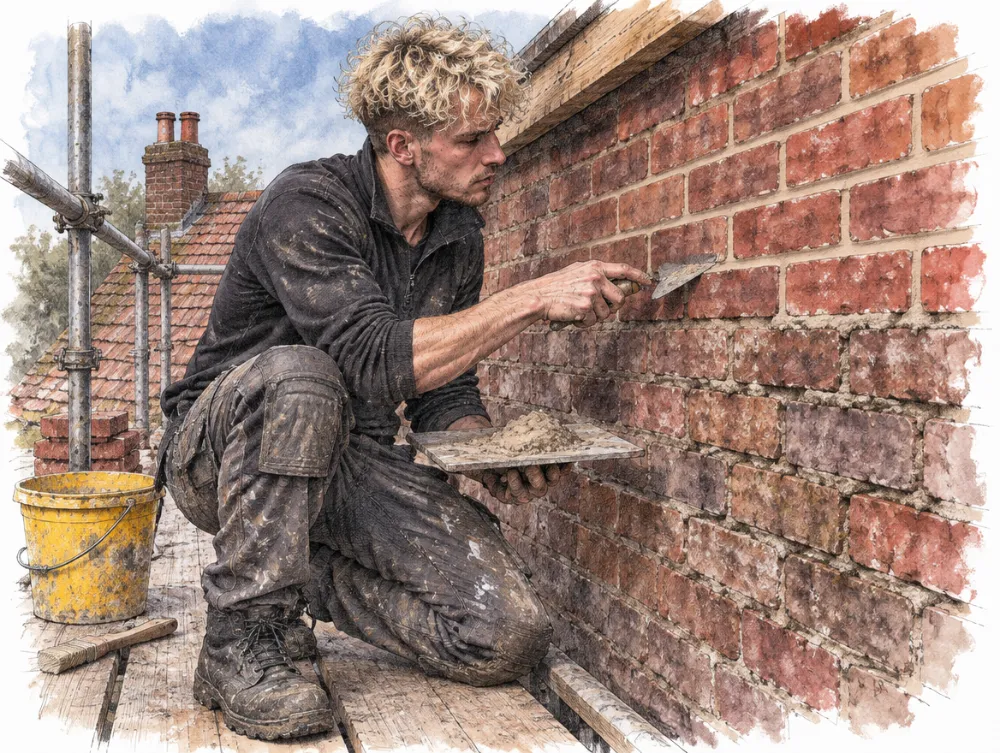
Good repointing is slow, careful and boring, which is exactly why you should ask how a firm plans to do it.
- Rake out. Old mortar comes out to a consistent depth. LABC suggests at least 12mm and no more than about 19mm, and some guidance says roughly twice the joint height.
- Protect the bricks. On older or softer bricks, rake out by hand, not with a grinder, which chews the brick edges and widens the joints.
- Clean the joints. Brush the dust out so the new mortar sticks.
- Dampen the wall. Wet the brickwork so it doesn't suck the water out of the fresh mortar.
- Fill in layers. Deep joints get filled in stages and pressed in hard, not smeared across the face.
- Finish the joint. Match the original profile, usually flush, slightly recessed or bucket-handle.
- Protect while curing. Lime especially gets covered from sun, wind, rain and frost with hessian or sheeting.
Shallow raking is one of the most common reasons repointing fails early.
A thin skim of new mortar just pops back out.
Council guidance also says avoid raised styles like ribbon or weather-struck pointing on older buildings, as they trap water and look wrong.
How long does repointing take?
It depends on the weather and the state of the joints, but 2026 guides give a decent steer.
| Job | Typical time on site |
|---|---|
| Single wall or garden wall | 1 - 4 days |
| Chimney stack | About a day, plus scaffold time |
| Terraced house, whole exterior | 1 - 2 weeks |
| Semi-detached, whole exterior | About 1 - 3 weeks |
| Large detached house | 3 - 6 weeks |
Scaffold takes a day or two to go up and about a day to come down.
How long does pointing last?
Good pointing lasts a long time, with one 2026 guide saying brickwork typically goes 40 to 80 years before it needs doing.
Chimneys, parapets, gable tops and garden walls go first, because they get wet from both sides.
When should repointing be done?
Spring to early autumn.
Mortar doesn't like cold and wet.
One 2026 guide says don't repoint below about 3°C, and cement mortar takes around 28 days to reach full strength.
The rain cloud, of course, will turn up the week your scaffold does.
Can you repoint brickwork yourself?
A small garden wall or a few joints at ground level is a fair DIY job if you take your time.
Materials are cheap, with one guide listing a 25kg bag of cement at about £8 to £9 and building sand at £4 to £5.
The hard part is doing it neat, consistent and deep enough, and it's slow going if you've not done it before.
Anything above head height, on a chimney or on an old lime-built house, leave to someone who does it every week.
Hours on a ladder against brickwork is risky, and bad pointing usually costs more to put right than doing it properly first time.
Repointing in Peterborough and the Fens
Round here, bricks are local.
The Fletton brick is named after its original home near Peterborough.
London Brick is still made at Kings Dyke in Whittlesey, and the Wisbech Standard reports it's been used in almost a quarter of Britain's housing stock.
So there's a fair chance your walls came from just down the road.
Peterborough and Wisbech have plenty of older brick terraces, many with solid walls originally built in lime.
Then there are the 1960s to 1980s bungalows, ex-council semis and estate houses across March, Whittlesey, Chatteris and Spalding, built with cement-based mortar.
That mix means the right mortar depends on the house, not the postcode.
If you're on the Georgian Brinks in Wisbech or in Peterborough city centre, you're likely in a conservation area.
Check with the council before work starts, because they may expect lime and a matching joint.
The Fens are flat and open, so exposed gable ends take driving rain and wind with nothing to stop it, and those walls wear first.
Fenland clay soils also shrink and swell between wet and dry seasons.
That's another reason to look hard at any cracking before you assume it's just old pointing.
Garden walls and the brick piers on flat-roof garages take a beating too, and they're often the first job people tackle.
Same goes further out in Holbeach, Long Sutton, Downham Market and King's Lynn: exposed walls, weathered joints and a lot of houses built around the same time.
If you're after repointing in Peterborough or a builder in Wisbech for a wall or a chimney, ask the questions below first.
How to choose someone to repoint your house
Repointing is a job where a neat finish can hide a bodge underneath.
Ask these before you agree to anything.
- What mortar will you use, and why is it right for my bricks?
- How deep will you rake out, and by hand or with a grinder?
- What joint finish will you match?
- Is scaffold included, and who sorts any pavement licence?
- How many bricks do you expect to replace, and at what price each?
- What happens if the weather turns?
- Is the price fixed in writing, and is there a written guarantee?
What a proper repointing quote shows
A quote worth having spells it out, so there's no argument halfway through.
- Which walls, and roughly how many square metres
- The mortar mix, and whether it's lime or cement-based
- Raking depth and method
- Scaffold or tower, and for how long
- A price per brick for any replacements
- Skip and clean-up
- VAT, stated clearly either way
If it just says "repoint house, £3,000", ask for the detail before you sign.
Should you just paint or render over it?
Covering bad pointing with paint or render doesn't fix it, it just hides it.
On old solid walls, a coating that doesn't breathe can trap damp in the same way hard cement does.
Sort the joints first, then decide on the finish.
Be wary of anyone who knocks offering to repoint the whole house cheap this week, or wants a big cash deposit up front.
Our guide to spotting cowboy builders covers the warning signs.
Not sure if it's the walls, the roof or the chimney letting water in?
A roof and building inspection can pin it down.
Ridge tiles bedded in mortar wear out the same way, and our guide to dry ridge systems explains the options.
Repointing brickwork cost: the short version
Expect roughly £20 to £75 per square metre for the work, rising to about £45 to £110 with access and extras.
A front elevation is often under £2,000.
A whole semi can run from about £1,900 to over £9,000, depending on scaffold, mortar and brick damage.
Match the mortar to the bricks, rake out deep enough, and don't repoint in a frost.
Roofz does a free survey and one fixed price in writing, so you'll know which walls need doing and which can wait.
Questions people ask
Do I need planning permission to repoint my house?
Ordinary repointing on most houses doesn't need planning permission. If the building is listed or in a conservation area, check with your council's conservation officer first, as consent and a specific mortar may be required.
Can you repoint over old mortar?
No, the old mortar needs raking out to a proper depth first. A thin layer over the top won't bond well and tends to fall out within a few years.
Is it worth repointing just one wall?
Often, yes, because the most exposed elevation usually wears first. A good bricklayer will match the mortar colour and joint style so the patch blends in as it weathers.
How do I know if my house was built with lime mortar?
Older solid-walled houses, especially those built before about 1920, were usually built with lime. Lime mortar tends to be softer and paler, and a roofer or builder can usually tell by scratching a joint.
Do you do repointing in Wisbech and Peterborough?
Yes. Roofz covers Wisbech, Peterborough and the Fens, including March, Whittlesey, Chatteris, Spalding and King's Lynn, for walls, chimneys and garden walls, with a free survey and a fixed written price.
Can repointing be done in winter?
It's best avoided when frost is likely, as frost can damage fresh mortar. One 2026 guide advises against repointing below about 3°C.
Sources
- MyJobQuote - Repointing Cost (2026)
- Book A Builder UK - House Repointing Cost UK 2026
- Homebuilding and Renovating - How much does repointing cost?
- MyBuilder - Repointing cost price guide
- LABC - Getting to the point about repointing brickwork
- South Kesteven District Council - Repointing guidance
- Wisbech Standard - Forterra celebrates London Brick works at Whittlesey
Prices are guide figures from the sources above and vary by job. Your free survey gives one fixed price in writing.